
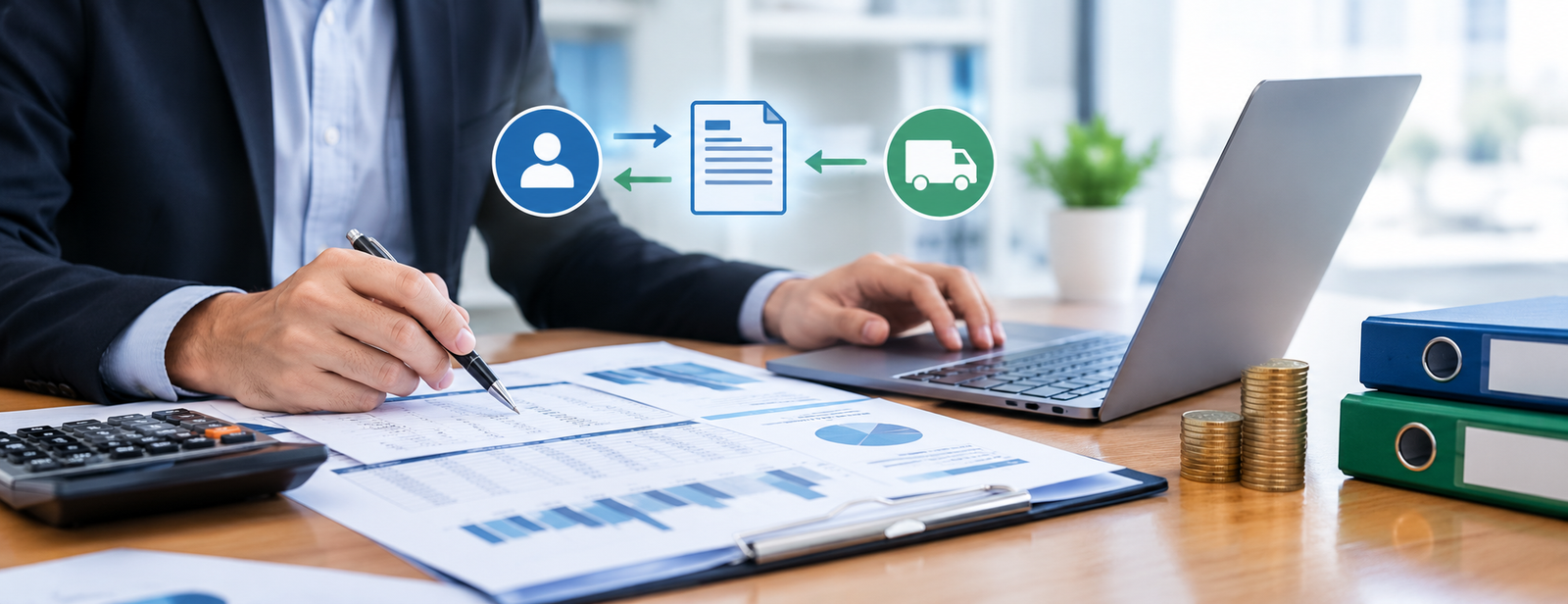
Customer and Supplier Account Statements
As credit sales and purchases increase, management and accounting questions begin to arise: How much does each customer owe the company? Which invoices have not yet been collected? How much do we owe suppliers? Has a particular payment been recorded? And why does the balance shown by the company differ from the balance in the other party's statement?
This is where customer and supplier account statements become important; they bring together transactions with each customer or supplier over a specific period, showing the opening balance, invoices, payments, returns, and adjustments through to the closing balance.
At Aamal Digital, we view account statements as a review and control tool rather than merely a printed report; they help accountants and management understand where balances come from, track outstanding amounts, and identify errors before they turn into discrepancies that are difficult to trace.
DigitalPro, the integrated accounting system, provides customer and supplier management and connects sales, purchases, and payment transactions with accounts and reports within a single system.
What Is a Customer and Supplier Account Statement?
A customer and supplier account statement is an accounting report that shows all financial transactions recorded in a customer's or supplier's account over a specific period, indicating the effect of each transaction on the balance through to the closing balance.
The statement may include:
- The opening balance.
- Sales or purchase invoices.
- Returns.
- Receipt vouchers.
- Payment vouchers.
- Discounts.
- Credit or debit notes.
- Adjustments.
- The balance after each transaction.
- The closing balance for the period.
The goal is to enable you to answer a simple question:
How did this customer's or supplier's account reach this balance?
Discover: The Best Accounting Software Programs in Saudi Arabia
What Is the Difference Between a Customer Account Statement and a Supplier Account Statement?
Although the report format may be similar, the nature of the accounting relationship differs.
Customer Account Statement
It is used to track amounts owed by the customer to the company.
The transaction usually originates from:
Credit sales invoice → Increase in the amount owed by the customer
Then:
Payment from the customer → Reduction in the outstanding balance
Supplier Account Statement
It is used to track amounts owed by the company to the supplier.
The transaction usually originates from:
Credit purchase invoice → Increase in the amount owed to the supplier
Then:
Payment to the supplier → Reduction in the balance
| Comparison | Customer | Supplier |
|---|---|---|
| Nature of the relationship | The company sells to them | The company buys from them |
| Primary invoice | Sales invoice | Purchase invoice |
| Payment | Collection from the customer | Payment to the supplier |
| Monitoring | Accounts receivable | Accounts payable |
| Purpose | Tracking collections | Tracking liabilities |
For a broader understanding of the relationship, you can review the guide to sales and purchase accounting, which explains the effect of invoices and payments on accounts and inventory.
What Information Should Appear in an Account Statement?
For the statement to be useful for review, it should not show only the closing balance.
It should preferably include:
| Field | Its Importance |
|---|---|
| Date | Understanding the sequence of transactions |
| Document number | Referring back to invoices and vouchers |
| Transaction type | Sale, purchase, receipt, payment, return |
| Description | Description of the transaction |
| Debit | Transactions recorded on the debit side |
| Credit | Transactions recorded on the credit side |
| Balance | The account balance after each transaction |
Having a document number is very important because any discrepancy in the account should lead you to a specific document that can be reviewed.
Ready to Try the System?
Start your free trial or speak with the sales team for help choosing the right solution.
Example of a Customer Account Statement
Suppose the customer started the month with no previous balance.
| Transaction | Amount | Outstanding Balance |
|---|---|---|
| Opening balance | 0 | 0 |
| Sales invoice | 10,000 SAR | 10,000 |
| Payment from the customer | 4,000 SAR | 6,000 |
| Sales invoice | 5,000 SAR | 11,000 |
| Sales return | 1,000 SAR | 10,000 |
| Payment | 3,000 SAR | 7,000 |
At the end of the period:
The balance owed by the customer = 7,000 SAR
But the true value of the statement lies not only in knowing the 7,000 figure, but in understanding how this balance was formed.
Example of a Supplier Account Statement
Suppose the company purchased from a supplier:
- Purchase invoice: 20,000 SAR.
- Payment: 8,000 SAR.
- New invoice: 5,000 SAR.
- Return to the supplier: 2,000 SAR.
The calculation:
20,000 - 8,000 + 5,000 - 2,000 = 15,000 SAR
Therefore, the amount owed to the supplier at the end of the period is:
15,000 SAR
This figure should be traceable through the invoices, payment vouchers, and returns shown in the statement.
How Do You Read Debit and Credit Balances?
This is one of the most confusing points.
In standard accounting practice:
The Customer
A customer's account usually shows a debit balance when the customer owes an amount to the company.
The Supplier
A supplier's account usually shows a credit balance when the company owes the supplier.
However, the opposite situations may occur.
For example:
- A customer paid in advance before the invoice was issued.
- A supplier received an advance payment.
- A return exceeds the current balance.
- An accounting adjustment exists.
Therefore, an opposite balance should not automatically be interpreted as an error; instead, review the transactions that led to it.
Why Do Discrepancies Occur in Customer or Supplier Account Statements?
One of the most common problems we see during a review is a supplier saying:
«Our balance is 25 thousand SAR»
While the company's system shows:
«22 thousand SAR»
This discrepancy is not resolved by directly adjusting the balance, but by finding the transaction that differs.
Common causes include:
- An invoice held by one party but not recorded by the other.
- A payment that has not been recorded.
- A payment recorded against another customer or supplier.
- A return that has not been recorded.
- A duplicate invoice.
- A difference in the recording date.
- An unrecorded credit or debit note.
- An incorrect opening balance.
- A discount that has not been processed.
- An error in the invoice amount or tax.
This is why we always recommend reconciling transaction details rather than comparing only the closing balance.
Discover: The Best Accounting Software in Saudi Arabia
How Do You Reconcile a Customer Account Statement?
Start with the documents, rather than trying to force the figures to match.
Step 1: Define the Reconciliation Period
For example:
From January 1 to January 31
Step 2: Verify the Opening Balance
If the first figure differs between the two statements, all subsequent results will usually remain different.
Step 3: Reconcile the Invoices
Review:
- The invoice number.
- The date.
- The amount.
- The tax.
- The returns.
Step 4: Reconcile the Payments
Review each:
- Receipt voucher.
- Bank transfer.
- Cash payment.
- Adjustment note.
Step 5: Identify Discrepancies
Create a list of transactions present in one statement but missing from the other.
Step 6: Correct the Cause
Once the cause is identified, the correct document is recorded or the appropriate adjustment is made in accordance with the business's accounting procedures.
We do not recommend manually adjusting the closing balance without identifying the source of the discrepancy.
How Do You Reconcile a Supplier Account Statement?
The same principle applies, but the focus is on:
- Purchase invoices.
- Payments to the supplier.
- Purchase returns.
- Discounts.
- Advance payments.
- Opening balances.
It is also important to ensure that every purchase invoice is recorded against the correct supplier, particularly when there is more than one branch or similar trade names.
What Is the Difference Between an Account Statement and a Debt Aging Report?
An account statement shows all transactions that led to the balance.
A debt aging report, on the other hand, focuses on the age of unpaid amounts.
Example:
The customer's total balance may be:
100,000 SAR
But the aging report shows:
| Age of Debt | Amount |
|---|---|
| Less than 30 days | 40,000 |
| 31–60 days | 25,000 |
| 61–90 days | 20,000 |
| More than 90 days | 15,000 |
Here, management can see that 15 thousand SAR is overdue by more than 90 days, rather than merely knowing the total balance.
Therefore, the collections department needs both the account statement + the debt aging report.
Why Are Customer Account Statements Important for Collections?
Effective collection starts with knowing what you are asking the customer to pay.
When an employee contacts a customer, they should know:
- The total balance.
- The open invoices.
- The date of each invoice.
- The previous payments.
- The returns.
- The overdue amounts.
Having this information reduces disputes and helps each invoice be discussed specifically.
This is why an account statement becomes more useful when it is directly linked to sales invoices and receipt vouchers within the system.
How Do Supplier Account Statements Help Manage Liquidity?
Suppliers represent financial liabilities for the business, so the finance manager needs to know:
- The amount owed to each supplier.
- The payment due dates.
- The open invoices.
- The advance payments.
- The total supplier balance.
This information helps with cash flow planning and prevents liabilities from being discovered only immediately before payment is due.
What Happens When Accounts Are Spread Across Excel and Different Programs?
Problems usually begin when:
- The invoice is in the sales program.
- The payment is in the bank statement.
- The supplier's account is in Excel.
- The inventory is in another program.
- The closing balance is held by the accountant.
In this case, the employee needs to bring together multiple sources to establish the true state of the account.
This is why integrated accounting systems keep the following cycle:
Invoice → Customer or supplier account → Receipt or payment → Balance → Report
Within the same database.
You can learn about integrated accounting software if your business needs to connect customer and supplier accounts with sales, purchases, inventory, and reports.
How Does DigitalPro Help Manage Customer and Supplier Accounts?
DigitalPro from Aamal Digital provides sales, purchase, customer, and supplier management within the accounting system.
This allows account transactions to be linked to their original documents.
When a credit sales invoice is issued:
The transaction appears in the customer's sales and account.
And when a payment is recorded:
The balance decreases according to the recorded transaction.
The same principle applies to suppliers through purchase invoices and payments.
This approach makes generating and reviewing account statements easier because it reduces the need to enter the same transaction again in more than one place.
What Are the Most Important Reports Related to Customers and Suppliers?
Do not rely solely on account statements.
Useful reports include:
- Customer balances.
- Supplier balances.
- A detailed account statement.
- Sales by customer.
- Purchases by supplier.
- Debt aging.
- Unpaid invoices.
- Collections.
- Payments.
- Profit and sales reports.
Management teams that need broader data monitoring can explore reporting software to review sales, accounting, and inventory indicators using system data.
How Do You Review an Account Statement Before Sending It to the Customer?
Use this checklist:
- Confirm the customer's name.
- Review the reporting period.
- Verify the opening balance.
- Review the invoice numbers.
- Review all payments.
- Verify the returns.
- Review the credit notes.
- Look for duplicate transactions.
- Reconcile the balance with the subsidiary ledger.
- Confirm the closing balance.
Sending an incorrect statement to a customer causes a dispute that could have been avoided with a simple review.
Ready to Try the System?
Start your free trial or speak with the sales team for help choosing the right solution.
Common Mistakes in Managing Customer and Supplier Accounts
Mistakes we recommend avoiding include:
- Creating more than one account for the same customer.
- Recording a payment against another customer.
- Ignoring the opening balance.
- Deleting an invoice instead of making the correct accounting adjustment for it.
- Failing to record a return.
- Delaying the recording of payments.
- Failing to perform periodic reconciliations.
- Focusing on the balance without reviewing invoices.
- Failing to follow up on old debts.
- Separating sales and purchases from accounting.
The more consistently transactions are recorded when they occur, the easier reconciliation becomes.
Frequently Asked Questions About Customer and Supplier Account Statements
What Is a Customer and Supplier Account Statement?
It is a report that shows all customer or supplier transactions over a specific period, such as invoices, payments, returns, and adjustments, and indicates the resulting balance after each transaction.
How Do I Prepare a Customer Account Statement?
Select the customer and the required period, then compile the opening balance, sales invoices, collections, returns, and adjustments, and calculate the balance after each transaction.
What Is the Difference Between a Customer Statement and a Supplier Statement?
A customer statement focuses on amounts owed to the company by the customer, while a supplier statement shows amounts owed by the company to the supplier, along with purchase and payment transactions.
What Does a Customer's Debit Balance Mean?
It usually means that the customer owes an amount to the company, although the account details must be reviewed before interpreting any unusual situation.
What Does a Supplier's Credit Balance Mean?
It usually means that the business owes an amount to the supplier.
Why Does the Account Statement Not Match the Customer's Records?
Usually because an invoice, payment, return, or note is held by one party but not recorded by the other, or because of a difference in the opening balance.
Does DigitalPro Provide Customer and Supplier Management?
DigitalPro brings customer and supplier accounts together with sales, purchases, accounting, inventory, and reports, helping track transactions and balances within the same system.
Conclusion
A customer and supplier account statement should not be treated merely as a report showing a final figure, but as a record explaining how that figure was formed.
The correct cycle is:
Invoice → Account transaction → Receipt or payment → Return or adjustment → Closing balance → Reconciliation
When these operations are connected within the system, it becomes easier to identify discrepancies, track collections and liabilities, and make financial decisions with greater clarity.
This is why DigitalPro for Accounting and Point of Sale from Aamal Digital provides an environment that connects customers and suppliers with sales, purchases, accounting, inventory, and reports instead of spreading data across multiple files.
You can also explore all Aamal Digital solutions, then request a trial and try creating a customer, supplier, invoice, and payment, and generating an actual account statement before adopting the system within your business.
Start Managing Your Business with Complete Flexibility
Try Aamal Digital for free. Start issuing your ZATCA-compliant electronic invoices within minutes.
- Free trial with no credit card required
- 24-hour technical support
- ZATCA compliant