
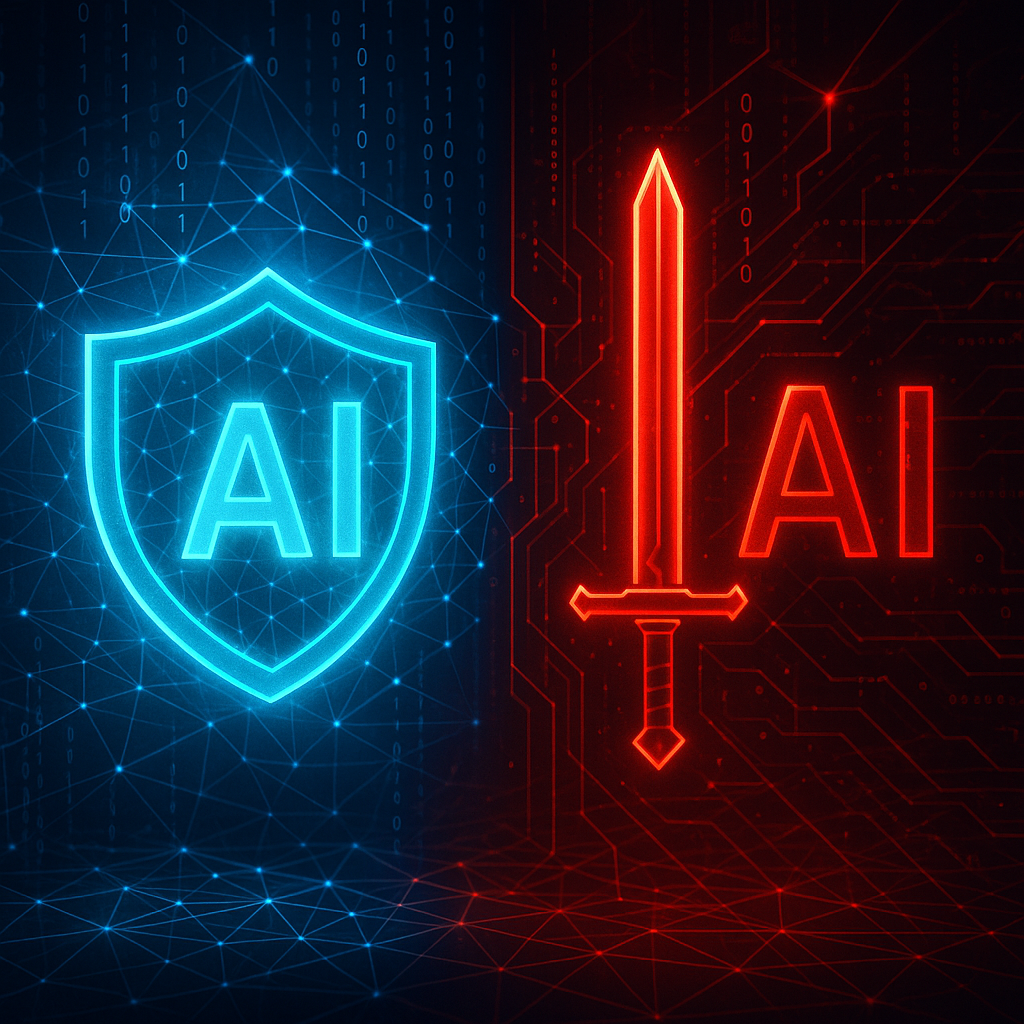
Artificial Intelligence in the Service of Cybersecurity – A Defensive Weapon or an Offensive Tool?
Our digital world is evolving rapidly, and with this evolution security challenges are increasing at an unprecedented rate. In the midst of this ongoing battle between defenders and attackers, AI has emerged as an influential force, promising to revolutionize cybersecurity. AI is no longer just a futuristic concept, but has become an essential tool that effectively contributes to the analysis, detection, and response of security threats in real-time, significantly reducing the magnitude of potential damage. Its advanced models can assist in penetration testing processes to gather vital information and detect hidden vulnerabilities in systems, enhancing organizations' ability to protect their digital assets. But is AI limited to being a protective shield, or does it have the potential to become a sword in the hands of attackers?
AI as a Protective Shield: Defensive Aspects of Cybersecurity AI
has proven its superior ability to enhance cyber defenses in ways that were never possible before. Its ability to process and analyze vast amounts of data with unparalleled speed and accuracy makes it an indispensable ally in the face of evolving threats. These defensive capabilities are manifested in several key aspects:
-
Big Data Processing and Threat Detection
One of the most prominent advantages of AI in cybersecurity is its ability to process massive amounts of data produced by networks and systems on a daily basis. Instead of relying on slow, error-prone manual analysis, AI can automate the process of detecting cybersecurity threats across multiple sources such as emails, website browsing logs, different apps, and shared files. It does this by identifying unusual patterns or abnormal behaviors that may indicate an attack. For example, if an employee clicks on a phishing link, the AI system can notice the change in the system's behavior and alert security teams immediately, allowing them to take appropriate actions quickly before the situation worsens. -
Continuous learning and adapting to new threats
AI algorithms, especially those that rely on machine learning and deep learning, have the ability to continuously learn and adapt over time. It not only detects known threats, but also learns about new trends and anticipates changes in attackers' tactics. This continuous learning allows them to gather information and identify potential threats with similar characteristics and effectively remove them. This adaptability makes AI-powered cybersecurity solutions able to detect new and unknown zero-day attacks that are not explicitly classified by traditional cybersecurity registries, posing a formidable barrier to advanced cyberattacks that hackers are constantly innovating. -
Consistent security around the
clock In a world that never sleeps, where cyberattacks can happen anytime, anywhere, AI provides cohesive security around the clock, seven days a week. Cyber attackers do not adhere to regular working hours, and their attacks are carried out from different time zones. Round-the-clock monitoring of your IT infrastructure is essential for real-time detection of malicious entities and hacking attempts, rather than waiting until the start of the next business day. Relying on AI for monitoring reduces the need for continuous human intervention, making it more cost-effective and more reliable compared to human teams working on a shift system. -
Anti-fraud and improve efficiency
Machine learning algorithms contribute significantly to combating fraud and preventing redundant actions. For example, companies like Google use machine learning algorithms to recognize suspicious and malicious emails, alert users and protect them from phishing attacks aimed at stealing sensitive information. In addition, AI reduces repetitive, time-consuming processes for human analysts, allowing them to focus on developing algorithms and exploring emerging threats rather than spending hours analyzing thousands of datasets. -
Malware detection and security log analysis
AI systems have a superior ability to detect malware and phishing attempts with high accuracy, often superior to traditional systems. AI is also used to analyze huge security logs using machine learning techniques to detect any anomalies or security breaches, even if there are no previously known threat signatures. This enables businesses to respond to potential threats faster and more effectively.
AI as a double-edged sword: Offensive and dark sides
Despite AI's immense defensive potential, its dual nature makes it a powerful tool that can also be exploited by attackers. The same capabilities that make it effective in defense can be used to launch more sophisticated and lethal attacks. This is the dark side of AI in cybersecurity:
-
Complex and large-scale attacks
Hackers can use AI to launch more sophisticated and large-scale attacks, finding and exploiting vulnerabilities more effectively. Instead of traditional attacks that rely on fixed rules, AI-powered attacks can learn from every attempt and adapt to their targets in real-time, making them more difficult to detect and counter. For example, AI can detect vulnerabilities in systems much faster than a human does, and exploit them before defenders can plug them in. -
Biometric Recognition and Privacy Violations Risks
As the reliance on biometric recognition technologies such as AI-powered facial and fingerprint fingerprints for security increases, so does the risks associated with them. Advanced scanning methods can provide third parties with accurate data on appearance and behavior, which can lead to serious privacy breaches. This data can be misused for surveillance and tracking, and even by repressive states to track down their adversaries or citizens, raising significant ethical and legal concerns. -
Increased data collection and privacy concerns
Artificial intelligence has made it possible to collect and process more data than ever before. While this data can be used to improve security, it also raises additional privacy and security concerns. The more data collected, the more likely it is to be compromised or misused, making individuals and organizations more vulnerable. -
Types of AI-Powered Attacks
AI-powered cyberattacks take multiple and sophisticated forms, including:
AI phishing: Large language models (LLMs) can craft tailor-made emails that mimic the internal communication patterns of companies, making them look like real messages from colleagues or managers. These messages are highly convincing and difficult to detect, which increases the chances of phishing attacks succeeding.
AI-based ransomware: Attackers use AI algorithms to identify high-value targets within networks and choose the optimal timing to launch an attack. This software can adapt to the victim's defenses and change their tactics to ensure maximum damage and ransom.
Deepfake: This technology is one of the most dangerous offensive AI applications. AI-generated audio or video content can impersonate executives or trusted personalities with incredible accuracy. These spoofs can be used to approve fraudulent transactions, spread misinformation, or even manipulate public opinion, posing a serious threat to financial and national security. -
Enhancing social engineering and exploiting machine learning systems
Artificial intelligence is enhancing social engineering, which is the art of manipulating humans to obtain confidential information. AI can generate tactics that exploit trust and familiarity, making social engineering faster, more scalable, and harder to detect. This includes creating texts that mimic the company's tone and vocabulary, developing tutorials and guidance using video language models, and creating artificial images or fake credentials to support identity fraud. In addition, attackers can exploit the machine learning systems themselves, by poisoning training datasets, creating hostile inputs to confuse models, or creating fake measurements and records to bypass monitoring tools, misleading defense systems and rendering them ineffective.
Challenges and the Future
The relationship between AI and cybersecurity is complex and constantly evolving. While AI provides powerful defensive tools, it also gives attackers unprecedented capabilities. This creates an ongoing digital arms race, where defenders and attackers compete for the use of the latest AI technology.
The main challenges in this area are:
-
High cost: The cost of developing and implementing advanced AI solutions in cybersecurity is still high, making them difficult for small and medium-sized enterprises.
-
Shortage of experts: There is a global shortage of experts specializing in artificial intelligence and cybersecurity, hindering the rapid development of defense solutions.
-
Evolving threats: AI-powered cyber threats are evolving rapidly, requiring constant updating of defense systems.
-
Ethical and legal concerns: Applications of AI in cybersecurity, especially those related to surveillance and identification, raise ethical and legal concerns that require clear regulatory frameworks.
To balance powers, advocates must invest more in defense AI research and development, foster public-private collaboration, and train a new generation of specialists. Focus should also be on developing AI systems capable of detecting and effectively responding to AI-powered attacks.
In conclusion, it can be said that AI is indeed a double-edged sword in the world of cybersecurity. It offers enormous potential to strengthen defenses and protect systems and data from increasingly sophisticated threats. But at the same time, it is a powerful tool in the hands of attackers, enabling them to launch smarter and more destructive attacks. The battle between defensive AI and offensive AI is an ongoing battle, requiring constant vigilance, continuous technology development, and global collaboration to address future challenges. A deep understanding of both sides, defensive and offensive, is key to building a more secure and resilient digital future.