
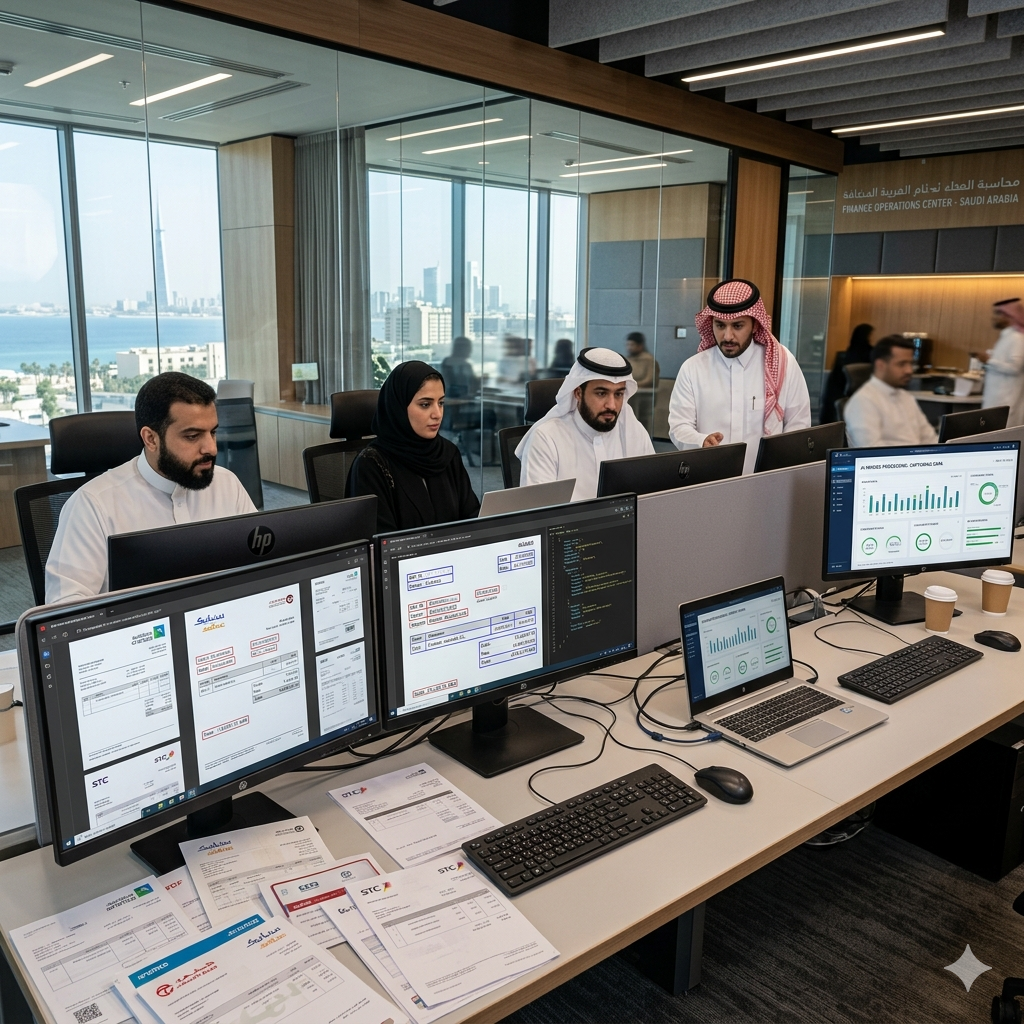
Best Practices for Extracting Data from Invoices Using OCR and Artificial Intelligence Techniques
Imagine sitting at your desk, with a huge pile of paper invoices or hundreds of PDFs that you receive every day via email from different suppliers. Your job is to accurately convey every number, every supplier name, and every date to your company's accounting system. This process is not only tedious and cumbersome, but it is a veritable minefield of human error that can cost the company huge amounts of money as a result of a simple mistake in placing a decimal point or forgetting a single tax number.
In today's fast-paced business world, time no longer allows for such slow manual processes. This is where modern technology comes to the rescue and revolutionizes how finance departments manage their data. In this comprehensive article, we'll simplify the concepts of OCR and AI, and how they work together in unison to transform invoices from static images or silent files into intelligent data that automatically flows through the veins of your company' s systems. We will also review global best practices that ensure the highest levels of accuracy and the lowest operational costs, in a simple and clear manner away from technical complexities.
What is OCR and how do I get smart thanks to AI?
Quite simply, OCR Optical Character Recognition (OCR) is the digital eye that reads printed or written text and converts it into digital text that can be understood and manipulated by a computer. In the recent past, this technique relied entirely on so-called templates, which meant that the programmer or accountant had to specify the program with extreme precision: look for the invoice number in this little box in the upper right corner. The biggest problem was when the vendor changed their invoice design even slightly, as the software completely failed to find the data, requiring painstaking manual resets. Today, AI has come online to give this eye a thinking mind. The program no longer searches for the location of the number based on geographic coordinates on the page but rather understands the meaning and context of the number. He now knows, thanks to deep learning algorithms, that a number preceded or appended by a word Total, Total, or Net Amount is the amount needed, regardless of where it is on the page, whether it's at the top, bottom, or even in the middle of a complex table.
A detailed comparison between traditional technology and smart technology
Flexibility and adaptability:
-
Traditional OCR systems rely on fixed templates and require manual adjustments when dealing with any new invoicing design.
-
AI-powered OCRs automatically adapt to different designs without the need for additional settings.
Understanding data and context:
-
Traditional OCR is limited to reading texts and numbers without realizing their meanings or function within the document.
-
AI-powered OCR is able to understand the context of data and differentiate between different fields such as release date and due date.
Accuracy and quality of extraction:
-
Traditional systems are affected by factors such as poor image quality, different fonts, or the gradient of the document.
-
In contrast, AI has a greater ability to process blurry images and handle documents that are wrinkled or have a variety of formats.
Cost and Sustainability:
-
Traditional systems require constant maintenance and periodic mold updates, which raise operational cost over time.
-
AI-based systems are more sustainable and have lower long-term costs thanks to their ability to learn and continuously improve.
Why should your company care about these technologies now?The
transition from traditional manual to intelligent automated processing is not just a technical or fashionable luxury, but an urgent strategic necessity to stay ahead of the competition, for the following fundamental reasons:
-
Massive and unprecedented cost savings: Global financial studies show that the cost of manually processing a single invoice including employee salary, time taken, and the cost of errors can range from $12 to $15. In contrast, this cost is reduced by up to 80% or more when using intelligent automation systems.
-
Lightning-fast speed and improved cash flow: What may take hours or days of a human employee, especially during peak or month-end seasons, is accomplished by AI in a matter of seconds. This speed allows the company to take advantage of early payment discounts and avoid late penalties.
-
Eliminate human error: AI doesn't get overwhelmed, doesn't get tired of repetition, and doesn't lose focus at the end of a long workday. This drastically reduces the likelihood of paying the wrong amounts, forgetting to calculate tax, or falling into the trap of repeatedly paying the same bill twice.
-
Compliance with tax regulations and legislation: In our Arab region, especially in Saudi Arabia and the UAE, electronic connectivity and compliance with the requirements of zakat, tax and customs authorities such as e-invoice has become vital. These techniques ensure that the data submitted to the bodies is accurate and fully identical to the recorded reality.
Global best practices for successful and accurate data extraction
To make the most of OCR and artificial intelligence technologies, it is not enough to simply buy and install software, but a smart work methodology must be followed to ensure the quality of the outputs. Here are the top practices recommended by experts:
Source quality is the cornerstone
Always remember the golden rule in the data world: bad inputs inevitably lead to bad outputs. To ensure up to 99% extraction accuracy, follow these steps:
-
Prefer digital PDFs: Strongly encourage your suppliers to send invoices as genuine system-generated PDFs directly rather than printing and then scanning them. Digital files have a text layer that is easy for the machine to read with absolute accuracy.
-
Professional scanning standards: If paper invoices must be handled, make sure to use good quality scanners, with a scan accuracy of at least 300 DPI. Shaky, blurry, or low-light photos taken with a phone camera increase digital noise and make AI more difficult.
-
Document cleanliness: Avoid as much as possible large stamps covering numbers, or random handwriting over important data, as these elements can distract machine intelligence and lead to inaccurate results.
Choosing solutions that understand the specificity of Arabic
Arabic is not just another language for OCR, it is a real technical challenge; the letters are connected to each other, their shapes change according to their location, and there is a unique reading direction from right to left. When choosing your system, make sure that:
-
The system is specially trained in large Arabic text models.
-
The system's ability to distinguish between Arabic numerals 1, 2, 3 and Indian numerals sometimes used in the Levant.
-
Understand local accounting and tax terms such as tax number, VAT, supplier, customer.
The application of automatic validation rules
is not limited to what artificial intelligence extracts as a by-law, but the system must have an intelligent control layer that validates the data before it is adopted, such as:
-
Arithmetic balance rule: The system should automatically add up the net amount + tax amount and ensure that the output is equal to the final total written on the invoice. If he finds a difference of even a penny, he should stop and ask for a human review.
-
Basic data matching: Ensure that the extracted tax number actually belongs to the said supplier by matching it to your pre-registered database.
-
Smart Duplication Detection: The security system should prevent the entry of any invoice with the same number, the same supplier, and the same amount to prevent duplication of payment.
Adopting the Human-in-the-loop
Principle Despite all the amazing advancements, technology is not 100% infallible. The best global practice is not to abolish the human role, but to repurpose it. The smart system extracts data and gives a confidence percentage for each field.
-
For example, invoices with a high confidence rate of more than 95% are automatically passed to the accounting system.
-
Invoices that the system suspects or whose picture is unclear are addressed to a human staff member for quick review and approval. This approach saves 90% of the employees’ time, focusing their effort only on exceptions rather than reviewing everything.
Deep integration with accounting systems ERP Integration
Extracting data and converting it into an Excel file is a good starting point, but the real professionalism lies in the direct programming API linkage. Extracted and audited data should flow directly to your accounting system like SAP, Oracle, Microsoft Dynamics, or cloud systems like Xero and QuickBooks to be ready to pay at the push of a button.
Real-world use cases: How are different sectors benefiting?
The use of this technology is not limited to accounting office’s only, but its impact extends to a wide range of sectors:
-
Retail and supermarket sector: where thousands of suppliers deal with daily and invoices containing hundreds of Line Items. AI helps in inventorying each item and automatically auditing its price and quantity.
-
Logistics and Shipping Companies: Dealing with bills of lading, customs invoices in multiple languages, and complex designs.
-
Contracting Sector: Paper invoices from small suppliers and subcontractors abound, which are often unregulated.
Security and privacy.
When using AI technologies, especially cloud-based ones, a legitimate question arises about data security. The invoices contain very sensitive information such as prices, supplier data, bank account numbers. So, the best practice is:
-
Ensure that the provider adheres to global data security standards such as ISO 27001 or SOC2.
-
Ensure that data is encrypted in transit and during storage.
In large or government enterprises, it may be best to use on-premises server systems to ensure that data doesn't go outside the organization's boundaries.
The challenges of the Arabic language and how to overcome them
OCR technologies face unique challenges when dealing with Arabic content, the most prominent of which are:
-
Interweaving of letters and complexity of fonts: Arabic letters change shapes depending on their location, and there are some decorative fonts that may fool simple systems. The solution lies in using systems based on neural networks that have been trained on millions of models.
-
Bilingual Hybrid Data: Most of our invoices in the Arab world are bilingual. The system must be smart enough to know when to read from the right and when to move left in the same line of code.
Practical Steps to Get Started on Your Billing Digital Transformation Journey
If you're excited to get started today, here's a practical and proven roadmap:
-
Assessment and diagnostics: Start by calculating how many invoices you process per month, how many employees are involved in the process, and what percentage of errors are currently detected.
-
Goal setting: Is your goal speed, cost reduction, or tax compliance?
-
Research and testing Pilot: Don't buy the system based solely on marketing promises. Request a demo and upload 50 to 100 invoices from your actual work, including difficult and unclear invoices, to measure true accuracy.
-
Step-by-step implementation: Don't try to automate everything in a day. Start with specific vendors or a single department, then gradually expand after making sure the experiment was successful.
-
Continuous development: Artificial intelligence is improving with time. Continuously monitor results and feed the system feedback to improve its performance in the future.
The future does not await the hesitant
, we must realize that extracting data from invoices using OCR and artificial intelligence technologies is not just an additional advantage that can be postponed, but it is the cornerstone of building a modern, efficient, and transparent financial department. By following the best practices we've reviewed—from improving source quality to ensuring integration with accounting systems—you can transform your company's accounting department from a center of cost and administrative slowness to a fast-paced strategic engine that supports financial decision-making based on accurate, real-time data.
The world is moving rapidly towards full automation, and AI is as accessible and affordable to small and medium-sized businesses as it is to large ones. Start your journey today, and make technology work in your favor, freeing up your team's time to create and analyze instead of drowning in a spiral of manual input.