
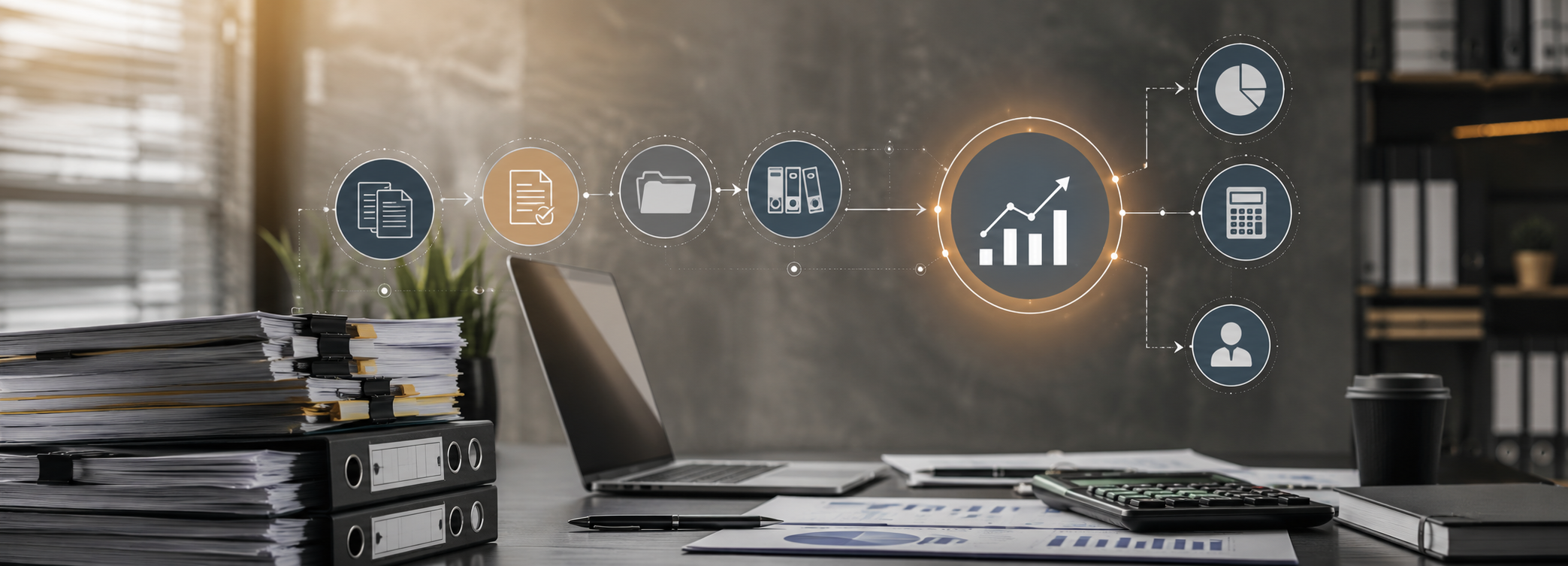
The Comprehensive Guide to Knowing the Difference Between the Documentary Cycle and the Accounting Cycle
Proper accounting work begins before recording the entry in the journal, as there must first be a document proving that the transaction actually occurred, such as a sales invoice, purchase order, receipt voucher, or inventory issue voucher. After reviewing and approving the document, it is processed in accounting until its effect appears in the accounts, reports, and financial statements.
Hence arises the difference between the documentary cycle and the accounting cycle. The documentary cycle focuses on the path of the document from its creation to its review and archiving, while the accounting cycle transforms the data contained in the documents into entries, balances, and financial reports.
Understanding the relationship between the two cycles helps reduce errors, prevent the recording of undocumented transactions, and improve control over sales, purchases, inventory, and customers. This guide explains the types and stages of the documentary cycle, the steps of the accounting cycle, how to record entries, and the most important elements of the accounting system, along with a table illustrating the main differences between the two cycles.
What is the Documentary Cycle?
The documentary cycle is the set of procedures a document goes through from the moment a financial or administrative transaction is initiated, through review, approval, and recording, until its archiving and the ability to refer back to it when needed.
The documentary cycle answers a set of important questions:
- What transaction occurred?
- When did it occur?
- Who created the document?
- Who reviewed and approved the transaction?
- Who are the parties involved?
- What are the value, quantity, and details?
- Was the transaction executed according to the authorizations?
- Where was the document saved?
- How can it be retrieved during an audit?
For instance, if a department requests the purchase of materials, the cycle does not begin only when the supplier's invoice is recorded, but it may go through a purchase request, official approval, purchase order, receipt voucher, supplier's invoice, and payment voucher. Each document performs a specific function in proving and controlling the transaction.
Documents can be:
- Paper-based.
- Electronic.
- Generated within an accounting program.
- Imported from another system.
- Attached as an image or electronic file.
- Linked to a digital signature or approval.
A large number of documents is not a goal in itself. The objective is to design a cycle that achieves control and provides necessary information without adding procedures that delay work.
The documentary cycle is the source that the accounting cycle relies upon when analyzing and recording transactions.
Types of Documentary Cycles
The types of documentary cycles vary according to the process the facility wants to organize. The most prominent include the cycles of inventory, sales, purchases, and customer accounts. These cycles may overlap; a product sale may start with a customer order and then affect inventory, the customer's account, cash, sales, and taxes.
The Inventory Documentary Cycle
The inventory documentary cycle comprises the procedures and documents that regulate the entry, exit, transfer, and inventory of items, as well as settling related discrepancies.
Among its most important documents:
- Goods receipt voucher.
- Inventory addition voucher.
- Issue voucher.
- Material issue request.
- Inter-warehouse transfer voucher.
- Inspection and receipt report.
- Return to supplier voucher.
- Return from customer voucher.
- Inventory count report.
- Damaged or obsolete goods report.
- Inventory adjustment voucher.
The purchase receipt process typically proceeds as follows:
- Receiving goods from the supplier.
- Matching the quantity with the purchase order.
- Inspecting the item and its quality.
- Issuing a receipt voucher.
- Approving the accepted quantities.
- Adding the quantity to inventory.
- Linking the receipt to the supplier's invoice.
- Archiving the documents related to the transaction.
When issuing materials to a department, the item, quantity, department or cost center, purpose of issuance, and the official who approved the request must be specified.
An organized cycle helps discover the reasons for discrepancies between the book balance and the actual quantity. A discrepancy may result from an unrecorded issuance, a measurement unit error, an unadded return, or undocumented damage.
Digital Business Company provides an integrated accounting system that includes features such as tracking inventory and product movement, and managing suppliers, warehouses, returns, and transfers, with financial and accounting reports linked to the operations.

The Sales Documentary Cycle
The sales documentary cycle organizes the transition of the sales process from the customer's order to delivery, invoicing, collection, and recording the financial impact.
It may include the following documents:
- Customer order.
- Quotation / Price offer.
- Sales order.
- Credit approval.
- Order preparation voucher.
- Delivery voucher.
- Sales invoice.
- Receipt voucher.
- Credit note or sales return.
- Customer account statement.
Example of a credit sale:
- The customer orders a set of products.
- The sales department issues a quotation.
- The customer approves the quotation.
- The customer's credit limit is reviewed.
- The sales order is issued.
- The warehouse prepares the items.
- The delivery voucher is issued.
- The sales invoice is generated.
- The amount is recorded in the customer's account.
- A receipt voucher is issued upon collection.
As for cash sales in a store, a point of sale might condense several documents into a single transaction, as it records the item, quantity, price, tax, and payment method, issues the invoice, and updates the inventory. However, shortening the steps does not mean canceling control; cashier shifts, discounts, cancellations, and returns must be audited.
Using an accounting system linked to points of sale helps document sales, payments, and returns, linking them to inventory and reports instead of manually transferring data between multiple files.
The Purchasing Documentary Cycle
The purchasing documentary cycle regulates requesting the facility's needs, selecting the supplier, approving the purchase, receiving the goods, recording the invoice, and paying its value.
It typically includes:
- Purchase request.
- Suppliers' quotations.
- Quotations comparison.
- Purchase order.
- Inspection report.
- Receipt voucher.
- Supplier's invoice.
- Return note.
- Payment voucher.
- Supplier's account statement.
The cycle begins when a department or warehouse discovers an actual need, not when the supplier's invoice arrives. This reduces unplanned purchases and prevents the same employee from requesting, approving, receiving, and paying for goods without oversight.
Among the most important control points in the purchasing cycle:
- Existence of an approved purchase request.
- Matching the supplier's price with the accepted offer.
- Segregation of duties between requesting and approving.
- Inspecting items upon receipt.
- Matching the purchase order, receipt voucher, and invoice.
- Ensuring the supplier's invoice is not duplicated.
- Reviewing taxes and totals.
- Payment approval from the authorized official.
- Updating the supplier's account and inventory.
The process of comparing the purchase order, receipt voucher, and supplier's invoice is known as the three-way match, which helps prevent paying for items that were not ordered or received.
The Customer Accounts Documentary Cycle
The customer accounts documentary cycle regulates the recording of credit sales, collections, settlements, returns, and outstanding debts.
It includes:
- Customer file and data.
- Account opening request.
- Credit limit approval.
- Sales invoices.
- Receipt vouchers.
- Debit or credit notes.
- Sales returns.
- Balance confirmations.
- Account statements.
- Aging of accounts receivable reports.
The cycle helps in knowing:
- The amount due from each customer.
- Invoice due dates.
- Paid installments.
- Overdue amounts.
- Available credit limit.
- Disputed invoices.
- Collection rate.
- Debt aging.
Common mistakes include recording receipts as new revenue instead of reducing the customer's balance, failing to specify which invoice the customer paid, or granting an unapproved discount.
The integrated accounting system from Digital Business Company links the customer's invoice with the receipt voucher and account statement, allowing the accountant to navigate from the balance to the documents.
Basic Stages of the Documentary Cycle
The documentary cycle typically goes through eight interconnected stages, starting with the occurrence of the transaction and ending with archiving and reviewing the document.
- Occurrence of the Transaction
The cycle begins with an event that requires documentation, such as selling a product, purchasing materials, receiving an amount, or issuing inventory.
- Creation of the Document
The document proving the transaction is issued, such as an invoice, purchase request, receipt voucher, or issue voucher.
- Completion of Data
The date, parties, value, quantity, tax, payment method, cost center, and any necessary data must be entered.
- Review
The document is reviewed to ensure the accuracy of numbers, data, and attachments, and to prevent transaction duplication.
- Approval
Approval is granted by the person with the authority based on the transaction's value or type.
- Execution and Recording
The transaction is executed, such as delivering goods or paying an amount, and then recorded in the system.
- Numbering and Linking
The document receives a unique number and is linked to preceding and succeeding documents, such as linking a purchase invoice to the purchase order and receipt voucher.
- Archiving and Follow-up
The document is saved physically or electronically in a searchable manner, retaining a record of modifications and approvals.
Details may vary from one facility to another; a factory's documentary cycle includes production orders and raw material issuances, while a restaurant's cycle involves recipes, waste, and transfers between the kitchen and warehouse.
The cycle must be reviewed as the company grows because a procedure suitable for a small company may become insufficient once it has multiple branches and users.
Importance of the Documentary Cycle
The importance of the documentary cycle lies in providing evidence that proves every transaction, defining responsibilities, and improving internal control before data reaches the accounting records.
Among its most important benefits:
- Proving the occurrence of transactions.
- Preventing the recording of fictitious or unapproved transactions.
- Defining the responsibility of each employee.
- Clarifying the approval workflow.
- Reducing duplicate invoices and payments.
- Organizing inventory movement.
- Facilitating the follow-up of customers and suppliers.
- Supporting internal and external audit work.
- Speeding up document retrieval.
- Linking entries to their sources.
- Improving the quality of accounting data.
- Reducing errors and manipulation.
- Supporting compliance with internal policies.
- Providing a historical record of operations.
Its importance becomes apparent when a discrepancy or error is discovered. If a shortage appears in an item, one can refer to purchase, receipt, issue, transfer, and inventory orders to determine the cause. If interconnected documents do not exist, explaining the problem relies on guesswork or employee statements.
The documentary cycle also helps implement the segregation of duties, so the person creating the supplier profile is not the same one who approves the purchase order, receives the goods, and pays the invoice without oversight.
Creating many forms is not enough; it is better for the cycle to be understandable and fast, and for every employee to know their role, the document they receive, and the document they hand over to the next stage.
What is the Accounting Cycle?
The accounting cycle is an organized set of steps used to analyze, record, post, and adjust financial transactions, then prepare financial statements and close accounts at the end of the accounting period.
The accounting cycle starts from the documents supporting the transactions, such as invoices and receipt/payment vouchers, then transforms their data into financial information that the facility's owners, management, and accountants can utilize.
The accounting cycle answers different questions than the documentary cycle, such as:
- Which accounts are affected by the transaction?
- What is the debit account and what is the credit account?
- What is the balance of each account?
- Are debit and credit balances equal?
- What is the result of the facility's operations?
- What is the value of its assets and liabilities?
- What are the required adjustments at the end of the period?
An example is a credit purchase invoice for materials:
- The invoice and receipt voucher prove the occurrence of the transaction in the documentary cycle.
- The accountant analyzes the transaction and records inventory or purchases on the debit side, and the supplier's account on the credit side.
- Its effect then appears in the general ledger, trial balance, and financial statements.
The accounting cycle is generally defined as a sequence that begins with identifying and analyzing transactions, followed by recording, posting, preparing trial balances, adjustments, financial statements, and closing.

What are the Stages of the Accounting Cycle?
The accounting cycle goes through a set of sequential stages, and although their division may differ among references, their core includes the following steps:
- Identifying Financial Transactions
Not all events are recorded in the accounts. Only transactions with a measurable financial impact, such as buying, selling, expenses, collection, and payment, must be identified.
- Collecting and Reviewing Documents
Invoices, vouchers, notes, and supporting documents are collected, then reviewed to ensure their accuracy and approval.
- Analyzing the Transaction
The accountant determines the affected accounts, the nature of each account, and the debit and credit values.
- Recording the Entry in the Journal
The transaction is recorded chronologically with an entry detailing the debit account, credit account, description, document number, and date.
- Posting to the General Ledger
Movements are transferred from the journal to their respective accounts in the general ledger to determine the balance of each account.
- Preparing the Unadjusted Trial Balance
Account balances are summed to verify that the total debits equal the total credits.
- Making Adjusting Entries
Necessary adjustments are recorded, such as:
- Accrued expenses.
- Accrued revenues.
- Prepaid expenses.
- Unearned revenues.
- Depreciation.
- Bad debt allowances.
- Inventory discrepancies.
- Bank reconciliations.
- Preparing the Adjusted Trial Balance
A new balance is prepared after recording the adjusting entries, serving as the basis for preparing financial statements.
- Preparing Financial Statements
This includes required statements according to the facility's nature and the applied accounting framework, such as the income statement, statement of financial position, and cash flows.
- Recording Closing Entries
Temporary accounts, such as revenues and expenses, are closed, and their results are transferred to the appropriate equity accounts.
- Preparing the Post-Closing Trial Balance
It includes the permanent accounts whose balances carry over to the next period.
Accounting software helps automate a large part of the recording, posting, and reporting, but the accountant remains responsible for the accuracy of classification, adjustments, and auditing.
When is the Accounting Cycle Prepared?
The accounting cycle is executed continuously throughout the financial period, while adjustment steps, statement preparation, and closing are completed at the end of the specified period.
Its execution can be divided by timing:
Daily:
- Reviewing sales and purchase invoices.
- Recording receipts and payments.
- Cash register review.
- Recording expenses.
- Reconciling points of sale.
- Updating customer and supplier accounts.
Weekly or Periodically:
- Reviewing unrecorded invoices.
- Following up on collections.
- Reconciling inventory.
- Reviewing bank accounts.
- Analyzing unusual transactions.
Monthly:
- Performing bank reconciliations.
- Reviewing accrued expenses.
- Calculating depreciation.
- Reviewing customer and supplier balances.
- Preparing the trial balance.
- Preparing a management income statement.
- Reviewing taxes.
Quarterly or Annually:
- Conducting physical inventory.
- Preparing final adjustments.
- Reviewing allowances/provisions.
- Preparing financial statements.
- Recording closing entries.
- Preparing data for audit.
Therefore, the accounting cycle does not only start at the end of the year; data is collected and recorded throughout the period, then reviewed and closed at specific dates.
The facility should not delay recording until the end of the month, as delays render reports outdated and increase the likelihood of losing documents or recording a transaction in the wrong period.
Ready to try the system?
Start your free trial or speak with the sales team to help you choose the right solution.
How to Record Accounting Entries
An accounting entry is recorded by analyzing the transaction, identifying the affected accounts and their values, then applying the double-entry rule, which requires the total debit amounts to equal the total credit amounts.
The process is carried out according to the following steps:
- Review the document supporting the transaction.
- Determine the date the transaction occurred.
- Identify the affected accounts.
- Classify each account: asset, liability, equity, revenue, or expense.
- Determine the increase or decrease in each account.
- Identify the debit and credit sides.
- Write a clear description for the entry.
- Add the document number or reference.
- Verify the equality of debits and credits.
- Approve the entry and post it to the ledger.
Example: Purchasing office equipment in cash for 10,000 Riyals
Fixed assets increase, and cash decreases:
Dr/ Office Equipment: 10,000 Riyals
Cr/ Cash or Bank: 10,000 Riyals
Example: Selling goods to a customer on credit for 5,000 Riyals
Dr/ Customers (Accounts Receivable): 5,000 Riyals
Cr/ Sales: 5,000 Riyals
If the transaction is subject to value-added tax (VAT), the sales value must be separated from the tax according to the applied treatment.
Example: Collecting 3,000 Riyals from a customer
Dr/ Bank or Cash: 3,000 Riyals
Cr/ Customers (Accounts Receivable): 3,000 Riyals
The collection here does not represent new revenue; because the revenue was recorded at the time of sale, while the collection reduces the customer's balance.
Example: Paying a month's rent of 8,000 Riyals
Dr/ Rent Expense: 8,000 Riyals
Cr/ Bank: 8,000 Riyals
Common mistakes include:
- Recording a transaction without a document.
- Reversing debits and credits.
- Recording an asset as an expense.
- Recording a collection as new revenue.
- Failing to separate the tax.
- Using a general account instead of the correct one.
- Duplicating the entry when importing data.
- Recording in a closed period.
- Failing to add a cost center.
The DigitalPro system contains a customizable chart of accounts, cost centers, financial statements, financial closing, and an integrated accounting system linked to purchases, sales, and warehouses.
Importance of the Accounting Cycle
The importance of the accounting cycle lies in transforming scattered documents into organized financial information that clarifies the facility's performance, financial position, and obligations.
Among its most important benefits:
- Ensuring regular recording of transactions.
- Knowing the balance of each account.
- Verifying the balance of entries.
- Preparing financial statements.
- Determining profit or loss.
- Knowing assets and liabilities.
- Tracking cash flows.
- Supporting managerial decisions.
- Facilitating budget preparation.
- Discovering errors and discrepancies.
- Supporting auditing and control.
- Comparing results between periods.
- Providing data for customers and suppliers.
- Supporting tax procedures.
- Measuring the performance of branches and departments.
When sales rise, management cannot judge performance without knowing the cost of sales, expenses, liabilities, and collections. The company may appear profitable from an accounting perspective, but it faces a cash shortage due to delayed customer payments.
The accounting cycle helps separate between:
- Revenue and collection.
- Expense and payment.
- Profit and liquidity.
- Asset and expense.
- Liability and purchases.
- Inventory balance and purchasing activity.
Adjustments also reveal errors that do not appear from daily recording, such as accrued expenses, unrecorded invoices, or bank and inventory discrepancies.
The Most Important Elements of the Accounting System
The elements of the accounting system consist of an interconnected set of inputs, procedures, tools, people, outputs, and controls. Buying good software is not enough if documents are unorganized, authorizations are undefined, or data is inaccurate.
The essential elements include:
Documents
They represent the primary input of the system, such as invoices, vouchers, purchase orders, receipt slips, and debit/credit notes.
Chart of Accounts
It is the structure within which accounts are classified, such as assets, liabilities, revenues, expenses, and equity. It must suit the nature of the business and the required level of detail.
Accounting Policies
They define the method of processing transactions, such as inventory valuation, depreciation calculation, revenue recognition, and the treatment of prepaid and accrued expenses.
Journals
Transactions are recorded in them chronologically, whether in a general journal or subsidiary journals for sales, purchases, receipts, and payments.
General Ledger
It aggregates movements by account, clarifying the balance of each account during the period.
Procedures and Documentary Cycles
They outline the method of creating, reviewing, approving, recording, and archiving the document.
Cost Centers
They help allocate revenues and expenses according to the branch, department, project, or activity.
Users
They include the accountant, cashier, storekeeper, purchasing officer, financial manager, and auditor, defining the responsibility and authorization of each user.
Software and Hardware
They comprise the accounting system, database, point-of-sale devices, printers, backup tools, and integrations.
Internal Control
It includes the segregation of duties, authorizations, approvals, modification logs, reconciliations, inventory counts, and backups.
Reports and Statements
They represent the outputs of the system, such as:
- Trial balance.
- Income statement.
- Statement of financial position.
- Customer and supplier statements.
- Sales reports.
- Purchases reports.
- Inventory reports.
- Cost center reports.
- Tax reports.
Feedback
It consists of discovering errors or procedural weaknesses, then modifying settings, policies, and cycles to prevent the problem from recurring.
Facilities that need to access data and reports from different locations can use a cloud accounting system, alongside reviewing authorizations, backups, and operational methods during connectivity outages. This is what the DigitalPro Cloud system provides, which is considered a cloud system supporting access from internet-connected devices, linking accounts with invoices, inventory, and points of sale.
The Difference Between the Documentary Cycle and the Accounting Cycle
The primary difference is that the documentary cycle documents the transaction and maps its documents and approvals, while the accounting cycle analyzes the financial impact of the transaction and records it so it appears in the financial statements.
The documentary cycle answers: "What is the evidence that the transaction occurred? And who approved it?", while the accounting cycle answers: "Which accounts were affected? And what is the transaction's impact on the facility's profits and financial position?".
The two cycles do not operate separately:
- The documentary cycle provides accurate and supporting data.
- The accounting cycle processes this data financially.
- If the document is incorrect, the resulting entry will be incorrect.
- If the document is correct but processed incorrectly in accounting, the reports become inaccurate.
| Comparison Element | Documentary Cycle | Accounting Cycle |
|---|---|---|
| Definition | Path of documents and procedures between departments | Stages of recording and processing financial transactions |
| Starting Point | Occurrence of a need or transaction | Receipt of a document proving a financial transaction |
| Objective | Documenting the transaction and controlling responsibilities | Producing financial information and statements |
| Core Focus | Document, approval, and execution | Account, entry, posting, and reporting |
| Participating Departments | Sales, purchasing, warehousing, management, and accounting | Primarily the accounting and finance department |
| Outputs | Requests, orders, invoices, vouchers, and receipts | Entries, balances, trial balance, and statements |
| Timing | Before, during, and after the transaction | After realizing the financial impact and throughout the period |
| Control | Ensuring proper approval and execution | Ensuring proper recording, classification, and measurement |
| Purchasing Example | Purchase request, order, receipt, and invoice | Purchases, tax, and supplier entry |
| Sales Example | Sales order, delivery voucher, and invoice | Sales, customer, and tax entry |
| Potential Errors | Issuing without document or approval | Incorrect entry or inappropriate account |
| Relationship Between Them | Provides the document that proves the transaction | Relies on the document to record the transaction |
Ready to try the system?
Start your free trial or speak with the sales team to help you choose the right solution.
Features of the Digital Pro Accounting System
The DigitalPro accounting system helps link the documents resulting from sales, purchases, and inventory with accounting processing and reporting, thereby reducing the separation between the documentary cycle and the accounting cycle.
Among the practical features that help the facility:
- Sales and purchases management.
- Issuing and archiving invoices.
- Customer and supplier management.
- Tracking payments and collections.
- Item and warehouse management.
- Recording returns.
- Tracking value-added tax.
- Managing users and permissions.
- Linking points of sale to inventory.
- Extracting financial reports.
- Tracking sales and profits.
- Branch management.
- Providing cloud solutions.
- Supporting electronic invoicing.
- Maintaining an audit trail of transactions.
The system aids in the sales cycle, where the process begins with registering the customer and products and issuing the invoice, then its impact transfers to accounts, inventory, and sales reports.
In the purchasing cycle, the supplier, purchase invoice, received quantities, and payments can be recorded, followed by tracking the supplier's balance and inventory movement.
A cloud accounting system also empowers authorized users to monitor accounts and reports from different locations, while emphasizing the importance of adjusting permissions, backups, and closing.
You can explore Digital Business software solutions to find the system closest to your business, then request a free trial version to experience the documentary and accounting cycle on transactions similar to what happens inside your facility.
Frequently Asked Questions
What is the documentary cycle in accounting?
The documentary cycle is the path that a transaction's documents traverse from inception, like a purchase request or sales order, until execution, approval, accounting recording, and archiving.
The cycle determines:
- Required documents.
- Responsible employees.
- Approvals.
- Control points.
- Document transfer method.
- Storage location.
The documentary cycle represents the primary source the accountant relies on to prove the validity of recorded transactions.
What is the accounting cycle?
The accounting cycle consists of the steps used to analyze transactions, record and post entries, prepare the trial balance, adjustments, financial statements, and closing.
It starts with an approved document, passes through recording, classification, and summarization, and ends with producing information detailing the facility's operational results and financial position.
In Conclusion:
Knowing the difference between the documentary cycle and the accounting cycle does not mean separating them; rather, it's understanding the role of each cycle and how they complement one another. The documentary cycle proves that the transaction occurred according to authorizations and procedures, whereas the accounting cycle transforms this transaction into an entry, balance, and financial information.
The clearer the documents, the more organized the approvals, and the more linked the entries to their sources, the more accurate the reports become, thus improving control over inventory, cash, customers, and suppliers. An integrated accounting system helps connect both cycles and reduces repetitive data entry, but it still requires clear procedures, trained users, and periodic review.
Book a demo to experience the sales, purchasing, inventory, and accounts cycle within DigitalPro, ensuring the system fits your facility's procedures before adopting it.
Start managing your business with complete flexibility
Try Digital Business for free. Start issuing your ZATCA-compliant electronic invoices in minutes.
- Free trial without a credit card
- 24/7 technical support
- ZATCA compliant