
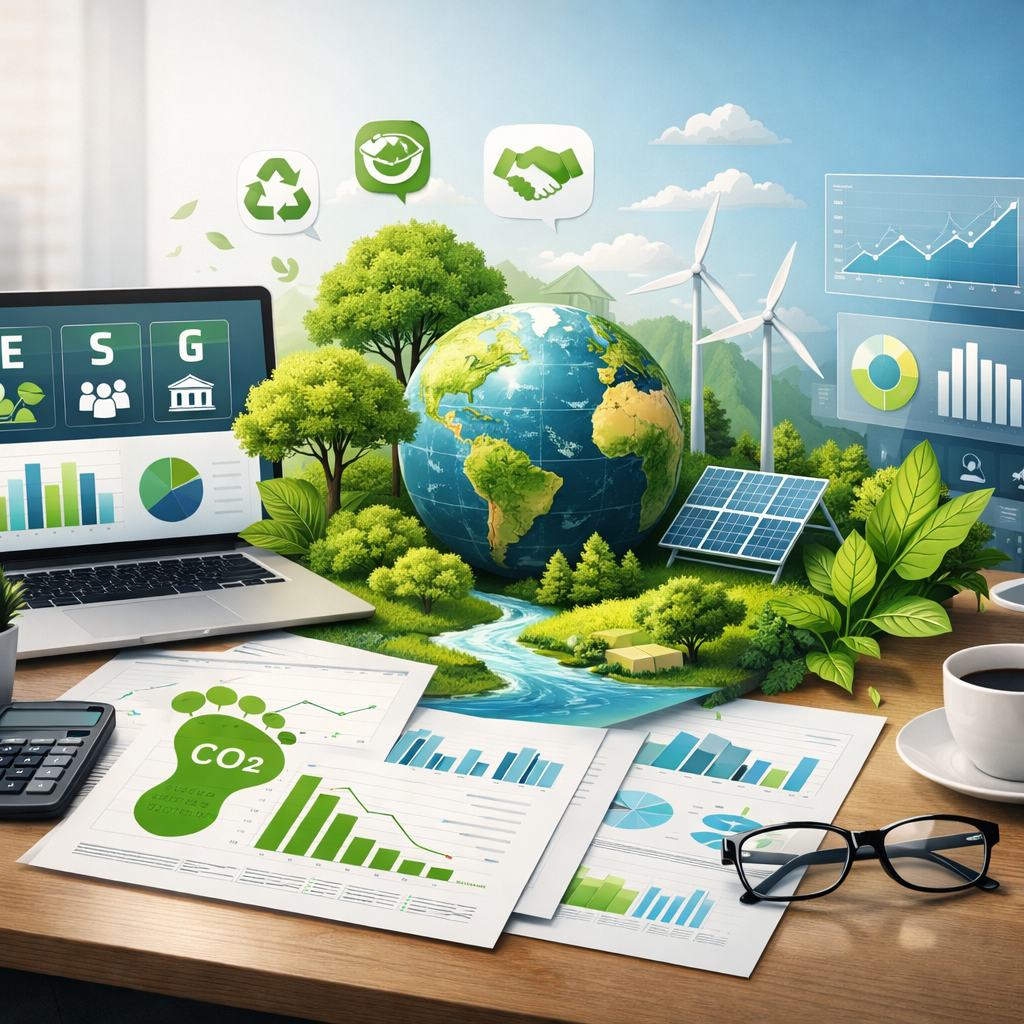
Sustainable Accounting
In today's world, companies and organizations are facing new challenges beyond just making financial profits. As awareness of environmental and social issues grows, it has become imperative that these entities adopt more responsible and sustainable practices. This is where sustainable accounting comes in, a concept that may seem complex at first glance, but is at its core simple and essential for a better future.
What is sustainability? And what does it have to do with accounting?
Before we dive into sustainable accounting, let's understand the meaning of the word sustainability itself. Simply put, sustainability means meeting the needs of the current generation without compromising the ability of future generations to meet their own needs. This concept is not limited to the environment, but encompasses three main integrated dimensions:
-
Environmental Dimension: It relates to the conservation of natural resources, pollution reduction, waste management, and the use of renewable energy. The goal is to reduce the environmental footprint of human activities.
-
Social Dimension: Focuses on social justice, workers' rights, equality, supporting local communities, and improving the quality of life for all.
-
Economic dimension: It includes achieving sustained economic growth in a way that does not drain resources, fosters innovation, creates jobs, and ensures long-term financial stability.
Historically, accounting has focused primarily on the financial side of a company, i.e., recording revenues, expenses, and profits. But with the advent of the concept of sustainability, it has become clear that financial performance alone is not enough to assess a company's true value or its full impact on the world. This is where the need for sustainable accounting comes into play, which expands traditional accounting to include measuring, tracking, and reporting on a company's environmental, social, and economic performance, as well as financial performance.
Why is sustainable accounting so essential?
Sustainable accounting is no longer just a luxury or an added benefit, it has become an urgent necessity for businesses of all sizes. There are several key reasons behind this shift:
-
Growing environmental and social awareness: Consumers, investors, and communities in general are becoming more aware of the impact of companies on the environment and society. They expect companies to be part of the solution, not part of the problem.
-
Regulatory and legal pressures: Many governments and international organizations are imposing new laws and standards that require companies to disclose their environmental and social performance. Compliance with these laws has become mandatory in many cases.
-
Attracting investments: Today's investors prefer companies that adopt sustainable practices. Studies have shown that companies with sustainable performance are often more attractive to investors, leading to an influx of capital towards them.
-
Improve reputation and brand: Companies that demonstrate a commitment to sustainability build a strong positive reputation, boosting customer loyalty and attracting top talent.
-
Risk management: Sustainable accounting helps companies identify and manage risks related to the environment and society, such as resource shortages, climate change, and social conflicts, reducing the likelihood of fines or reputational damage.
-
Innovation and resource efficiency: Sustainable accounting encourages companies to seek innovative solutions to reduce resource consumption, improve energy efficiency, and reduce waste, resulting in long-term cost savings.
The relationship between sustainable accounting and governance
Sustainable accounting is often mentioned along with the term ESG, which is an acronym for Environmental, Social, and Governance. These three dimensions represent the framework through which companies' performance in sustainability is evaluated.
-
Environmental : Includes how a company impacts the environment, such as carbon emissions, water consumption, waste management, use of renewable energy, and biodiversity conservation.
-
Social: It relates to how a company manages its relationships with employees, suppliers, customers, and the communities in which it operates. This includes workers' rights, working conditions, product safety, community contribution, and diversity and inclusion.
-
Governance: refers to the internal leadership of a company, management structure, control controls, shareholder rights, transparency, and anti-corruption. Good governance ensures that the company is run in an ethical and responsible manner.
Sustainable accounting is the tool that enables companies to measure and report their performance in these three dimensions of ESG. Without sustainable accounting, it will be difficult for companies to track their progress, identify areas for improvement, and provide transparent reporting to stakeholders.
Accounting plays a
vital role in transforming a company's environmental and social activities into measurable and analysable data. Here's how accounting contributes to this:
First, Measuring and Evaluating Environmental Performance Accounting
helps in identifying and measuring the environmental impact of a company through several indicators, including:
-
Carbon Emissions: Track the amount of greenhouse gases emitted by a company's operations such as carbon dioxide and methane. Companies can use this data to set goals to reduce emissions and improve energy efficiency .
-
Energy and water consumption: Measuring the amount of energy and water used in operations, and identifying opportunities to reduce consumption and switch to renewable sources.
-
Waste management: Track the amount of waste produced, the percentage of recycling, and efforts to reduce waste.
-
Environmental Footprint: Assessing a company's overall impact on the environment, including land use and natural resources.
Second, Measuring and Evaluating Social Performance
Social accounting focuses on measuring a company's impact on society, employees, and other stakeholders. Indicators include:
-
Workers' Rights and Working Conditions: Tracking fair employment practices, wages, working hours, occupational health and safety, and diversity and inclusion in the workplace.
-
Community contribution: Measuring investments in local communities, such as education programs, health care, or support for philanthropic initiatives.
-
Customer satisfaction: Assessing customer satisfaction with products and services, and how complaints are handled.
-
Responsible supply chain: Ensuring that suppliers adhere to similar ethical, environmental, and social standards.
Accounting Tools Used in Sustainability Measurement
To facilitate the process of measuring and reporting sustainable performance, companies use a range of specialized tools and methodologies:
-
Environmental Accounting: It focuses on measuring a company's environmental costs, such as pollution costs, waste treatment, and oil spill cleanup. This tool helps companies understand the true cost of their environmental impact.
-
Social Accounting: Measures a company's social impact, including investments in human capital, societal contributions, and the impact of products and services on society. It aims to demonstrate the social value that a company creates.
-
Sustainability Reporting: Comprehensive documents that companies provide to stakeholders about their ESG performance. There are global standards for these reporting, such as the Global Reporting Initiative (GRI) and the SASB (SASB), that provide guidance on how to disclose information in a uniform and transparent manner.
-
Life Cycle Analysis (LCA) is a methodology for assessing the environmental impacts of a product or service throughout its entire life cycle, from raw material extraction and manufacturing, to use and disposal. This tool helps companies identify environmental hotspots in their operations.
Benefits of Sustainable Corporate AccountingThe application of sustainable accounting is not only limited to complying with laws or improving reputation, but also offers a wide range of tangible benefits to businesses:
-
Improve management decision-making: Sustainable accounting provides comprehensive and accurate data on environmental and social performance, enabling management to make informed decisions to improve efficiency, reduce risk, and identify opportunities for innovation. For example, adidas can use carbon data to develop more sustainable products.
-
Boosting investor and stakeholder confidence: In the modern business world, transparency has become one of the key factors that boost investor and stakeholder confidence. Sustainable accounting plays a pivotal role in promoting this transparency by providing accurate and reliable reports on a company's sustainability performance. According to a report by Morgan Stanley, 85% of investors today are interested in investing in sustainable companies.
-
Improving a company's reputation and long-term value: A good reputation is one of the most important assets a company has. Sustainable accounting helps reinforce this reputation by demonstrating a company's commitment to sustainability, which leads to increased long-term value. Companies that adopt sustainable practices are often more resilient in the face of challenges and have a competitive advantage.
-
Attracting top talent: Today's employees prefer to work for companies that demonstrate a commitment to social and environmental responsibility. Sustainable accounting helps companies attract and retain top talent.
-
Regulatory compliance: Sustainable accounting helps businesses comply with increasing environmental and social laws and regulations, avoiding potential fines and penalties.
The Role of Technology in Sustainable Accounting
With technological advancements, modern accounting software is playing a crucial role in facilitating the application of sustainable accounting. For example, software such as Koood can provide advanced tools for managing financial and non-financial data, enabling businesses to:
-
Data Collection Automation: Automatically collect data related to environmental and social consumption, reducing errors and saving time.
-
Reporting: Easily create comprehensive, internationally compliant sustainability reports.
-
Analysis and Forecasting: Analyzing data to identify trends, evaluate performance, and predict future risks and opportunities.
-
Progress tracking: Monitor progress toward achieving the company's set sustainability goals.
Sustainable accounting is not just a new term in the business world, it is a holistic approach that changes the way companies think about their operations and their impact on the world. By incorporating environmental, social, and governance (ESG) dimensions into accounting reporting, companies can achieve sustainable growth, build stakeholder trust, and contribute to building a better future for all. It is an investment in the future, benefiting the company, society, and the planet alike.