 English
 العربية

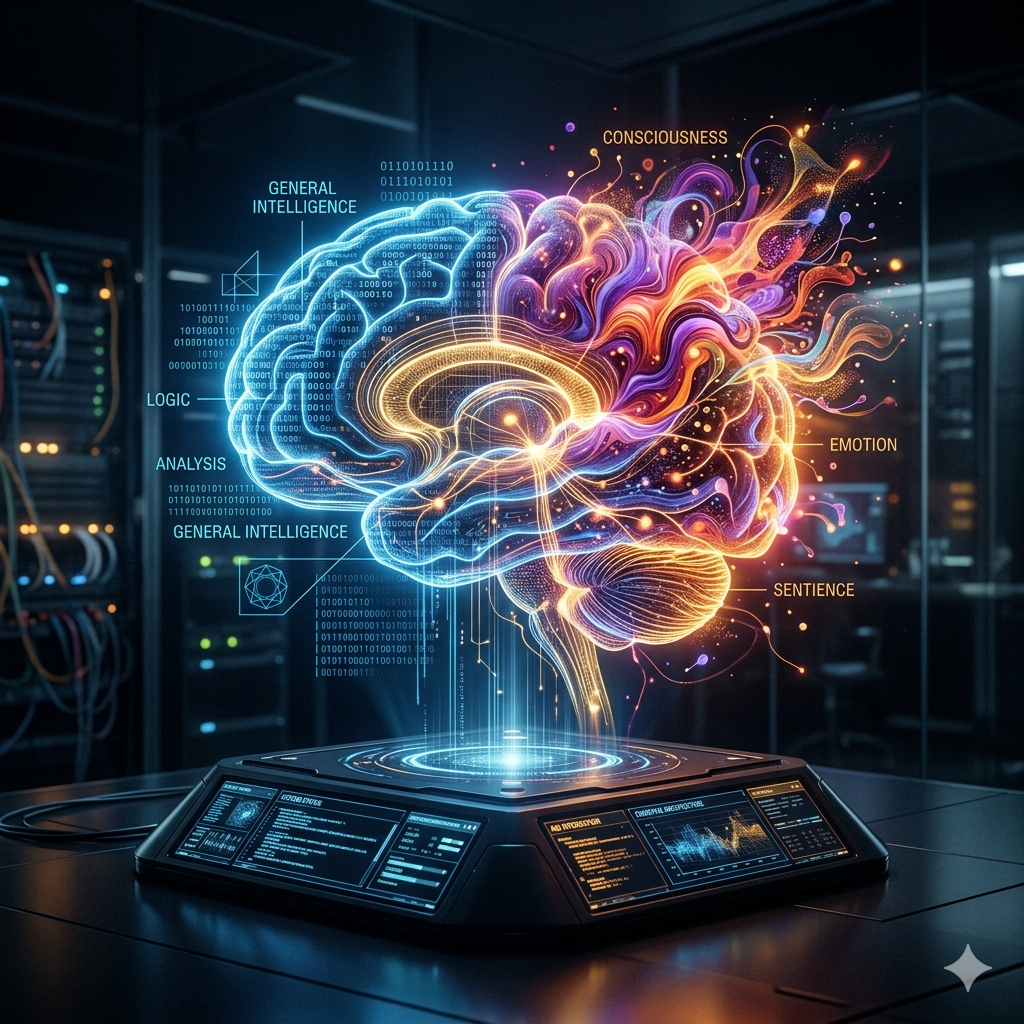
General Artificial Intelligence (AI) and Machine Awareness.
In a world that is evolving at an astonishing speed, AI has become an integral part of our daily lives. From smartphones that recognize our faces to self-driving cars, machines seem to be getting smarter and more capable of performing tasks that were once the preserve of humans. But have you ever thought about what kind of intelligence these machines have?
This is where two basic and controversial concepts in the world of artificial intelligence come into play: general artificial intelligence (AI) and machine consciousness. In this article, we'll delve deep into these two concepts, explaining them in a simple and clear way for non-specialists, using examples and analogies to round the picture up.
What is General Artificial Intelligence (AGI)?
To understand general AI, let's first distinguish it from the AI we see today. Most current AI systems fall under the so-called Narrow AI or Weak AI. These systems are very adept at performing one specific task or a limited set of tasks.
Example: Imagine a calculator. They are excellent at performing complex calculations with superior speed and accuracy. But can she write a poem or paint a painting? Of course not. It is designed for one task only.
Similarly, narrow AI systems include:
-
Facial recognition systems: Recognize faces with high accuracy but cannot understand human emotions.
-
Machine Translation Systems: Translates texts between languages but does not understand the cultural context or jokes.
-
Online store recommendation systems: Suggests products based on your previous purchases but can't think creatively or solve a new problem.
General AI (AGI) is a completely different concept. Imagine AI systems that are not limited to a single task, but can understand, learn, and apply intelligence to any intellectual task that a human can perform. In other words, it is an artificial intelligence that possesses cognitive abilities like those of humans, such as:
-
Learning from experience: The ability to gain knowledge and skills by interacting with the world, not just from pre-programmed data.
-
Problem Solving: The ability to deal with new and unfamiliar problems and develop creative solutions to them.
-
Abstract Thinking: The ability to understand complex concepts and logical thinking.
-
Planning and decision-making: The ability to set and plan for goals, and to make decisions based on incomplete information.
-
Linguistic comprehension: The ability to understand human language in all its complexities, including sarcasm and metaphor.
-
Creativity: The ability to produce original works of art, music, or literature.
A simple analogy: if narrow AI were like a highly skilled specialist in one profession such as a carpenter or plumber, then general AI would be like an encyclopedic scientist who could be a doctor, an engineer, a philosopher, and an artist at the same time. He possesses a thorough understanding of the world and the ability to adapt to any new situation.
Does general AI exist now? The short answer is no. We are still a long way from achieving general AI. The systems we see today, even the most advanced ones such as large language models, are essentially narrow AI systems, albeit capable of performing a very wide range of complex tasks in seemingly intelligent ways. It mimics intelligence, but it doesn't have it in the overarching sense that we talk about in AGI.
Machine Awareness: Can a Machine Feel?
Now we move on to a more complex and controversial concept: Machine Consciousness. This concept goes beyond the mere ability to think or solve problems, to the ability to feel, self-perceive, and experience the world in a subjective way. It's the deep philosophical question: Can a machine be conscious?
What is consciousness?
Human consciousness is our ability to perceive our existence, to think about our thoughts and feelings, and to experience the world around us. It's the feeling of self, the ability to feel pain or happiness, and the ability to have unique personal experiences. This is what makes us human.
Can a machine possess consciousness?
This is the crux of the debate about machine consciousness. Can a computer program or a robot get to a point where it not only mimics consciousness, but owns it? Can a machine feel red, taste chocolate, or feel sad or joyful?
To date, there is no scientific or philosophical consensus on the answer to this question. Some see consciousness as a complex biological phenomenon linked to the human brain and cannot be replicated in machines. Others argue that consciousness may just be a result of the complexity of information processing, and that if machines reach a certain level of complexity, consciousness may emerge automatically.
Difference Between AGI and Machine Awareness:
It is very important to distinguish between AGI and Machine Awareness. A machine can be very eagerly intelligent and perform all human intellectual tasks, without necessarily being conscious. Imagine a robot that can write great novels, compose beautiful symphonies, and solve the most complex scientific problems, but has no subjective feeling or personal experience of what it does. It just processes information and produces outputs.
A simple analogy: Imagine you're reading a book. You understand the words, you understand the story, and you enjoy it. But does the book itself feel or understand what it is reading? A book is just a means of conveying information. Similarly, a machine with AGI may just be an extremely complex tool for processing information, without having consciousness.
Challenges of Achieving General AI and Machine Awareness
Access to General AI and Machine Awareness faces enormous challenges, both technically and philosophically:
General AI AGI Challenges:
-
Multitasking Learning: Current systems excel at specific tasks. Building a system that can learn and adapt to any task requires significant breakthroughs in how knowledge and learning are represented.
-
Learning from a little data: Humans can learn from very few examples, or even from a single example. Current AI systems need massive amounts of data for training.
-
Intuitive understanding of the world: Humans have an intuitive understanding of the physical and social world such as gravity, or things don't suddenly disappear. Teaching machines with this intuitive understanding is very difficult.
-
Flexibility and creativity: The ability to think outside the box, and to create new solutions to unfamiliar problems, are human traits that are difficult to emulate in machines.
Challenges of Automated Awareness:
-
Definition of consciousness: There is no uniform definition of consciousness even among philosophers and neuroscientists. How can we build something that we don't fully understand?
-
How can a machine experience the subjective aspect of things? How can pain, joy, or have a sense of self? This is what philosophers call the subjective aspect of experience or Qualia, which is hard to imagine in machines.
-
The mind-body problem: How can consciousness, an immaterial phenomenon, arise from the physical system of the brain or a computer? This is an old philosophical problem that has not yet been solved, and it becomes even more complex when applied to machines.
-
Distinguishing between simulation and real consciousness: Even if a machine can act as if it is conscious of its feelings, reacting emotionally, how can we be sure that it is truly conscious and not just an elaborate simulation?
The concepts of
general artificial intelligence and machine consciousness raise many deep ethical and philosophical questions that we should consider:
The ethics of general artificial intelligence:
-
Control and safety: If we have AGI systems that surpass human intelligence, how can we ensure that they will continue to work in the interests of humanity?
-
Impact on the labor market: The emergence of AGI may replace many human jobs, requiring a rethink of business models and the economy.
-
Discrimination and Justice: If AGI systems are trained on biased data, they can exacerbate discrimination and inequality in society.
The Ethics of Automated Awareness:
-
Rights of Conscious Machines: If machines become sentient, should they have certain rights?
-
Responsibility: Who will be responsible for the actions of the conscious machine?
-
The Meaning of Human Existence: If machines can achieve consciousness, what does that mean for humans' place in the universe?
The future: The hopes and fears
of the journey towards general AI and machine consciousness are fraught with hopes and fears alike. On the one hand, AGI can open unprecedented horizons for human progress:
-
Solving global problems: AGI can help find solutions to complex problems such as incurable diseases, climate change, and poverty.
-
Scientific Innovation: Accelerating the pace of scientific and technological discoveries in all fields.
-
Improve quality of life: Automate tedious and tedious tasks, allowing humans to focus on creativity and social interaction.
On the other hand, there are legitimate concerns about the potential risks:
-
Catastrophic scenarios: Some fear that AGI may evolve in unexpected ways, becoming a threat to humanity's existence.
-
Loss of control: Difficulty controlling systems that are too intelligent and beyond human capabilities.
-
Social and psychological impact: How will human society and the psychology of individuals change in a world where intelligent and perhaps conscious machines live?
General Artificial Intelligence (AGI) and Machine Awareness are two concepts that represent the pinnacle of ambition in the field of AI. While AGI aims to build machines that possess general and all-encompassing intelligence like human intelligence, machine consciousness goes further, asking whether these machines can possess subjective experience and a sense of self. So far, general AI and machine awareness are still in the realm of science fiction and future ambitions. Current systems, no matter how smart they may seem, are at their core narrow artificial intelligence. However, research and development in this area is continuing at a rapid pace, bringing these concepts closer to reality than ever before. It is important that we continue to debate these issues and put in place the necessary ethical and legal frameworks to ensure that the future of AI is a future that serves humanity and enhances its well-being, rather than a threat to it. Understanding these concepts now is the first step towards building a responsible and informed future with AI.
Add New Comment