
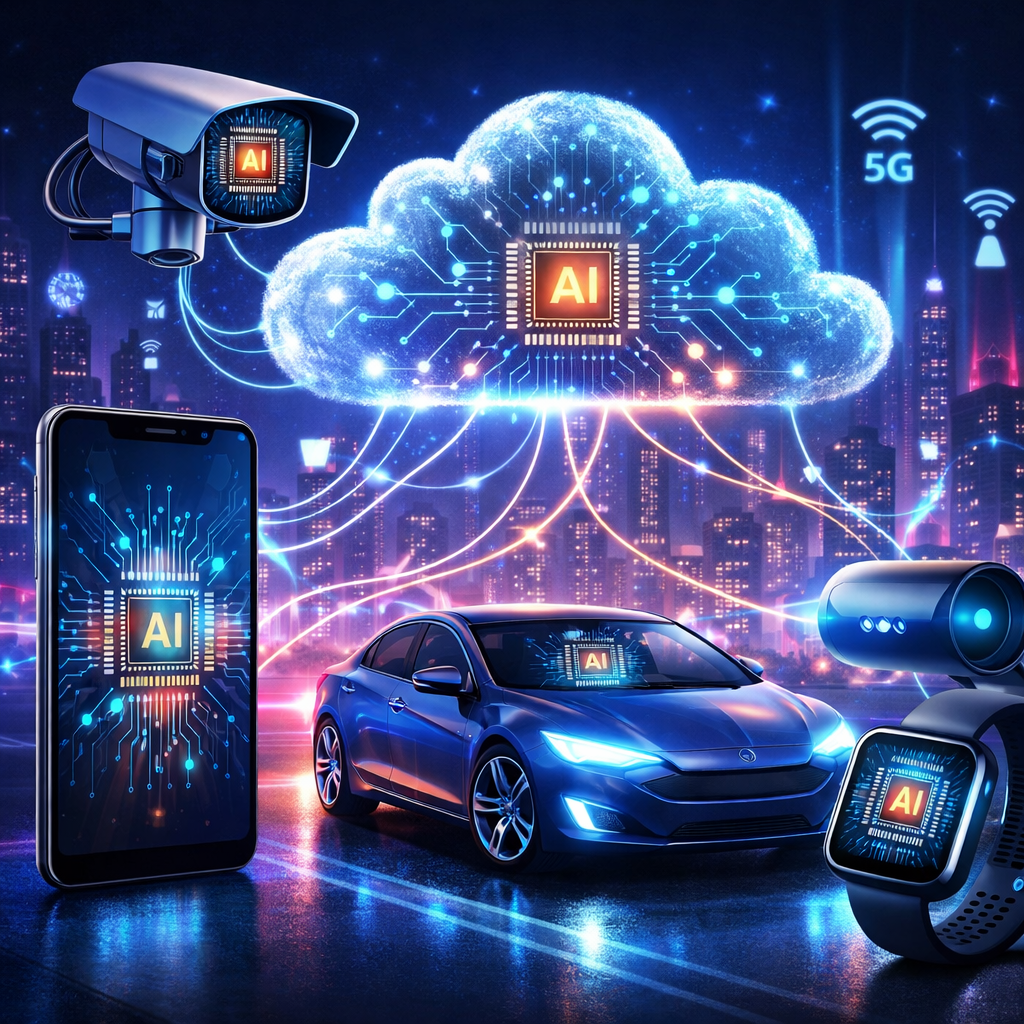
Edge AI
In a world where technological development is accelerating at an astonishing pace, the term AI is resonating with us everywhere. We use it every day without even realizing it, when we open our phones with Face ID, when YouTube suggests a new video, or even when we ask our voice assistant to tell us the weather. But have you ever stopped to ask yourself: Where are these processes thought about? Traditionally, most AI tasks have relied on what we call the cloud, which are giant servers located in huge data centers around the world. But today, we're witnessing a radical shift toward what's known as Artificial Intelligence on Devices, or Edge AI. It's a revolution in how we process data and how we interact with devices.
This article aims to delve deep into this concept, and explain it in a very simplistic style that suits the non-specialist reader, while reviewing its many benefits, its applications that are already changing our lives, the challenges it faces, and what the future holds for us in this exciting field.
What is Edge AI?
To simplify it, let's use an example from our daily lives. Imagine you want to cook a dinner. In a cloud AI system, it's like ordering food from a remote restaurant; you have to send your order, then the restaurant prepares the meal, and then it is delivered to you. This process takes a delay in connection and depends on having an open way internet connection. Edge AI is like having a skilled chef in your own kitchen. You own the data plug-in, and the prototype chef processes immediately within your device. No need to wait or worry about service interruptions. Technically, AI on devices refers to the practice of running AI algorithms and models locally on the device itself, whether it's a smartphone, a surveillance camera, a sensor in a factory, or even a car. Data is collected, processed, and decisions made based on it in the same place, without the need to send it to remote servers.
Why do we call it Edge?
The word "edge" in English means edge or tip. In the world of computer networking, the cloud is the center, while the devices we use such as phones and smartwatches are the edge because they are located at the edges of the network, that is, near the end user and the data source. So, when we put AI in these devices, we put it at the edge of the network, hence the name.
How does this technique work simply?
Some may ask: How can a device as small as a phone perform tasks that used to require huge servers?
-
Initial training, the AI model is taught or trained in the cloud using massive amounts of data and enormous computing power. Just like a student studies at a large university to become an expert.
-
Summary Optimization Phase: After the model is smart enough, engineers perform a process similar to summarizing a huge book. The model is compressed and optimized to become compact and light, so it can run efficiently on a microprocessor without consuming too much power.
-
Inference Implementation Stage: This smart summary is sent to your device. Now, your device has the ability to understand and make decisions locally. When you take a photo, the device immediately understands that it's a picture of a human face and optimizes the lighting in milliseconds.
Why do we need AI on devices?
There are five main reasons why Edge AI is an urgent necessity in our time:
-
Instantaneous Speed Instant Response
Often, a delay of even a fraction of a second is unacceptable. Imagine a self-driving car going at high speed; if it sees an obstacle, it can't wait to send the image to the cloud and wait for a response. The decision must be made immediately on the vehicle itself to ensure safety. Artificial intelligence on devices provides this blazing speed. -
Privacy and security of your data Staying with you
is one of the most important reasons for users. When your data such as your personal photos or audio recordings is processed within your device, it never leaves it. This significantly reduces the chances of your data being hacked or spied on while it travels online. You own your data, and you control it. -
Work anywhere without the need for the internet
Have you ever tried using a language translator in an area with no internet coverage? If it's equipped with local AI, it will work very efficiently. This feature makes the technology very useful in airplanes, remote areas, or even underground. -
Data Consumption and Cost
Saving Sending huge amounts of data such as high-resolution videos from surveillance cameras to the cloud consumes a lot of bandwidth and costs a lot of money. By processing the video locally and sending only important alerts such as: A stranger has been discovered, we save a lot of effort and money. -
Energy efficient:
Processing data locally using dedicated chips saves energy compared to sending and receiving large amounts of data over a network.
Applications that change our daily lives Artificial
intelligence on devices is not the technology of the future, it is now present in many of the tools we use:
-
In our phones: Portrait Mode is based on artificial intelligence that understands the dimensions of the image and separates the person from the background at the moment the photo was taken. Voice assistants like Siri or Google Assistant are also starting to handle a lot of simple commands locally to be faster.
-
In our homes: smart doorbell cameras that can distinguish between a mail package, a cat, or a stranger, and send you a specific alert without the need for video analysis in the cloud.
-
In healthcare: Smart pacemakers or watches that monitor ECG can detect any sudden abnormality and alert the patient or doctor immediately, potentially saving lives at critical moments.
-
In industry and agriculture: drones that fly over fields and detect agricultural pests in crops and pinpoint their locations, or sensors in factories that hear the sound of a machine and know it's about to malfunction before it actually happens.
-
In cars: Driving assistance systems that monitor the driver's attention and warn him if he is drowsy, all done via a camera and processor inside the car cabin.
Illustrative comparison: Where do we put our data?
Cloud AI
-
Response speed: Depends on internet speed, and response delays may occur.
-
Privacy: Data is sent to third-party corporate servers for processing.
-
Internet: Internet connection is very necessary, without which the system does not work.
-
Mental ability: He has very high processing abilities, and is able to solve the most complex problems and analyze large amounts of data.
-
Cost: Often based on monthly subscriptions, as well as data transfer and cloud consumption costs.
Artificial Intelligence on Devices (Edge AI)
-
Response Speed: Instant and instantaneous response as it works directly on the device.
-
Privacy: Data stays inside the device and is not sent to external servers.
-
Internet: It does not require a constant internet connection for daily operation.
-
Mental Ability: Specialized and optimized intelligence to perform specific tasks quickly and efficiently.
-
Cost: The cost is concentrated in the purchase of the device or hardware, while saving the cost of data transfer in the future.
It is important to understand that the world is not moving towards the elimination of the cloud, but rather the combination of the two. The cloud will remain for tasks that require deep thinking and analysis of big data from millions of users, while Edge AI will take over fast, private everyday tasks.
Despite
all these advantages, there are difficulties that scientists are working to solve:
-
Battery power: AI processing consumes energy, and scientists are trying to create very smart electronic chips that consume little electricity so that the phone's battery doesn't drain quickly.
-
Hardware heat: Intensive processing leads to overheating, which is a major challenge in small appliances without cooling fans.
-
Limited memory: We can't put all human knowledge into a smartwatch, so you have to choose what the device needs with extreme precision.
The future of AI on devices
We are now on the cusp of a new era called AIoT. In the near future, devices will not just be tools that carry out commands, but will be colleagues who understand what we need. With the proliferation of 5G networks, these devices will be able to talk to each other at breakneck speeds. Imagine a smart city where traffic lights communicate with cars locally to regulate traffic and prevent accidents without waiting for an order from a remote control center. Or imagine ultra-light augmented reality glasses that tell you the names of the people you're meeting and translate their words in front of your eyes instantly and in complete privacy.
Artificial intelligence on devices is the bridge that will take us from the world of rigid devices to the world of conscious devices. It makes technology more human, more respectful of our privacy, and more rapid in meeting our needs. The next time you open your phone with a glance, remember that there's a smart chef working hard inside your device, providing you with a safe and fast experience with complete privacy. It's an exciting journey at the beginning.