 English
 العربية

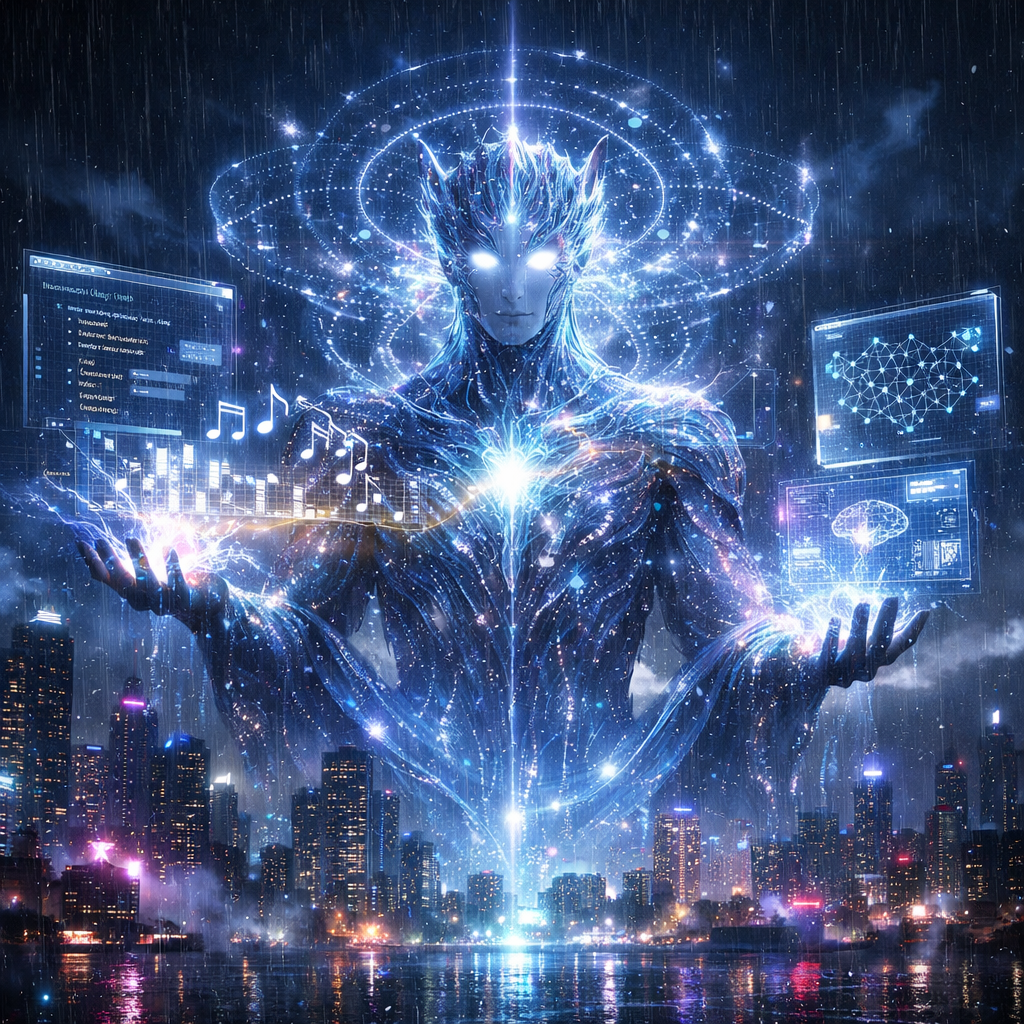
Generative AI:
In the past few years, the world has undergone an astonishing technological transformation that has made science fiction seem like a reality we live in every day. Artificial intelligence is no longer just deaf algorithms that analyze big data, predict the weather, or suggest you a movie to watch at your night, but has moved to a more exciting and surprising stage; it has become a creative writer who writes stories, paints paintings, composes music pieces, and even programs entire applications from scratch. This new type of technology is known as Generative AI, and it's the mighty engine behind popular tools that have become the talk of the hour like ChatGPT, Midjourney, andClaude. In this article, we'll embark on a detailed and simplified journey to understand this new giant in clear language and away from boring technical complexities.
What is Generative AI?
To understand generative AI, let's compare it to what we previously knew in the world of technology. Traditional or discriminatory AI was like a classifier or analyst; if you gave him a thousand images of cats and dogs, he could tell you with precision: This is a cat, this is a dog. He is very adept at recognizing patterns, classifying data, and making decisions based on pre-existing information. Its primary function is to answer the question: What is it? Or what will happen based on what we know?. Generative AI is a major quantum leap; it is like an artist, an author, or an innovator. He doesn't just recognize the cat's image, but if you ask him for a strange request such as: Draw me a cat in a spacesuit and walking on Mars in the style of the paintings of the international artist Van Gogh, he will not search for a similar image on Google, but will generate and create a completely new image that did not exist anywhere in the world before the moment of your request. Simply put, generative AI is a sophisticated branch of AI that focuses on creating new and original content, whether that content is literary text, art images, audio clips, real-life videos, or even complex code, based on the deep patterns it has learned from vast amounts of human data.
How does this magic work?
At first glance, it may seem as if the machine has acquired consciousness or a human imagination, but the scientific truth is a very complex and intelligent mathematical and statistical process. This technique is mainly based on so-called Mega Language Models (LLMs) and deep neural networks that mimic the way the human brain works. Imagine you want to teach a young child how to become a professional writer. You will make them read millions of books in various fields. Over time, the child will automatically learn that words come in a certain order, that sentences have context, and that stories have a specific dramatic structure. Generative AI does the same but on a cosmic and mighty scale. He reads trillions of words from the internet, digital books, science articles, human conversations, and analyzes billions of images and drawings. Through this extensive reading and analysis, the model learns what we call contextual probabilities. If the model starts by writing a sentence that is, it knows statistically and with astonishing accuracy that the next word is often in, then ancient, then tense. He doesn't understand the spiritual or emotional meaning of words as we humans do, but he's very adept at predicting what the next word or pixel should be placed here for the result to make sense, human, and beautiful. In the case of images, the model learns the complex relationship between written words and pixel-colored dots. He understands that the word sunset is associated with the colors of orange and red, the horizon line, and the reflection of light on water. When asked for a picture of a sunset, he combines these mathematical patterns to produce a unique painting that no one has ever seen before.
Generative
AI is not just an entertaining chat, but its applications extend to every aspect of our contemporary lives, revolutionizing productivity and creativity:
-
Revolutionizing the content and writing
industry, tools like ChatGPT, Claude, andGemini have become the second minds of writers, journalists, students, and staff. These tools can write draft articles, summarize long financial reports in simple bullet points, draft professional emails in multiple languages, and even help write poetry and screenplays. It doesn't replace the human creator, but rather acts as a smart assistant that breaks down the barrier of fear of beginnings and saves long hours of research and routine drafting. -
Visual arts and creative design platforms
like Midjourney , DALL-E, andStable Diffusion have created an earthquake in the world of design. Anyone, even if they don't have the skill of hand-drawing, can turn their wild imagination into a stunning visual reality by simply writing an accurate text description. This app opens up huge possibilities for designers to come up with new ideas, and for businesses to create visual content and advertising campaigns at a breakneck speed and at a cost that was previously unimaginable. -
Programming and Software Development The era of the super programmer
is perhaps the technology sector and programmers who are the most affected and benefited from this technology. Generative AI can now write complete code in different languages, detect complex vulnerabilities, and propose solutions to technical problems that used to take days of research. This development has made the process of building apps and websites many times faster, and has allowed programmers to focus on the overall engineering of projects rather than getting bogged down in the details of routine code. -
Medicine, Science, and Drug Innovation
In advanced scientific laboratories, generative AI is used to design entirely new protein molecules that can lead to the creation of drugs and vaccines for incurable diseases. It also helps analyze complex radiology images and create 3D models of human organs to help surgeons plan precise procedures before they are performed, raising success rates and saving lives. -
Personal education and learning The teacher who does not tirelessly
imagine if every student in the world had a genius private teacher available to him around the clock, who can explain the most difficult theories of physics in a style suitable for a ten-year-old, or practice conversation with you in a foreign language and correct your pronunciation and mistakes immediately and with endless patience. This is the revolutionary role that generative AI is beginning to play in transforming education from a unified indoctrination to personalized learning.
Despite
all these seemingly miraculous benefits, generative AI poses significant ethical, legal, and social challenges that require us to take a serious stance:
-
The intellectual property rights dilemma: Since these intelligent models have been trained on millions of artworks and books produced by real humans, a thorny legal question arises: Who owns the rights to the machine-produced content?
-
The danger of deepfakes: The incredible ability to create very realistic images, videos, and voices of real people opens a dangerous door for financial fraud, spreading misleading fake news, discrediting individuals or even influencing public opinion and elections. This requires great community awareness and the development of counter-techniques to detect this counterfeiting.
-
The Future of Jobs and Employment: There is a legitimate and global concern that this technology will lead to the replacement of humans in many jobs that rely on writing, translation, design, or simple programming. However, many experts believe that history repeats itself: just as the typewriter did not destroy the book, AI will not eliminate creators, but will create entirely new jobs that we never imagined, such as a command engineer or an AI quality controller.
-
Digital Hallucination: Sometimes AI falls into the trap of providing completely false information or inventing historical facts that don't exist, but it does so in a very confident and convincing way. It does not lie in the human sense, it simply follows false statistical probabilities at that moment, making accurate human review indispensable.
How do we prepare to live in this new age?
Generative AI is not just a passing technological trend that will disappear after a while, but an essential tool that will shape the 21st century, just as the internet did in the 1990s and electricity in the last century. The secret to successfully dealing with this transformation is not to fear it or try to ignore it, but to learn and adapt.All of us, regardless of our specializations, must develop our skills in dealing with these tools. Learning Prompt Engineering has become a basic skill, which is the art of knowing how to accurately address and formulate requests for the best results. We must also enhance our critical and analytical thinking skills to be able to distinguish real content from fake, and reliable information from that resulting from machine hallucinations.
Man and machine. Towards an Ultimate Creative Partnership
Generative AI, in all its technical prowess, remains merely a tool made by the human mind to serve and expand humanity's horizons. He has no soul, no feelings, no self-will, no ambition. It is a giant digital mirror of our collective intelligence, our history, and our creativity recorded in the trillions of data we have produced through the ages. If we use this technology well and put the appropriate ethical and legal frameworks in place, generative AI will be our greatest partner in the journey of creativity and innovation. He will take on the routine and tedious tasks, leaving us humans with the most room for philosophical thinking, human empathy, and complex creativity that no machine, no matter how powerful, can emulate. Today we are living in the dawn of a new digital renaissance, where the distance between an abstract idea and its concrete implementation is just a few words we type in a chat window. The future does not belong to the machine alone, nor to the man who rejects change, but to the man who masters dancing with the machine, uses its intelligence to enhance his intelligence, and builds a more prosperous, intelligent, and creative world with it.
Add New Comment