
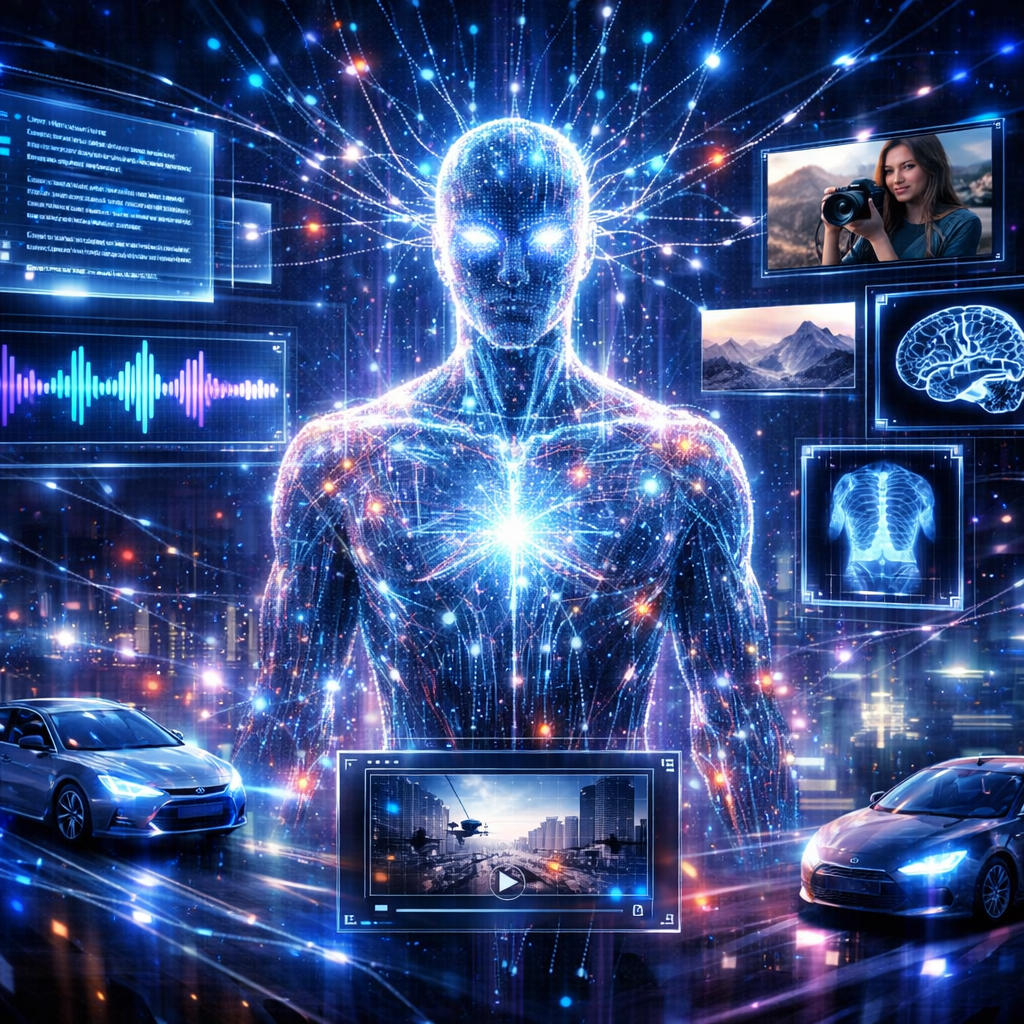
Multimodal AI
Imagine sitting down with a friend and telling them about your recent trip. You don't just put words into words, you show him pictures on your phone, imitate the sounds of nature you've heard, and maybe wave your hands to describe the size of the mountains. Your friend absorbs all of these media together in one moment to build a complete picture in his mind. Until recently, AI was like a person who only reads text without seeing images or hearing the accompanying sounds. But today, we are living in the age of multimodal AI, a development that gives machines multiple senses that bring them closer to human perception than ever before. In this article, we'll take you on a simplified journey to understand what this type of intelligence is, how it works, why it represents the most important leap in today's tech world, and how it will change the shape of our lives in the next few years.
First: What is multimedia AI?
Simply put, modalities are the different ways we communicate or receive information. Humans use the five senses: sight, hearing, touch, smell, and taste. In the computer world, media are types of data: text, images, sounds, videos, and even data coming from sensors such as temperature or speed. Traditional AI was unimodal Unimodal. For example, there was a model that specialized only in translating texts, and another model specialized in recognizing faces in images. Multimedia AI is one integrated system that can process and understand different types of data simultaneously. He doesn't see the image as a separate file and the text as another, but rather understands the relationship between them just as we do. If you give an old AI a picture of a cat and ask it to describe it, it might say it's a cat. But multimedia AI can watch a video of a meow shot, so it can understand from the sound that it is hungry, from the movement that it is approaching the food bowl, and from the text written in the caption that it is a lost cat, to give you a complete and comprehensive conclusion.
Second: How does this magic work?
You might be wondering: How can a computer combine image pixels, sound waves, and text letters in one place? Let's imagine that there is a universal secret language that AI understands. When he sees an image of an apple, he converts it into a set of numbers in this secret language. When he reads the word "apple", he also converts it into numbers very close to the numbers in the picture in the same language. When he hears the sound of an apple biting, he does the same. Thanks to this unified digital language, the system is able to connect all of these inputs. Let's imagine that there are specialized translators within the system: one translator for images, another for sounds, and a third for text. These translators exchange information to understand the full picture. This interconnectedness is what allows models like GPT-4o or Gemini to answer a question about an image you've uploaded to them, or describe what happens in a video with incredible accuracy. These systems can also generate new data, so you can give the system text that describes an imaginary scene, and turn it into a realistic image or a short video with appropriate music. This seamless exchange makes multimedia AI a limitless creative tool.
Third: Why do we need multimedia AI?One
might say, "Textual AI like ChatGPT in its early days was great, so why the complexity?. The answer is that the real world is not just textual.
-
Understand the context: Words alone can be misleading. The tone of voice and facial expressions give the real meaning. Multimedia intelligence can understand sarcasm or sadness by combining audio with text.
-
High accuracy: In medicine, an image scan alone is not enough, it must be linked to the medical history text. Combining the two reduces the error rate significantly.
-
Natural interaction: As humans, we prefer to speak, point and see. Multimodal intelligence makes handling a machine feel like you're dealing with a real human who understands your gestures and voice.
Fourth: Applications that are changing our world today
Multimedia Artificial Intelligence is not just a theory, it already exists and changes vital sectors:
-
Healthcare Comprehensive Digital Doctor
Imagine a system that reviews X-rays, reads doctor's notes, and listens to your pain description at the same time. This system can detect rare diseases that may be absent from humans because they require linking information from a variety of sources with great precision. -
Smart and personalized learning
Students can interact with a smart teacher who sees what they write on camera, hears their questions, and explains concepts with real-time graphs. If the system notices confusion on the student's face, it can automatically change the explanation style to suit them. -
E-commerce Shop with Your Eyes
Do you like a shoe that someone wears on the street? Instead of trying to describe it in words in a search engine which is a difficult task, you can simply picture it. The AI will understand the design, color, and branding, find you the nearest store to sell it, and even suggest clothes that suit it based on your personal taste. -
Autonomous Cars
This is the most complex and important application for human safety. The self-driving car relies not only on cameras that represent the sense of sight, but also on radar and lidar devices that represent the sense of remote touch to measure distances, digital maps that represent memory and textual information, and the sounds of street alarms that represent the sense of hearing. Combining all of these media into one system is what makes a car able to distinguish between a plastic bag flying in the air and a child suddenly running towards the road, making a fateful decision in split seconds to avoid an accident. -
Supporting People of Determination Inclusive Technology
This is perhaps the noblest application of multimedia AI. For blind people, the system can act as a digital eye that describes the world around them through voice, telling them what's written on a shop sign, or describing the facial expressions of the person they're talking to. For people with hearing impairments, the system can convert speech and ambient sounds such as a doorbell or fire alarm into text or alarm vibrations on their phone. It breaks down barriers and makes the world a more accessible place for everyone. -
Creativity and Content Creation
In the past, a content creator had to learn separate skills: writing, designing, and editing. Today, thanks to multimedia AI, a single person can turn a written idea into a painting, video, or piece of music. Artists are now using these tools to explore new horizons of creativity, as they can combine hand drawing with text commands to produce hybrid artwork that wasn't possible before. This does not mean replacing the artist, but rather giving them a clever brush that understands their imagination and helps them embody it.
Fifth: The most famous models that we use today
You may have heard of these names, and they represent the pinnacle of what science has reached in this field:
-
OpenAI's GPT-4o : The letter O stands for Omni. This model can talk to you in real-time, see the world through your phone's camera, and understand your emotions from your tone of voice.
-
Google's Gemini: Designed from the ground up to be multimedia, it excels at understanding long videos and connecting complex information between books and images.
-
Anthropic Claude 3.5 : Superior ability to analyze complex graphs and technical images with pinpoint accuracy.
Sixth: Challenges and Fears. Not everything is rosy
Despite all these positives, there are significant challenges facing this development:
-
Privacy: For this intelligence to work, it needs access to cameras and microphones, which raises huge questions about who is watching us and where our data goes.
-
Energy cost: Operating these models requires enormous computing capabilities and massive electricity consumption, which affects the environment.
-
Bipartisan: If AI trains only certain images or sounds, it may become biased against other categories of humans. For example, if the system does not recognize certain accents or facial features from different cultures, it can lead to unfair or discriminatory results, which requires strict ethical oversight and a great diversity of data used for training.
-
Deepfakes and Disinformation: The ability to combine audio, image, and text makes it very easy to create fake videos or audio recordings that look completely real. This poses a significant threat to personal and political security, as it can be used to spread misinformation or discredit individuals. Therefore, it has become necessary to develop counterfeit detection tools that work with the same multimedia AI techniques to distinguish the real from the fake.
Seventh: The Future of Multimedia AI 2026 and Beyond
We are approaching the era of intelligent agents with emotional intelligence. AI won't just be an app, it will be an assistant in your glasses or watch, seeing what you see and feeling what you feel. If your assistant notices from your tone of voice that you're stressed, he or she may suggest soft music or remind you when to rest. We will also see an evolution in home robots that interact with family members and understand complex commands such as bring a glass of water next to the Red Book. These tasks require an understanding of language, place, and distances, which multimedia AI provides. AI will become an invisible part of our lives, moving from being a tool to an everyday partner.
Multimodal AI is the bridge that has been missing between complex human language and rigid machine language. Thanks to him, machines are starting to come out of the text box to share our world with all its colors, sounds, and details. The ultimate goal is not to replace humans, but to create tools that better understand us, help us solve the most complex medical and scientific problems, and make technology accessible to everyone, even those who can't write or read, through simple audio-visual interaction. We are at the beginning of an exciting new chapter in human history, where the machine becomes a partner to see, hear and understand. Just like us.