
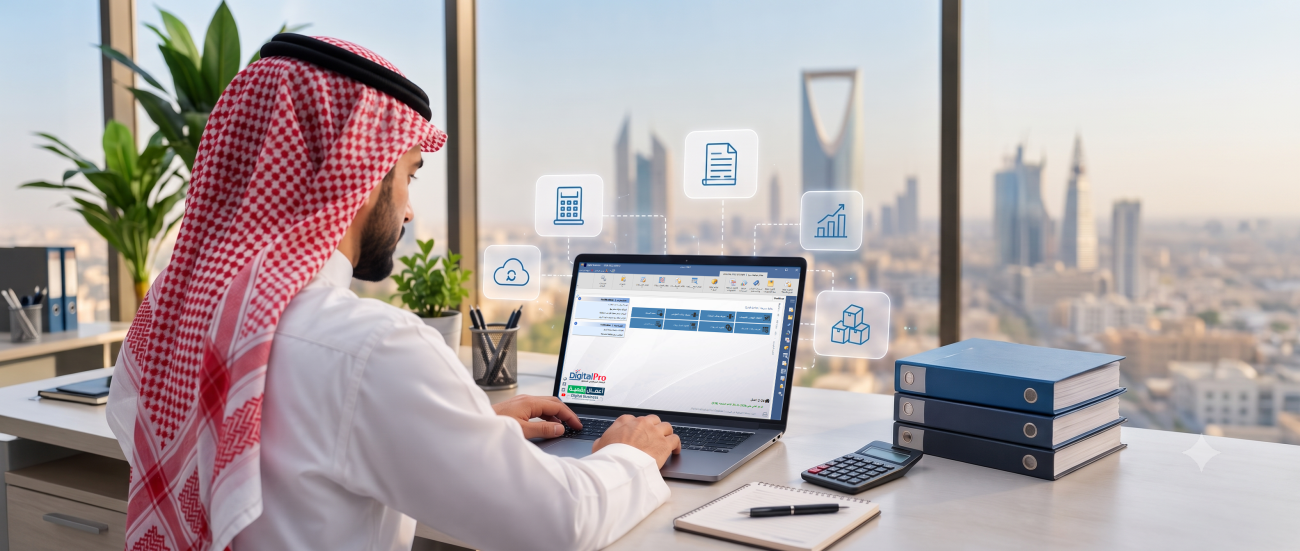
Types of Accounting Software: Your Guide to Choosing the Right Software for Your Business in Saudi Arabia
Using inappropriate accounting software may cause problems that go beyond recording entries and invoices; such as inventory balance discrepancies, delayed reports, difficulty tracking branches, repeated data entry, and a weak ability to determine the true profit of the business. Therefore, choosing a program does not depend solely on the price or the number of features, but rather on the nature and size of the establishment's work, the number of system users, and the extent of its need for integration between accounting, sales, inventory, and management.
In this guide, you will learn about the types of accounting software according to function, establishment size, type of activity, and operating method, while clarifying the difference between accounting software, ERP systems, and point-of-sale (POS) systems.
You will also find practical criteria to help you choose the right solution, whether you manage an individual project, an online store, a restaurant, a small or medium-sized enterprise, or a multi-branch institution.
What is Accounting Software?
Accounting software are digital systems used to record, process, and organize financial transactions, such as sales, purchases, expenses, revenues, payments, and customer and supplier accounts. These systems help prepare financial reports and track cash flows, inventory, and taxes instead of relying entirely on manual recording or scattered spreadsheets.
A simple definition of accounting software: It is a set of software tools that transform the scattered and disorganized daily transactions of an establishment into organized financial data that can be reviewed, analyzed, and utilized in decision-making.
Before searching for an answer to what accounting software is, one must differentiate between three main levels:
- A simple program for recording revenues and expenses and issuing invoices.
- A specialized program that combines accounting with sales, inventory, or payroll.
- An integrated system that connects accounting with the rest of the establishment's departments, such as procurement, sales, human resources, and customer service.
How working on accounting software works:
Working on accounting software begins with creating a chart of accounts, then adding customers, suppliers, items, and opening balances, and after that, recording daily operations. The program posts the impact of each operation to the accounts associated with it, so the results appear in professional financial reports such as the income statement, balance sheet, account statements, and tax and inventory reports.
Features of Accounting Software
The most important features of accounting software lie in its ability to transform scattered and disorganized financial operations into organized and interconnected procedures and data, which reduces the time required to prepare accounts and helps management access clearer information, aids in making more accurate decisions, and contributes to the growth of the establishment.
Among the most notable features of accounting software:
- Reducing recording and calculation errors: The program executes calculations and postings professionally according to predefined settings, reducing errors resulting from manual calculations.
- Saving time: Invoices can be issued, inventory updated, and entries related to the operation recorded through a single action.
- Organizing customer and supplier accounts: The program helps track debts, entitlements, and overdue payments.
- Preparing financial reports: It allows access to reports on revenues, expenses, profits, losses, and cash flows.
- Tracking inventory: Some accounting software links sales and purchases to available quantities and item movements.
- Defining user permissions: Each employee can be granted an access level appropriate for their role.
- Unifying data: Instead of having separate files for sales, warehouses, and accounting, operations are saved within an organized database.
- Improving internal control: Systems provide logs showing which user created or modified an operation and the time of the action.
- Supporting decision-making: Reports help identify the most profitable products, the best-performing branches, and expenses that need review.
- Readiness for growth: Some systems can add branches, users, or operational units as the establishment expands.
The importance of accounting software becomes even more apparent when the number of transactions increases or branches and warehouses multiply. At this stage, management via manual files or disconnected software becomes a potential source of conflicting numbers and delayed reports.
Discover: The Best Accounting Software in Saudi Arabia
The Evolution of Accounting Software from Paper Ledgers to Cloud Systems
Accounting began by relying on paper ledgers where entries and transactions were recorded manually. Auditing accounts and preparing financial statements required a long time, and discovering and correcting errors was a complex process.
With the spread of computers, desktop programs emerged that were installed on a single device or internal network. These programs helped speed up calculations and save data electronically, but they remained tied to specific devices and locations, and the process of updating them and backing up their data required technical intervention with high costs and more time, with the possibility of data loss.
After that, ready-made accounting software appeared, providing pre-prepared modules for invoices, accounts, sales, and inventory. These programs allowed small and medium-sized enterprises to obtain an organized system without developing custom software from scratch.
With the development of the internet and cloud computing, online accounting software spread, allowing users to access the system through a browser or application and follow work from different devices and locations easily. Cloud systems also contributed to facilitating updates, collaboration between branches, managing backups, and accessing reports faster.
Today, the role of financial accounting software is no longer limited to keeping entries only, but is considered an integrated accounting system that combines invoices, sales, inventory, reports, analytics, and integration with other systems, making them part of the operational infrastructure of the establishment.
What are the Types of Accounting Software?
The types of accounting software can be classified according to four main criteria based on: the function the program performs, the size of the establishment, the type of activity, and the system's operating method.
Common types include:
- General accounting software.
- Enterprise Resource Planning (ERP) systems.
- Payroll software.
- Inventory management software.
- Invoicing software.
- Accounting software for small and medium enterprises.
- Specialized accounting systems for various sectors.
- Desktop accounting software.
- Cloud accounting software.
- Point of Sale (POS) systems linked to accounts and inventory.
The multiplicity of accounting software types does not mean that the establishment needs to use a separate program for each function. Many modern systems combine more than one module within a single platform, such as accounting, sales, inventory, POS, and reports.
Discover: The Best Cloud Accounting System in Saudi Arabia
Accounting Software by Function
Accounting software is divided by function into general systems, integrated systems, and specialized programs for payroll, inventory, or invoices. The choice depends on the operations the establishment needs to manage within the system.
General Accounting Software
General accounting software is the system that manages basic accounting functions, such as the chart of accounts, journal entries, customer and supplier accounts, receipts and payments, and financial reports.
This type suits establishments that focus on organizing accounts without the need for complex operational management. The program may include:
- General ledger.
- Cost centers.
- Accounts receivable and payable.
- Receipt and payment vouchers.
- Bank reconciliations.
- Income statement and balance sheet.
- Tax reports.
You must verify the program's ability to customize the chart of accounts and reports to suit the nature of the establishment, because some accounting systems and programs provide basic functions only and do not support specialized operations or multiple branches.
Enterprise Resource Planning (ERP) Software
An ERP system is an integrated platform that connects accounting to the various departments of the establishment, such as sales, procurement, inventory, human resources, projects, and customer service.
When recording a purchase within an ERP system, its impact can automatically reflect on the inventory, the supplier's account, the tax, and general accounts. This interconnection reduces the need to enter the same transaction into more than one program.
An ERP system is suitable for companies that:
- Have multiple departments or branches.
- Need to unify data.
- Have multiple approval cycles and operational procedures.
- Want to monitor financial and operational activities from a single platform.
- Need detailed permissions and reports by department or branch.
This does not mean that an ERP is suitable for every small project, as it may be larger than the establishment's needs if its operations are limited, and implementing it requires good preparation and user training.
Payroll Software
Payroll software is a system dedicated to calculating salaries, deductions, allowances, bonuses, advances, and dues related to employees.
The program helps organize the payroll cycle by:
- Saving employee data.
- Recording base salary and allowances.
- Calculating deductions or advances.
- Linking salaries to attendance and departure when integration is available.
- Preparing payroll sheets.
- Recording the accounting impact of salaries.
- Preparing employee cost reports.
Payroll software can be independent, or a module within an ERP system or integrated accounting software. It is preferable to use the integrated system when the establishment wants to automatically record salary expenses and related liabilities in the accounts.
Inventory Management Software
Inventory management software tracks the movement of items from purchase and receipt to storage, sale, and transfer between branches or warehouses.
Its functions include:
- Defining products and units of measurement.
- Recording inventory balances.
- Tracking purchases, sales, and returns.
- Transferring between warehouses.
- Stocktaking and reconciliations.
- Setting minimum inventory levels.
- Tracking slow-moving and fast-moving items.
- Calculating inventory cost according to the valuation method used.
Stores, restaurants, pharmacies, factories, and distribution companies need a system that links inventory movement with invoices and accounts. Using an inventory program separate from accounts may lead to a difference in inventory value between the financial department and the warehouse if accurate integration does not exist.
Invoicing Software
Invoicing software is a solution that focuses on creating and sending invoices, recording payment status, and managing customer and product or service data.
It is suitable for freelancers, service establishments, and small projects that need to issue a limited number of invoices and do not have complex accounting or inventory operations.
However, one should be aware that invoicing software does not always equal complete accounting software. It may allow issuing an invoice without providing a chart of accounts, financial statements, bank reconciliations, or detailed expense management.
In Saudi Arabia, one must verify the compatibility of the invoicing system used with the e-invoicing requirements applied to the establishment; the Authority clarifies that the technical solution must adhere to the technical and regulatory requirements, whether the service provider is on the indicative list of providers or not.
Therefore, we advise you to contact us and book a free consultation if you are looking for the best accounting system in Saudi Arabia.
Comparison Table of Software Types by Function
| Type | Primary Function | Suitable For | Key Point to Verify |
|---|---|---|---|
| General Accounting | Entries, accounts, and financial reports | Service and commercial companies | Flexibility of the chart of accounts and reports |
| ERP | Linking accounting to all departments | Multi-department and multi-branch institutions | Scope of implementation, customization, and training |
| Payroll | Calculating salaries and entitlements | Establishments with multiple employees | Integration with attendance and accounts |
| Inventory Management | Tracking items, quantities, and costs | Stores, restaurants, and factories | Inventory valuation method and multiple warehouses |
| Invoicing | Issuing invoices and tracking collection | Freelancers and small projects | Tax compliance and accounting integration |
Ready to try the system?
Start your free trial or speak with the sales team to help you choose the right solution.
Types of Accounting Software by Business Size
The appropriate software varies depending on the size of the business, the number of transactions, branches, and users. A simple program may be sufficient for a solo project, while a large institution requires an ERP system that supports more complex procedures.
Accounting Software for Micro-enterprises and Solo Businesses
Micro-enterprises typically need a simple program to record revenues and expenses, issue invoices, and track customers.
Among the most important features suitable for this category:
- Ease of setup.
- Clear interface.
- Basic financial reports.
- Ability to export data.
- Subscription cost that matches the business size.
- Support for e-invoicing when needed.
- Ability to upgrade to a larger package in the future.
Ready-made accounting software may be suitable for these projects provided that it does not restrict the business owner when the number of customers increases, employees are added, or sales expand.
Point of Sale (POS) Software for Small Commercial Establishments (Shops, Cafes, Pharmacies)
Shops, cafes, and pharmacies need a system that combines speedy sales at the cashier with tracking inventory and accounts.
The appropriate system must provide:
- A fast and easy sales screen.
- Support for barcode scanners and printers.
- Management of discounts and offers.
- Tracking cash and payment methods.
- Updating inventory with every sale transaction.
- Returns management.
- Shift and sales reports.
- User permissions.
- Linking with invoices and accounts.
Digital Aamal Software Solutions Company offers an accounting system that combines accounts, POS, and tracking sales, inventory, suppliers, and reports, which helps commercial establishments avoid separating cashier data from accounting data.
Accounting Software for Small and Medium Enterprises
Small and medium enterprises need a program that goes beyond simple invoices to include general accounts, sales, purchases, inventory, customers, suppliers, and reports.
Among the most important selection criteria:
- Support for multiple users and permissions.
- Managing more than one branch or warehouse.
- Cost centers.
- Financial and operational reports.
- Ability to link with points of sale.
- Ease of adding new modules.
- Availability of support and training.
- Ability to access data from outside the company's headquarters.
- System compatibility with e-invoicing requirements.
Accounting software for small companies and medium ones is suitable when it is scalable; because choosing a limited program may force the establishment to transfer its data to a new system after a short period.
Advanced Accounting Software for Large Enterprises (ERP Systems)
Large enterprises need an ERP system that manages a large number of users, branches, departments, and procedures.
Typical requirements include:
- Managing multiple companies and branches.
- Consolidating financial reports.
- Approval and authorization cycles.
- Budgets and cost centers.
- Asset management.
- Procurement and supply chains.
- Human resources and payroll.
- Project management.
- Customer relationship management.
- Integrations with external systems.
- Audit trails and advanced permissions.
The implementation process must be preceded by a study of current operations, because the success of the system depends not only on the strength of the program but also on data preparation, defining procedures, training users, and managing the transition from previous systems.
Accounting Software for Non-Profit and Government Sectors
Non-profit and government entities need software that takes into account the nature of funding, budgets, projects, programs, and restricted expenses.
Needs include:
- Accounting by funds or projects.
- Tracking grants and donations.
- Budget preparation.
- Monitoring expenses by line items.
- Separating restricted and unrestricted resources.
- Asset and procurement management.
- Detailed reports for auditing and governance.
- Multiple approval cycles and permissions.
Therefore, it is not enough to choose one of the best accounting software in the market generally; rather, one must ensure its compatibility with the financial and administrative model specific to the entity.
Comparison Table by Business Size
| Business Size | Generally Suitable Solution | Basic Functions | Complexity Level |
|---|---|---|---|
| Solo Project | Invoicing program or simplified accounting | Revenues, expenses, and invoices | Low |
| Small shop or cafe | POS linked with inventory and accounts | Sales, inventory, and shifts | Low to Medium |
| Small or Medium Enterprise | Integrated or cloud accounting software | Accounts, sales, purchases, and reports | Medium |
| Large Enterprise | ERP System | Linking all departments and branches | High |
| Non-profit or Government Entity | Specialized system or configured ERP | Budgets, projects, and auditing | Medium to High |
Types of Accounting Software by Type of Activity
The accounting software must match the nature of the activity, as the basic operations in a restaurant differ from a hotel, and managing a service company differs from a retail store or a contracting company.
Among the most notable systems by activity:
- Retail and Shops: Need a POS program, barcode, inventory, offers, returns, and shift and branch management.
- Restaurants and Cafes: Need management for orders, tables, kitchens, recipes, meal costs, wastage, and delivery. You can explore an accounting system for restaurants and cafes that combines points of sale, order management, inventory, reports, and tracking product costs.
- Hotels and Furnished Apartments: Need reservations, accommodation, payments, commissions, accounts, taxes, and human resources. The Hotel Management System provides tools for managing reservations, accounts, payments, reports, and hotel operations.
- Service Companies: Need price quotes, invoices, projects, recurring payments, and customer tracking.
- Contracting: Needs project management, cost centers, progress billings, expenses, materials, and suppliers.
- Manufacturing: Needs raw materials, bill of materials, production orders, wastage, and final product cost.
- Distribution: Needs warehouse management, delegates, customers, sales, collection, and distribution lines.
- Companies that rely on sales and customer service: Can link commercial operations with a Customer Relationship Management (CRM) system that manages potential customers, price quotes, invoices, projects, support tickets, and recurring payments.
- Activities that require advanced administrative analysis: Benefit from a Smart Reporting Program to track sales, purchases, expenses, revenues, and inventory through reports and dashboards.
Digital Aamal Software Solutions provides systems tailored to multiple sectors instead of offering a single program with the exact same functions for all activities. This specialization is important because a powerful program is one that addresses the actual workflow of the establishment, not just the one that has the largest number of screens.
Types of Accounting Software by Operating Method
Accounting software is divided by operating method into desktop programs installed on the establishment's devices, and cloud programs that work via the internet or applications linked to external servers.
Desktop Accounting Software
Desktop accounting software are systems installed on a specific device or internal network at the establishment's headquarters, and their data is usually saved on a local server.
Among their advantages:
- Ability to work within the local network.
- Direct control over devices and the database.
- Suitability for some environments that suffer from poor internet connection.
- Ability to customize technical infrastructure according to company policy.
Potential challenges include:
- The need for internal devices or a server.
- Responsibility for backup and maintenance.
- Difficulty accessing from outside the workplace.
- The need to install updates on devices.
- High technical management cost when there are multiple branches.
Desktop programs remain suitable for some establishments that require local operating policies, provided there is a clear plan for data protection, backups, and business continuity.
Cloud Accounting Software
Cloud accounting software are systems used via the internet, and their data is stored on servers managed by the service provider or cloud infrastructure provider.
They offer the following features:
- Access from different devices and locations.
- Centralized updates.
- Ease of collaboration between branches and users.
- Reducing the need for a local server.
- Tracking reports on the go.
- Adding users or branches according to the package.
- Backups and protection procedures according to the provider's policy.
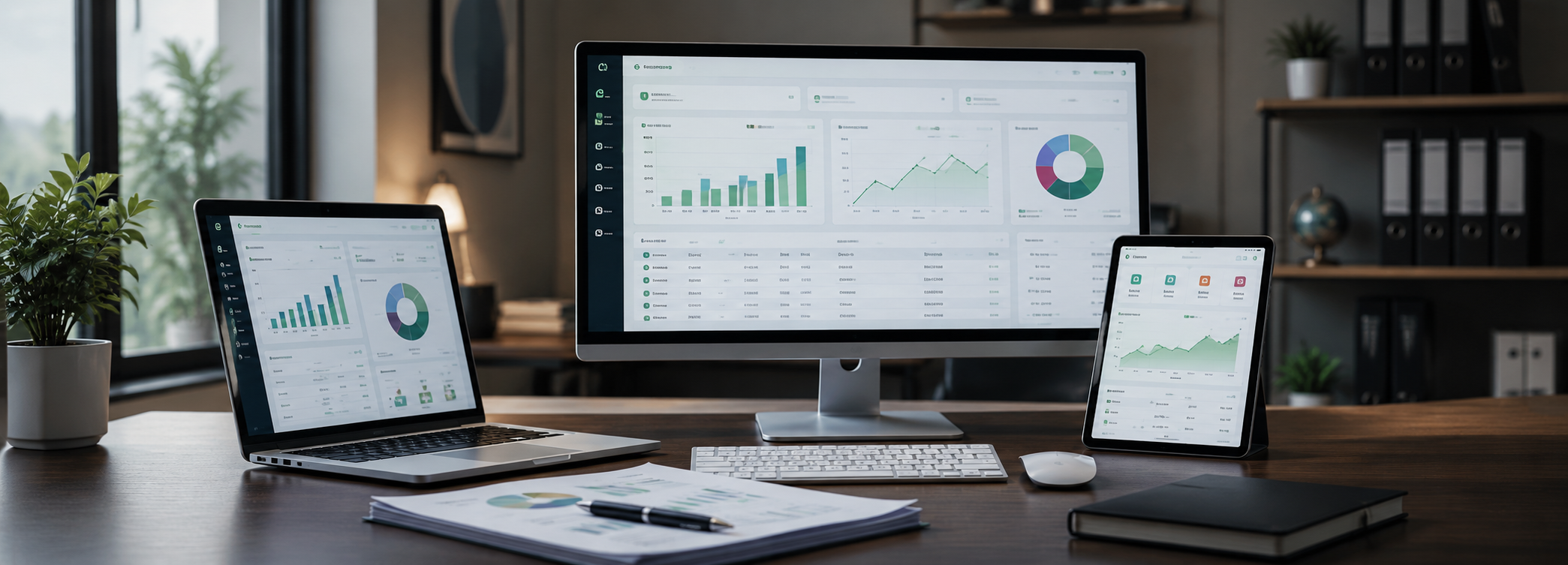
A cloud accounting system from Digital Aamal allows tracking accounts, financial transactions, sales, and inventory via an interface that works on multiple devices, with solutions aimed at small and medium enterprises, retail sectors, and restaurants.
However, using online accounting software requires a careful assessment of internet connection quality, data protection policy, backup mechanisms, permission levels, and a service recovery plan in emergencies.
Comparison Table Between Desktop and Cloud Software
| Comparison Element | Desktop Software | Cloud Software |
|---|---|---|
| Operating Location | Devices or network within the establishment | Browser or app via the internet |
| Remote Access | Requires special configurations | Available depending on permissions and connection |
| Updates | Manual installation or by a technical team | Usually executed by the system provider |
| Technical Infrastructure | May require internal servers and devices | Relies on cloud infrastructure |
| Backup | Usually the establishment's responsibility | According to the service provider's policy |
| Expansion and Branches | Requires extra setup and linking | Usually easier depending on the subscription plan |
| Working Offline | Possible in some systems | Depends on system features |
| Cost | Licenses, equipment, and maintenance | Usually a recurring subscription |
Ready to try the system?
Start your free trial or speak with the sales team to help you choose the right solution.
Which is Better: Desktop Accounting Software or Cloud Accounting Software?
There is no one best option for all establishments. The cloud program is often more suitable for companies that need remote access, managing several branches, and reducing internal technical infrastructure, while a desktop program is suitable for some environments that rely on a local network or require specific internal operation.
You can choose the right accounting software through the following questions:
- Does the manager or accountant need to follow up on data from outside the office?
- Are there branches or users in different locations?
- Does the establishment have a technical team to manage the server and backups?
- Is the internet connection stable at work locations?
- Do you need to work offline at certain times?
- What is the policy for backup and data recovery?
- Can the data be transferred upon the end of the contract?
- What is the total cost of ownership, not just the license price?
- How are permissions and recording of operations managed?
- What level of support and updates are available?
For most small and medium enterprises and multi-branch ones, cloud accounting software offers higher operational flexibility. Establishments with special technical or security requirements may prefer a desktop system or a hybrid environment that combines local operation and cloud synchronization.
The Future of Accounting Software
The future of accounting software is heading towards automation, instant analysis, and integration between systems, so that the program's role moves from recording operations after they occur to helping management discover problems and opportunities early.
Among the most prominent trends:
- Accounting Automation: Suggesting entries, categorizing expenses, matching payments, and reducing repetitive data entry.
- Artificial Intelligence: Analyzing patterns, discovering unusual transactions, and predicting cash flows.
- Real-time Reporting: Displaying indicators for sales, profitability, inventory, and collection without waiting for the end of the month.
- API Integration: Linking accounting with online stores, banks, payment gateways, and HR systems.
- Mobile Access: Enabling management to review performance, approvals, and reports on the go.
- High Information Security: Increasing reliance on multi-factor authentication, session management, data encryption, and audit logs.
- Specialized Solutions: The emergence of systems designed for workflows specific to restaurants, hotels, factories, and contracting.
- Predictive Analytics: Using historical data to predict sales, expenses, and inventory needs.
- Compliance Management: Updating invoicing and tax functions according to regulatory requirements.
However, an increase in intelligence within the system will not mean dispensing with accounting expertise. The accountant's role will remain essential in designing policies, reviewing data, interpreting results, and ensuring the accuracy of accounting treatments.
What are the Advantages and Disadvantages of Accounting Software?
Accounting software helps improve organization, accuracy, and report speed, but it can become a burden if a system is chosen that does not suit the activity or is implemented without thoughtful setup and training.
Main Advantages:
- Accelerating transaction recording.
- Reducing manual operations.
- Organizing documents and accounts.
- Tracking customers and suppliers.
- Preparing reports much faster.
- Linking sales to inventory and accounts.
- Improving control and permissions.
- Tracking performance by branch or department.
- Supporting expansion and adding users.
- Facilitating information sharing between departments.
Main Disadvantages and Challenges:
- Cost of licenses or subscriptions and equipment.
- The need to train employees.
- Result errors when entering incorrect data or settings.
- User resistance to transitioning from old methods.
- Difficulty migrating data from some systems.
- Dependence on the service provider in cloud systems.
- The need to update security policies and permissions.
- The presence of many features the establishment doesn't need.
- Cost of customization and linking with external systems.
- Disruption of operations if there is no backup and business continuity plan.
Therefore, one should not look for the absolute most powerful accounting software, but rather the system most suitable for the workflow, budget, current stage, and growth plan.
What is the Difference Between Accounting Software and Enterprise Resource Planning (ERP) Systems?
Accounting software primarily focuses on recording financial transactions and preparing accounts and reports, whereas an ERP system links financial operations with operational and administrative operations within a single platform.
For example, accounting software can record a purchase invoice and supplier entry, whereas an ERP can link the purchase request, approval, receipt, inventory, supplier invoice, payment, and accounting impact in one cycle.
Advanced accounting software may include modules for inventory, sales, and payroll, so the difference may seem limited. However, the real difference appears in the scope of interconnection between departments and the depth of operational procedures.
Comparison Table Between Accounting Software and ERP System
| Comparison Element | Specialized Accounting Software | ERP System |
|---|---|---|
| Primary Goal | Managing accounts and financial transactions | Managing enterprise resources and operations |
| Scope of Functions | Accounts, invoices, and reports | Accounting, sales, procurement, inventory, HR, etc. |
| Users | Financial management and some departments | Various departments across the enterprise |
| Integration | Limited or via add-ons | Internal integration across modules |
| Implementation | Usually faster and simpler | Requires broader analysis and setup |
| Customization | Limited to Medium | Medium to High |
| Cost | Usually lower | Higher depending on scope |
| Suitable For | Projects and companies with clear operations | Enterprises with multiple departments and procedures |
| Expansion | Adding features or packages | Adding modules, branches, and companies |
| Reports | Primarily financial and accounting | Comprehensive financial, operational, and administrative |
An integrated accounting system that combines accounts, POS, inventory, and reports may be suitable for an establishment that does not need a massive ERP application, but at the same time has exceeded the needs of a simple invoicing program.
The Difference Between Accounting Software and POS Software
Accounting software manages the financial impact of transactions, while POS software manages the direct sales process at the cashier.
The POS system records items, quantities, prices, discounts, and payment methods, then issues the invoice and updates inventory. As for accounting software, it records the revenue, tax, cash or bank movement, and customer accounts, and uses the data to prepare financial reports.
Comparison Table Between Accounting Software and POS Software
| Comparison Element | Accounting Software | POS Software |
|---|---|---|
| Primary User | Accountant and Financial Management | Cashier and Sales Employee |
| Function | Accounts, entries, and reports | Executing sales transactions |
| Inventory | Financial and quantitative tracking by the system | Deducting items upon sale |
| Invoices | Sales, purchase, and accounting invoices | Direct sales invoices |
| Speed | Focuses on accuracy and processing | Focuses on speedy customer service |
| Hardware | Computer or browser | Cashier screen, printer, and barcode scanner |
| Reports | Financial statements and accounts | Sales, shifts, and items |
| Best Application | Linking between both systems | Linking between both systems |
The problem arises when the cashier program is completely separated from accounting; employees need to transfer total sales, taxes, and inventory manually. Therefore, it is preferable to use a POS system linked to accounts, especially in shops, restaurants, and pharmacies.
Get: The Best Restaurant and Cafe Management Software
What is the Best Type of Accounting Software for Small and Medium Enterprises?
The best software for small and medium enterprises is the system that covers its current needs and expands with it without imposing unnecessary complexity.
It should preferably include:
- General accounts.
- Sales and purchases.
- Customers and suppliers.
- Inventory when needed.
- Electronic invoices.
- Financial reports.
- Cost centers.
- Multiple users and permissions.
- Branches and warehouses.
- Backup.
- Support and training.
- Ability to export data.
- Integrations with systems used.
Before purchasing your accounting software, write a list of operations you want to manage and problems you are trying to solve, then test the system using realistic scenarios, such as creating an invoice, returning an item, recording a partial payment, performing a stocktake, and extracting a profit report.
Get: ZATCA-Approved Accounting Software
What are the Best Types of Accounting Software for Shops?
The best accounting software for shops is a POS system integrated with inventory, accounts, and e-invoicing, allowing the store owner to track sales, cash, items, and branches from a single dashboard.
Look for the following features:
- Fast cashier interface.
- Barcode support.
- Product and units management.
- Multiple pricing.
- Offers and discounts.
- Returns and exchanges.
- Shift and cash drawer management.
- Multiple payment methods.
- Low stock alerts.
- Item transfer between branches.
- Inventory stocktaking.
- Customer and supplier accounts.
- Reports on profits and best-selling items.
- Operation on devices used in the store.
- Electronic invoicing.
- Employee permissions.
Priorities differ depending on the type of shop. A pharmacy may need to track batches and expiry dates, a clothing store needs sizes and colors, a supermarket needs fast sales and managing a large number of items, while a service shop needs invoices and appointments more than inventory.
Get: Tailoring Shops Management Software or contact us and we will help you choose the ideal program for your business for free
Why Choose Digital Aamal as an Accounting System?
Digital Aamal provides a range of accounting and administrative solutions tailored to multiple sectors, including accounts, POS, inventory, restaurants, hotels, customer service, and smart reporting. This allows the establishment to choose the system closest to the nature of its operations rather than using a generic solution that doesn't address the sector's needs.
System Accreditation by the Zakat, Tax and Customs Authority (ZATCA)
The accounting software from Digital Aamal is on the list of e-invoicing service providers, which means the system supports invoicing compatible with the requirements of the Zakat, Tax and Customs Authority and Phase Two.
It is important to clarify that ZATCA considers the adherence of the used system to the requirements as the primary criterion, even if the service provider is not on the indicative list; whereas the list includes providers who have passed the qualification conditions set by the Authority.
Therefore, the establishment must ensure that the version and infrastructure used are compatible with the phase applied to it, and test the invoice issuance and integration cycle before actual operation.
Having a Trained Team to Help You Add and Enter Data into the System
Having a specialized team during software implementation helps reduce initial errors, especially when setting up the chart of accounts, customers, suppliers, items, and opening balances.
The setup phase should preferably include:
- Reviewing business needs.
- Determining the modules to be operated.
- Setting up accounts and taxes.
- Adding users and permissions.
- Preparing products, customers, and suppliers.
- Entering or importing opening balances.
- Training employees on daily operations.
- Testing invoices and reports.
- Reviewing results before launch.
All old data should not be transferred without review, but rather it is better to clean up customer, item, and account lists before entering them into the new system.
Ease of Use
Ease of use means the ability of employees to perform daily tasks clearly, not just the beauty of the program's interface.
At Digital Aamal Software Solutions Company, we provide accounting and administrative systems with easy-to-use interfaces, and the cloud solution works on different devices and screens, with the ability to follow data from any internet-connected device.
When testing the system, ask employees to perform actual tasks such as:
- Creating an invoice.
- Adding a customer.
- Recording an expense.
- Returning a product.
- Extracting an account statement.
- Checking inventory.
- Changing a user's permission.
- Extracting a sales report.
If simple daily tasks require many steps, usage errors may increase even if the system is feature-rich.
Security and Data Protection
System security relies on a set of procedures, not just a password. The most important among them are permission management, connection encryption, backups, activity logs, system updates, and the data recovery policy.
We at Digital Aamal provide features related to security, encryption, and data protection, in addition to operating the cloud solution across different devices.
Before subscribing, inquire about:
- Data storage location.
- When backups are performed.
- Retention period for backups.
- Data recovery steps.
- Password management.
- Multi-factor authentication if available.
- User modification log.
- Data export permissions.
- How to obtain a copy of your data.
- Service continuity plan.
Subscription Cost and Technical Support
Software should not be compared based solely on the subscription price. A program might seem low-cost but require additional fees for users, branches, training, integration, or support.
Calculate the Total Cost of Ownership (TCO), including:
- Subscription or license.
- Number of users.
- Number of branches and devices.
- Training and setup.
- Data importation.
- Technical support.
- Updates.
- Integrations.
- Customizations.
- Backups.
- Maintenance and hardware in desktop systems.
The Digital Aamal website mentions the availability of technical support and the ability to request a trial version before subscribing, helping the establishment test the system and discuss its needs before making a decision.
After choosing the right system, you can also learn about the Success Partners Program designated for Digital Pro clients who recommend the solutions to other establishments looking for accounting software, POS, or inventory management.
Discover the services and products suitable for your business, then book a demo to experience the operations your establishment actually uses before making the decision to subscribe.
Frequently Asked Questions About Types of Accounting Software
What are the types of accounting software?
- Types of accounting software include:
- General accounting software
- Invoicing software
- Payroll software
- Inventory management software
- POS software
- Cloud software
- Desktop software
- Integrated ERP systems.
The suitable type depends on the size of the establishment and the nature of its operations.
What are the most popular accounting programs?
There are multiple local and global programs, but the popularity of a program doesn't mean it's the most suitable for all activities. One must evaluate compatibility with local systems, language, electronic invoicing, support, inventory, reports, and the nature of the activity.
What is accounting software?
Accounting software are digital systems used to record sales, purchases, expenses, payments, and customer and supplier accounts, then turn these transactions into financial reports that aid in tracking and decision-making.
What is the difference between cloud and desktop accounting software?
A desktop program is installed on a device or internal network, while a cloud program works via the internet and can be accessed from multiple devices and locations. Responsibility for updates, backups, and technical infrastructure differs between the two types.
What is the best accounting software for companies?
The best accounting software for companies is one that covers the company's operations, supports expansion, provides appropriate permissions and reports, and integrates with sales, inventory, and systems used. There is no single program that is the best for all companies.
Are POS programs considered accounting software?
A POS program is not necessarily complete accounting software, but it can be part of an integrated accounting system. POS manages the sales process, while the accounting system manages the financial impact, reports, statements, and accounts.
Is ready-made accounting software suitable for small companies?
Yes, ready-made accounting software can be suitable for small companies when it provides the required functions and can be expanded in the future. You must ensure there are no restrictions on the number of users, branches, or basic reports the company needs.
How do I know if the accounting software is right for my business?
Determine your daily operations, number of branches and users, invoice volume, inventory needs, and reports. Then, try executing real scenarios inside the software and compare the results with your business requirements.
Can the system be tested before subscribing?
Digital Aamal allows requesting a trial version and speaking with the sales team to choose the right solution, as detailed on the website pages. During the trial, it is preferable to test sales, inventory, reports, permissions, and invoices rather than just looking at the interface.
What is the difference between accounting software and ERP systems?
Accounting software focuses on transactions and financial reports, whereas an ERP links accounts with sales, purchases, inventory, human resources, projects, and other departments of the institution.
Conclusion
The types of accounting software vary between general systems, invoicing, inventory, and payroll programs, POS, desktop and cloud software, and ERP systems. The correct choice does not depend on having many features, but rather on the software's compatibility with the size of the business, workflow, number of users, branches, and reporting and compliance requirements.
Start by identifying the problems you want to solve, then compare systems in terms of functions, ease of use, security, integration, support, and full cost. After that, test the software using real operations from within your establishment.
Choosing the right system from the start helps you organize accounts, link sales with inventory, and access clearer reports, and saves you the cost of changing software and migrating data after business expansion. To evaluate the appropriate solution for your needs, book a demo and see how your establishment's operations are executed inside the system before subscribing.
Start Managing Your Business with Complete Flexibility
Try Digital Aamal for free. Start issuing your ZATCA-compliant electronic invoices in minutes.
- Free trial without credit card
- 24-hour technical support
- ZATCA Compliant