

Best Accounting Software for Small Businesses in Saudi Arabia: A Selection Guide
What is Accounting Software?
Accounting software consists of digital systems that help companies record revenues, expenses, sales, and purchases, manage customer and vendor accounts, issue invoices, and prepare financial reports. These programs transform scattered daily transactions into organized data that business owners and accountants can rely on to monitor liquidity, profits, and obligations, as well as to make informed decisions.
The need for the best accounting software for small businesses increases when the business starts receiving a larger volume of invoices, or when sales, items, branches, and users expand. At this stage, spreadsheets and manual ledgers become more prone to errors, duplicate entries, and difficulties in identifying discrepancies.
This guide helps you understand the importance of accounting software for small businesses, the key features to look for, the challenges the system addresses, and how to compare programs before subscribing, along with explaining the characteristics of cloud accounting solutions available for companies in Saudi Arabia.
Importance of Accounting Software
The importance of accounting software lies in its ability to organize the financial workflow within the company, starting from recording the invoice up to reflecting its impact on the customer or vendor account, inventory, and financial reports.
The role of the software is not limited to performing mathematical operations; it also helps the company create a unified data source instead of distributing information across employee files, emails, spreadsheets, and cashier programs.
Key benefits provided by accounting software for companies include:
- Recording revenues and expenses in an organized manner.
- Issuing sales invoices and recording purchase invoices.
- Tracking amounts due from customers.
- Monitoring obligations and required payments to vendors.
- Preparing journal entries and the general ledger.
- Tracking cash flow and bank accounts.
- Managing items, quantities, and inventory movements when the appropriate module is available.
- Generating income statements, balance sheets, and trial balances.
- Comparing performance across periods and branches.
- Defining user permissions inside the system.
- Maintaining an audit log of transactions and modifications.
- Providing the necessary data for auditing and tax compliance.
Accounting reports help the business owner answer practical questions, such as:
- Is the company generating real profit, or is current liquidity merely a result of payables owed to vendors?
- What is the volume of monthly expenses?
- Which customers are late on payments?
- What are the top-selling and most profitable products?
- Are there slow-moving items or quantities at risk of running out?
- Can the business afford expansion or adding a new branch?
You can leverage the Smart Reporting Portal to track sales, purchases, expenses, revenues, inventory, and customer and vendor account statements through interactive reports and dashboards, accessible from mobile phones or various devices.
Why Small Businesses Need Accounting Software
Small businesses need accounting software because they often operate with limited resources and cannot afford the cost of recurring errors, delayed collections, or purchasing inventory beyond their actual needs.
A project might start with a small number of customers and invoices, allowing the owner to track accounts using a simple spreadsheet. However, as operations grow, problems begin to surface, such as:
- Forgetting to record certain expenses.
- Lack of visibility regarding overdue amounts from customers.
- Discrepancies between actual inventory and recorded stock.
- Difficulty separating personal expenses from business expenses.
- Delays in generating financial reports.
- Duplicate data entry for sales and purchases.
- Loss of invoices or documentation.
- Relying on a single employee to know the details of the accounts.
- Lack of clear user permissions.
- Difficulty comparing performance across months or branches.
Small business accounting software helps address these issues by centralizing operations into a single system. When a sales invoice is created, customer accounts, sales, taxes, and inventory are automatically updated according to system settings, rather than recording each effect in a separate file.
Business owners should distinguish between three types of solutions:
| Solution Type | Core Functionality | Who Is It For? |
|---|---|---|
| Invoicing Software | Issuing invoices and tracking collection | Freelancers and low-volume operations |
| Accounting Software | Accounts, invoices, expenses, and reporting | Small businesses with clear workflows |
| Integrated Accounting Software | Accounts, sales, purchases, inventory, and POS | Commercial companies with multi-users or multi-branches |
Using software does not eliminate the need for an accountant. The system processes data based on user inputs and settings, while the accountant reviews journal entries, adjustments, policies, and financial statements to ensure accuracy.
Key Features of the Best Accounting Software for Small Businesses
The best accounting software for small businesses is a system that covers current operational needs, remains scalable, provides a clear interface, offers useful reports, enforces proper permissions, and seamlessly integrates accounting with sales and inventory.
A system should not be evaluated solely by its feature count. Software may contain dozens of tools your company doesn't need while lacking essential functions like multi-branch support, cost centers, or inventory tracking.
Ease of Use
Ease of use means employees can complete daily tasks in minimal steps, with clear fields, menus, and error messages.
You can evaluate ease of use by testing the following processes:
- Adding a new customer and vendor.
- Creating a sales invoice.
- Recording a purchase invoice.
- Recording an expense and payment voucher.
- Creating a sales/purchase return.
- Generating a customer account statement.
- Checking inventory balances.
- Closing a POS shift.
- Generating a Profit and Loss report.
- Adding a user and defining their permissions.
A visually attractive interface is not enough if issuing an invoice or looking up an item requires overly complex steps. Therefore, the staff who will use the system daily should participate in testing it, rather than relying solely on a management demonstration.
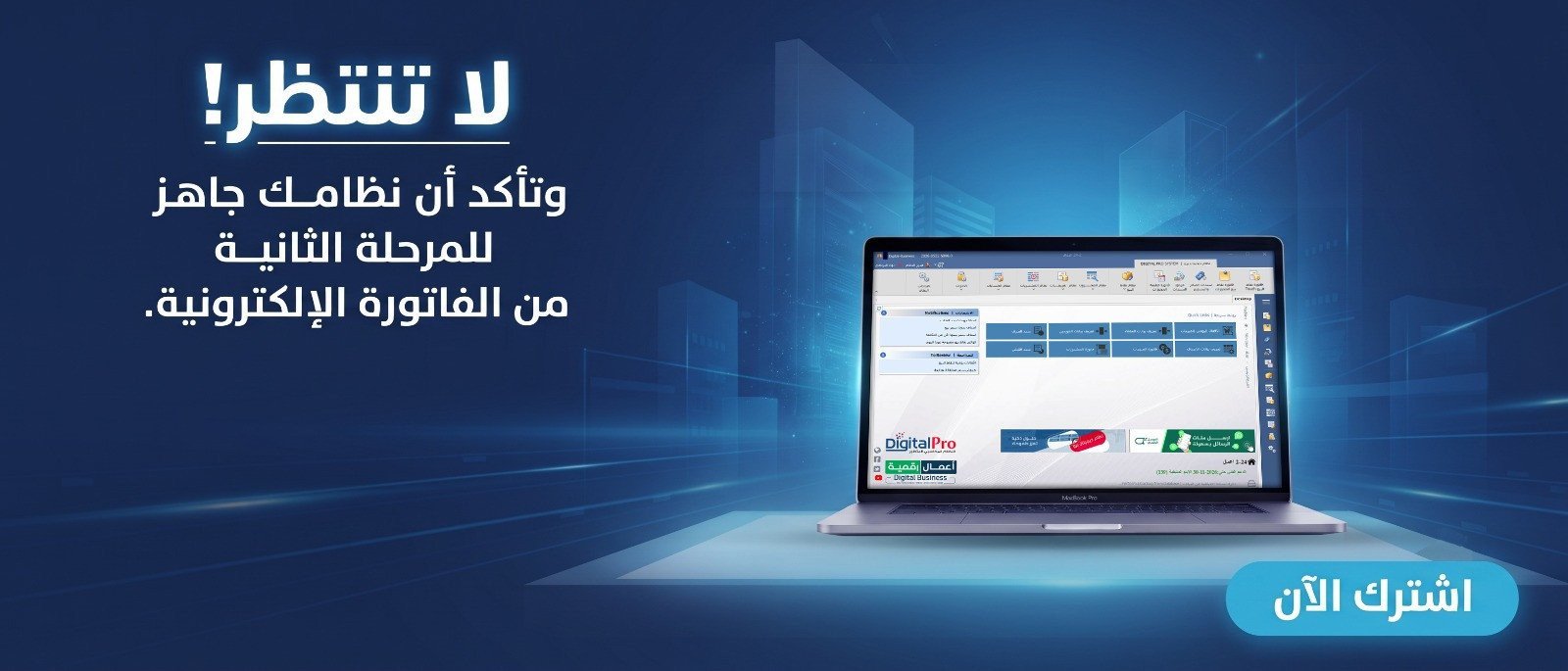
The accounting system from Aamal Digital provides a customizable interface and supports various hardware and POS devices, along with tools for managing sales, returns, payments, and reporting.
Arabic Language Support
Arabic language support is critical for Saudi businesses as it simplifies staff training, account and report reading, and data entry for customers, vendors, and items.
It is not enough for the main menu to be translated; you should verify full Arabic support across:
- User interface.
- Account and item names.
- Invoices and documents.
- Financial reports.
- Search and filtering functionality.
- System messages and alerts.
- Right-to-left (RTL) data entry.
- Training and support services.
The DigitalPro Cloud accounting system supports Arabic and offers an easy-to-use interface tailored for small and medium-sized enterprises.
ZATCA and Tax Compliance
The software used in Saudi Arabia must comply with Value Added Tax (VAT) and E-Invoicing regulations applicable to your business, including issuing and storing invoices, managing returns, and credit/debit notes according to regulatory standards.
The Zakat, Tax and Customs Authority (ZATCA) states that taxpayers can obtain an e-invoicing system from any solution provider, provided that the system complies with all e-invoicing technical requirements. ZATCA also clarifies that a provider's presence on the advisory list does not exempt the taxpayer from verifying that the solution actually complies with requirements in practice.
Before adopting a system, verify:
- Accurate VAT calculation.
- Support for Standard Tax Invoices and Simplified Tax Invoices as required.
- Saving invoices in a structured electronic format.
- Handling returns, credit notes, and debit notes.
- Compliance with the specific E-Invoicing phase applicable to your business.
- Compatibility across all point-of-sale devices.
- System updates whenever technical requirements change.
- Ability to generate required tax reports.
The cloud accounting software from Aamal Digital supports E-Invoicing and Phase 2 compliance, and the company is listed among e-invoicing service providers in Saudi Arabia.
Sales and Purchase Management
The software should enable management of the complete sales and purchasing cycle, rather than merely recording the final invoice value.
In the sales cycle, look for features like:
- Price quotations.
- Sales orders.
- Sales invoices.
- Discounts.
- Multiple payment methods.
- Returns management.
- Receipt vouchers.
- Tracking customer receivables.
- Accounts receivable aging.
- Sales breakdown by product, employee, or branch.
In the purchase cycle, verify support for:
- Purchase requisitions.
- Purchase orders.
- Vendor invoices.
- Purchase returns.
- Payment vouchers.
- Tracking vendor payables.
- Purchase price comparison.
- Linking goods receipt to inventory.
- Purchase approval workflows.
For retail stores, it is recommended to use a POS accounting system like DigitalPro that connects point of sale with inventory and general accounts, covering sales, payments, returns, stock, vendors, and financial reports.
Comprehensive Financial Management
A **small business accounting program** should cover the complete accounting cycle, from initial documentation to final financial statements and reports.
Core functionalities include:
- Chart of accounts.
- General journal entries.
- Receipt and payment vouchers.
- Accounts receivable and payable.
- Bank reconciliations.
- Cost centers.
- Expenses and revenues.
- Fixed assets management (when needed).
- Trial balance.
- Income statement (P&L).
- Balance sheet (Statement of Financial Position).
- Cash flow statement.
- Customer and vendor account statements.
- Tax reports.
- Period-end accounting closure.
The system should also allow traceability back to original source documents. When an entry appears in the sales account, an accountant should be able to drill down to the originating invoice to review details.
Companies looking for a unified platform can explore an integrated accounting system that connects accounts, sales, inventory, POS, and reporting within a single solution.
Ready to try the system?
Start your free trial or talk to our sales team to help you choose the right solution.
Scalability for Business Growth
The software must scale alongside increases in customers, invoices, users, and branches, eliminating the need to migrate to a new platform shortly down the road.
Ask your provider about:
- Maximum user capacity.
- Ability to add branches and warehouses.
- Option to add administrative and accounting modules.
- Support for multi-company or multi-CR entities.
- Data volume handling capability.
- Cost of adding users and branches.
- Subscription plan upgrade options.
- Data migration process when moving to an enterprise edition.
- Specialized industry features for future growth.
Businesses may later require specialized vertical solutions. For instance, food service businesses can review an accounting system for restaurants and cafes, while hospitality operations can check out hotel management software. Having specialized modules helps manage operational workflows beyond basic invoicing.
Multi-Branch Integration
Connecting branches centralizes data while retaining the ability to measure performance for each branch independently.
The software should enable:
- Tracking branch-specific sales and expenses.
- Creating one or more warehouses per location.
- Inter-branch inventory transfers.
- Setting variable price tiers when needed.
- User role management by branch location.
- Independent financial reporting per branch.
- Consolidated reporting across all branches.
- Tracking cash drawers and point of sale points.
- Unifying or segregating customer/vendor accounts per policy.
- Monitoring available inventory across multiple locations.
A common mistake is creating isolated files for each branch without a clear consolidation mechanism, leading to duplicate master data and difficulties producing consolidated company reports.
Data Security and Confidentiality
The software must protect financial data against unauthorized access, loss, or unrecorded modifications.
Look for the following security elements:
- Role-based access control (RBAC).
- Restricting users from unauthorized functions.
- Detailed audit trail logs for entry creation and edits.
- Password policies.
- Multi-factor authentication (MFA) availability.
- Encrypted connections (SSL/TLS).
- Automated regular backups.
- Disaster recovery plan.
- Controlled export permissions for reports.
- Device and session logging.
- Regular security patches and updates.
- Segregation of duties (e.g., transaction entry vs. approval).
Do not settle for generic statements like "The system is secure." Request clear details regarding data hosting locations, backup frequency, retention periods, restoration responsibilities, and data export procedures.
Note that while the Smart Reporting Portal from Aamal Digital provides end-to-end encryption and remote access to financial KPIs, user permissions should always be strictly configured according to operational responsibilities.
Integration and API Connectivity with External Systems
System integrations allow seamless data flow without manual double-entry, reducing time, human errors, and data discrepancies.
Small businesses often need to integrate accounting software with:
- Point of Sale (POS) terminals.
- E-commerce stores.
- Payment gateways.
- Inventory management systems.
- Customer Relationship Management (CRM) tools.
- HR and time-attendance software.
- Shipping and logistics providers.
- Sales representative mobile apps.
- Messaging and communication channels.
- Analytics and BI reporting platforms.
Before committing to any integration, clarify:
- What specific data syncs between systems.
- Data synchronization direction (one-way vs. bi-directional).
- Sync frequency (real-time vs. scheduled batches).
- Duplicate transaction handling mechanisms.
- Error logging and resolution handling.
- Integration maintenance and upgrade costs.
- Impact of system downtime on data sync.
- Data ownership and portability.
Business operations can be linked with a CRM system to organize leads and sales pipelines, or connected to a chatbot application to manage messaging channels. Always request a live demonstration of your specific integration scenario.
Major Challenges Facing Small Businesses in Financial Management
Small businesses face accounting challenges stemming from resource constraints, multi-tasking staff, and rapid transactional growth outstripping existing financial procedures.
Key challenges include:
Delayed Transaction Entry
When invoices and expenses are accumulated until month-end, understanding true financial standing during daily operations becomes impossible. The solution is real-time entry at the source.
Co-mingling Personal and Business Funds
Using the same account or cash drawer for business and personal expenses complicates profit and liquidity calculations. Accounts must be segregated and owner draws logged correctly.
Poor Accounts Receivable Management
Sales figures might look strong while the business suffers cash flow shortages due to delayed customer payments. AR aging and due dates must be actively monitored alongside total sales.
Lack of Expense Controls
Small recurring expenses accumulate into significant amounts by month-end. Categorizing expenses and assigning them to cost centers helps identify cost drivers.
Inventory Discrepancies
Discrepancies occur due to unrecorded returns, damaged goods, transfers, or sales without inventory updates. Sales, purchasing, and stock counts must be tied together in the system.
Relying on Fragmented Files
When employees maintain independent spreadsheets, customer and item data duplicate, resulting in conflicting numbers. A centralized database with role-based access is necessary.
Limited Financial Literacy of Business Owners
Owners may confuse revenue with net profit, or cash flow with overall financial performance. Reports help, but professional accountant reviews remain essential.
Difficulty Meeting Tax Deadlines
Delayed invoice entries or tax errors make filing returns stressful and error-prone. The system and workflows should be set up correctly from day one.
Weak User Access Controls
Granting broad permissions to all users increases risks of unauthorized edits, deletions, or data leaks. Enforce the principle of least privilege for every role.
Choosing Misaligned Software
Under-featured tools hinder growth, while overly complex ERPs inflate costs and complicate training. Choose a system that fits your current phase with clear scalability.
Cloud Accounting Systems for Small Businesses
A cloud accounting system operates over the internet, allowing authorized access to accounts and transactions from any device without relying on dedicated local hardware.
The **best cloud accounting software** suits small businesses when it provides:
- Data access from the office, home, or on the go.
- Seamless multi-branch and multi-user collaboration.
- Centralized, automatic system updates.
- Reduced need for local servers and infrastructure.
- Centralized user permission management.
- Automated backup policies via the service provider.
- Real-time dashboards and reports.
- Easy addition of users or branches per subscription tier.
- Integrations with third-party web tools.
However, moving to the cloud requires evaluating several key considerations:
- Internet connection stability.
- System response speeds during peak working hours.
- Data storage location and data residency compliance.
- Backup frequency and recovery SLA.
- Availability of full raw data export.
- Data retention policies.
- Privacy policy terms.
- Scalable user seat pricing.
- Quality and availability of technical support.
- Offline contingency plans for connection outages.
Aamal Digital offers a cloud accounting system targeted at SMEs, supporting Arabic, ZATCA e-invoicing, financial reporting, and multi-device cloud accessibility.
| Comparison Criteria | Cloud System | Desktop / On-Premise System |
|---|---|---|
| Accessibility | Authorized devices via web connection | Local device or internal network only |
| Updates | Handled centrally by provider | Requires manual installation/maintenance |
| Infrastructure | No local server hardware required | Requires local servers and hardware setup |
| Multi-Branch | Centralized and easy to manage | Requires complex network configuration |
| Cost Model | Recurring subscription (SaaS) | Upfront license + setup + maintenance |
| Backups | Managed by cloud vendor SLA | In-house responsibility of the business |
| Offline Capability | Depends on software offline mode feature | Full offline capability on local network |
| Scalability | Instant seat/tier additions online | Requires hardware and license upgrades |

How to Choose the Best Accounting Software for Small Businesses
Choosing the best accounting software starts with identifying your business processes and challenges, then testing the system's ability to execute them in practice.
Follow these steps:
- Define Business Nature
Are you a service or trading company? Do you manage physical inventory? Do you use POS systems? Do you offer subscriptions? Each model has distinct needs.
- Map Current Operations
Document your workflow for sales, purchases, collections, payments, inventory, and expenses, identifying responsible personnel for each task.
- Identify Core Pain Points
Is your primary challenge collections, inventory control, reporting, branch synchronization, or duplicate data entry? Software should solve actual problems, not just add screens.
- Categorize Required Features
Divide feature requirements into:
- Must-have from Day 1.
- Required within 12 months.
- Nice-to-have non-essential features.
- Verify Local Compliance
Confirm support for Arabic, SAR currency, local VAT rules, ZATCA e-invoicing standards, required documentation formats, and localized reports.
- Test Ease of Use
Have actual operational staff test daily transactions during trials; don't rely solely on a sales representative's controlled demo.
- Inspect Reporting Capabilities
Ensure the system generates necessary reports with proper filtering by date range, branch, cost center, customer, and product.
- Review Access Security
Set up test roles for accountants, cashiers, branch managers, and owners to verify proper segregation of duties.
- Test Data Import and Export
Verify support for bulk importing customers, vendors, items, and opening balances, as well as exporting reports in standard formats (Excel, PDF).
- Validate System Integrations
Don't rely solely on logos on an integration page. Request a live demo of actual data flow between the systems.
- Calculate Total Cost of Ownership (TCO)
Include all cost elements:
- Base subscription or license fee.
- Per-user seat costs.
- Multi-branch fees.
- Implementation and setup fees.
- Data migration charges.
- Training costs.
- Technical support plans.
- Software updates and upgrades.
- Third-party integration fees.
- Hardware requirements.
- Custom development costs.
- Review Terms of Service (SLA)
Examine data ownership clauses, cancellation policies, backup extraction rights, response time guarantees, and vendor liability limits.
- Conduct a Trial Before Buying
Use sample data matching your business operations to run a full cycle—from quotation to payment receipt, and purchase order to vendor payment.
You can review Aamal Digital Software Solutions to compare general accounting, POS, cloud software, and specialized solutions based on your business model.
Best Small Business Accounting Software from Aamal Digital
Aamal Digital offers multiple accounting and management solutions depending on business nature, transaction volumes, POS needs, inventory complexity, and cloud access requirements.
For small and medium enterprises, Aamal Digital Software Solutions provides a cloud accounting platform supporting Arabic, financial transaction management, reporting, and ZATCA e-invoicing via an accessible cloud interface.
For retail businesses and shops requiring POS, sales, and inventory management, the DigitalPro POS & Accounting System offers capabilities including:
- Sales cycle and flexible payment method management.
- Returns processing.
- Item, pricing, and cost tracking.
- Inventory and product management.
- Vendor and warehouse management.
- Financial and accounting reporting.
- Sales and profitability analytics.
- POS hardware, barcode scanner, and receipt printer support.
- Remote performance monitoring across devices.
No single system can be labeled the absolute **best accounting software in Saudi Arabia** for every business; a service firm requires different capabilities than a retail store, restaurant, or construction company. The best system is the one that succeeds in real-world testing for your specific operations, offering the integration, reporting, support, and scalability you require.
Before deciding:
- Define user count and branch locations.
- List required financial reports.
- Identify systems needing integration.
- Test invoicing, purchasing, and returns workflows.
- Verify inventory management setup.
- Review user security permissions.
- Confirm ZATCA Phase 2 compliance details.
- Request full TCO pricing clarity.
- Verify data migration procedures.
- Test system speed on your hardware.
You can request a free trial through the website form, selecting POS accounting, DigitalPro Cloud, or other solutions. You can also contact us to discuss your business type, user numbers, branch requirements, and custom integration needs.
Explore our services and products, then schedule a live demo using realistic business scenarios—such as creating an invoice, return, receipt voucher, stock audit, and profit report—so you can thoroughly evaluate the system before subscribing.
Ready to try the system?
Start your free trial or talk to our sales team to help you choose the right solution.
Frequently Asked Questions About Small Business Accounting Software
What is the best accounting system for a small project?
The best system for a small project provides invoicing, expense tracking, customer and vendor management, and basic reporting without complexity, while offering scalability for additional users, inventory, or POS functionality as the business grows.
Service-based projects may only need invoice, expense, and receivable tracking. Commercial projects typically require linking accounting with purchasing, inventory, and sales.
What is the best online accounting software for small and medium businesses?
The best online software offers secure multi-device access, Arabic language support, ZATCA e-invoicing compliance, robust reporting, role-based access, and automated backups matched to your team size and branch structure.
Systems should always be evaluated through practical hands-on trials rather than feature lists alone.
How do you manage accounting for a small business?
Small business accounting can be managed through these steps:
- Separate personal and business finances.
- Establish a clear chart of accounts.
- Record sales and expenses daily.
- Issue compliant invoices promptly.
- Monitor overdue customer accounts receivable.
- Log vendor purchases accurately.
- Perform periodic inventory audits.
- Reconcile bank accounts and cash drawers regularly.
- Review profit/loss statements and cash flows.
- Consult an accountant to review entries and tax filings.
What is the best accounting system for small companies?
The best accounting system strikes a balance between ease of use and functional coverage. It must handle accounts, sales, purchases, reports, and permissions, adding inventory and POS modules whenever the business requires them.
It should also scale effortlessly without forcing complex, unused features on the business.
What are the best accounting and inventory software programs for SMEs?
The best accounting and inventory software connects item purchasing, receiving, warehousing, sales, and returns directly to their financial impact.
It should support:
- Multi-warehouse and multi-branch management.
- Units of measure (UOM).
- Barcode tracking.
- Costing methods (FIFO, Average Cost, etc.).
- Stock takes and inventory adjustments.
- Inter-warehouse transfers.
- Low stock alert notifications.
- Integrated sales and purchasing workflows.
- Customer and vendor ledger tracking.
- Profitability and inventory valuation reports.
What is the best accounting software for businesses?
There is no single best software for every enterprise. Selection depends on business size, industry sector, branch network, user volume, and the complexity of sales, inventory, and reporting workflows.
A small firm may need cloud accounting software, while a multi-department enterprise requires a full ERP suite.
Does cloud accounting software require a permanent internet connection?
This depends on the deployment architecture. Cloud-native systems require internet access to process transactions and sync data, whereas desktop/on-premise software can operate over a local area network (LAN).
Does Aamal Digital provide technical support in Arabic?
Yes, the cloud accounting software from Aamal Digital supports Arabic, and the technical team provides continuous support from initial onboard implementation through ongoing business expansion. You can request a free demo version to explore all details.
Can I test the software before purchasing?
Yes, Aamal Digital provides a demo request form on the website to test POS accounting, DigitalPro Cloud, or other solutions by submitting your business details.
It is recommended to use the trial period to process real business transactions rather than just browsing the interface.
Can the software scale as my company grows?
The right software scales by allowing you to add users, branches, warehouses, and operational modules, though expansion limits vary across software tiers and plans.
Before subscribing, request explicit pricing for additional users, branches, data limits, available future modules, and data retention guarantees when upgrading tiers.
Selecting the **best accounting software for small businesses** does not start by asking for the most famous name or the lowest price, but by defining your operational needs and testing the system's performance across invoicing, purchasing, inventory, reporting, permissions, and regulatory compliance. The better the software fits your operations and scales with your vision, the more effectively it reduces errors and empowers confident financial decision-making.
Book a live demo before subscribing and request a full walkthrough using workflows identical to your business operations.
Start Managing Your Business with Complete Flexibility
Try Aamal Digital for free. Start issuing ZATCA-compliant e-invoices in minutes.
- Free trial without a credit card
- 24/7 technical support
- ZATCA compliant
Add New Comment