 English
 العربية

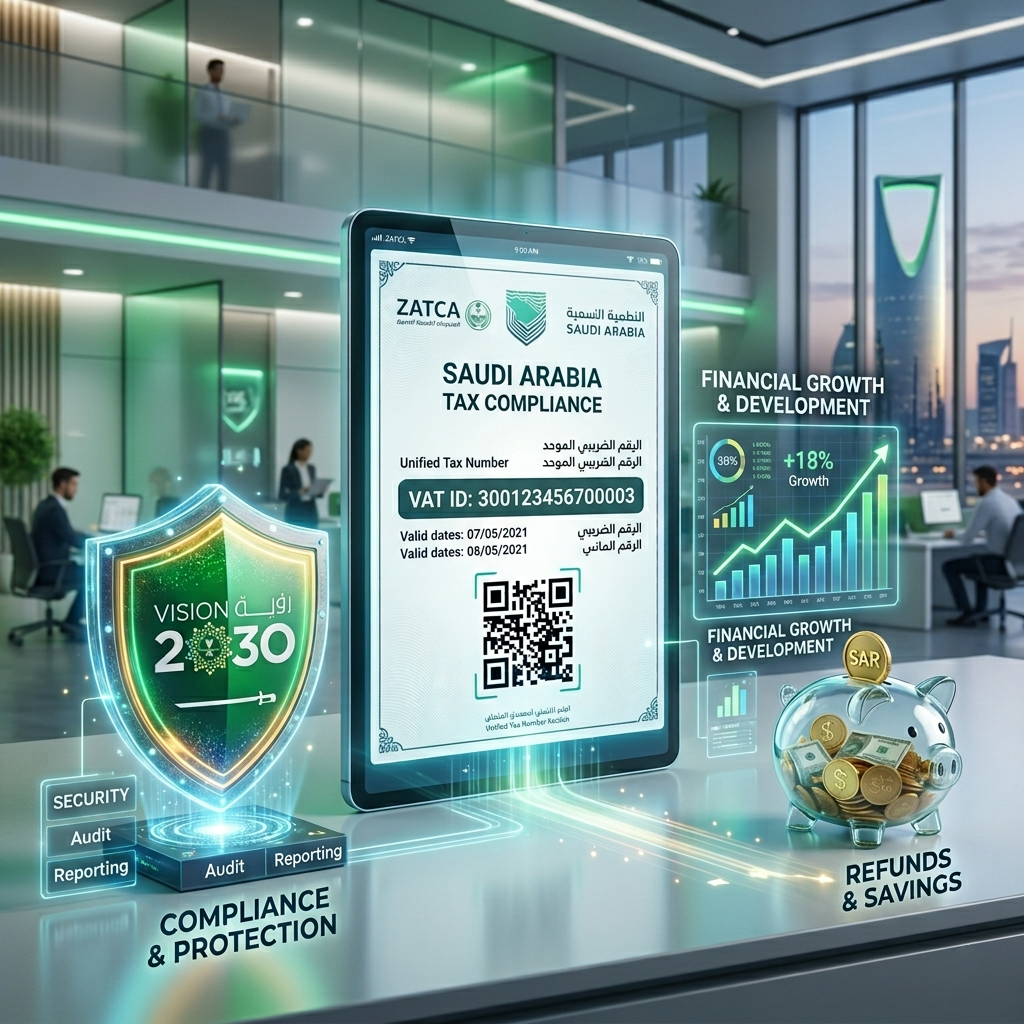
The Comprehensive Guide to the Tax Number in the Kingdom of Saudi Arabia.
Considering the amazing economic transformation that the Kingdom of Saudi Arabia is witnessing, and under the umbrella of the ambitious Vision 2030, the financial and tax system has witnessed qualitative leaps that have placed the Kingdom among the ranks of technologically and administratively advanced countries. The tax number is no longer just a series of numbers that appear at the bottom of the invoices, but has become an integrated economic identity, a bridge between the establishment and the regulatory authorities, and a tool that ensures transparency and fairness in the Saudi market.
Imagine that you are starting your own business, whether it is an online store, a modern café, or a consulting firm, you will find that the first thing that knocks on your door is the need to understand the tax number. Many business beginners are intimidated by tax terms, but the truth is that the system is designed to be merchant-consumer friendly if understood correctly. In this extensive guide, we will take you on a comprehensive knowledge journey, in a simple and clear way, to explain everything related to the tax number, from A to Z, to turn this complex topic into practical knowledge that you can benefit from in your daily life and business.
What is a tax number simply?
The Tax Identification Number (TIN) is a unique and distinctive number granted by the Zakat, Tax and Customs Authority (ZATCA) to every entity or individual registered in the VAT system. You can liken it to an individual national ID number, or a business registration number for enterprises, but it is exclusively for tax transactions. This number is the key that opens the doors for you to deal with the state and with big companies. Without it, your business remains off the tax radar, depriving you of many rights and exposing you to legal risks.
What do these 15 digits mean?
The tax number in Saudi Arabia consists of 15 carefully arranged numbers, each part of which tells a story about the establishment:
-
The first digit from the left: It represents the symbol of the country in the unified Gulf system, and in Saudi Arabia, the number always starts with the number 3.
-
Numbers 2 to 9: The unique serial number of the establishment, which is never repeated between two facilities.
-
The tenth digit: called a check digit, is the result of a complex calculation performed by systems to ensure that the entered number is not random and is technically correct.
-
Numbers 11 to 13: Indicate the number of the organization's branch, if the company has multiple branches, this part helps to distinguish them.
-
Numbers 14 and 15: Determine the type of tax registration, for example, whether it is VAT or other types of taxes.
Why is the tax number a treasure for the employer and a shield for the consumer?
Some may think that the tax figure is just a tool for collection, but the reality is that it holds major strategic benefits for everyone:
-
Legal Compliance and Avoiding the Trap of Fines The
system in Saudi Arabia is clear and strict: every establishment with annual sales exceeding SAR 375,000 is required to register for VAT and obtain a tax number. Failure to do so is not just negligence, but a legal violation that may cost you a fine starting from SAR 10,000 and escalating to percentages of sales volume. Obtaining a tax number is a certificate of innocence for your establishment before the law. -
The era of e-invoice The Kingdom has
completely moved to the e-invoice system. It is not possible to issue a legal invoice that is acceptable in courts, banks, or government agencies without having the tax number clearly printed on it, along with a QR code. The tax number is the backbone of this bill; without it, your paper is just a scrap of legal value. -
Input Recovery Feature: How Does a Tax Number Save You Money?
This is the most important point for business owners. Let's say you bought your company's computers for SAR 100,000, and paid VAT on them SAR 15,000.
If you do not have a tax number: You will bear the SAR 15,000 as a loss or additional expense.
If you have a tax number: You can claim a refund of this SAR 15,000 from the Authority, or deduct it from the taxes you collect from your customers. Here the tax number turns into a straightforward financial savings tool. -
Building a wall of trust and professionalism
in the business world, the first impression lasts. When you submit a quote or invoice with a notarized tax number, you are sending a silent message to your client: I am a regulated, professional, and compliant business of the country. Large companies and government agencies completely refuse to deal with any supplier that does not have a tax number, because this also exposes them to accounting problems.
The journey to get a tax number Simplified practical steps
Obtaining a tax number no longer requires paperwork or field visits. The Zakat, Tax and Customs Authority has harnessed the best techniques to make it easier:
-
Access to the ZATCA Portal Login to the official website of the Authority, which is the only and official portal.
-
Initial registration: If your business is new, you will create an account using your CR number and owner details.
-
Submit a VAT application: From the dashboard, you choose Indirect Taxes and then VAT.
-
Fill in financial statements: You'll be asked to assess the value of your sales for the past 12 months, and your forecast for the next 12 months. Remember: honesty here is essential because the Authority is technically tied to banking and procurement systems.
-
Attach documents: They are often simple documents such as a commercial registration certificate and a memorandum of association for companies.
-
Review and Receipt: Within a short period of one to 5 business days, you will receive a letter of approval, and you can upload your 15-digit tax registration certificate.
How do you detect a fake number?
As a consumer, you pay an additional 15% on your purchases as a national contribution. You have the right to make sure that these funds go to the state and not to the pockets of fraudsters. Here's how to make sure:
-
The Authority's official application: It is the fastest way. Open the app, point the camera at the QR code on the invoice, and it will immediately tell you: the facility is registered or the number is incorrect.
-
Website: You can manually enter the tax number in the registration verification service on the Authority's website.
-
Warning signs: If you find a handwritten invoice, doesn't have a tax number, or has a number of less than 15 digits, it's a danger sign. In this case, the merchant is prohibited from collecting tax from you by the system, and you have the right to report it through the Consumer Reports app.
Disengagement between the tax number and the distinctive number causes
a great confusion among entrepreneurs between these two terms, and here is the fundamental difference:
-
The TIN is a 10-digit number that anyone who has a commercial registration gets by simply opening a file with the Authority. It is used for zakat and income tax.
-
The VAT ID is the 15-digit tax number we are talking about, and it is only given to those who are already registered for VAT.
-
The golden rule: Everyone with a 15-digit tax number necessarily has a 10-digit unique number, but not everyone with a special number has a tax number.
List of prohibitions and fines What you should avoid
Tax compliance requires vigilance. Here are some common mistakes that can lead to painful fines:
-
Do not display the certificate: The system requires you to hang the tax registration certificate in a prominent place for the public to see in your shop or office. The fine may be up to 5,000 riyals.
-
Collect tax without registration: If you don't have a tax number yet, you're strictly prohibited from adding 15% to the price. Doing so is considered tax fraud, and the penalty is very severe.
-
Incomplete Invoice Issue: An invoice that lacks a tax number, date, or address is considered a violation of the e-invoicing system.
-
Late returns: Even if you don't have sales in each month, you must file zero returns. Delays will subject you to fines starting from 5% of the tax value.
How do you make technology work in your favor?
Managing taxes manually in our day and age is an uncalculated risk. Human errors in calculations can lead to fines that eat up your profits. This is where cloud accounting software comes into play as a constraint:
-
Full automation: Once you enter your tax number in the settings, the software generates invoices that are fully compliant with the Authority's conditions including the QR Code.
-
Calculate Taxes Accurately: The software automatically deducts input tax from output tax, telling you exactly how much you should pay to the Authority or how much you will recover from it.
-
Push-button acknowledgments: Instead of spending hours compiling invoices, Entries prepare a detailed report ready to upload to the Authority's website, ensuring you have peace of mind and full punctuality.
Golden Tips for Sustainable Growth
-
Keep your records: The system requires you to keep invoices for at least 6 years. Cloud software saves it for you forever without fear of damage or loss.
-
Optional Registration: If your sales are between SAR 187,500 and SAR 375,000, we recommend that you register optionally. So, you can recover the taxes you pay to your suppliers, reducing your operating costs.
-
Ongoing education: Follow Zakat, Tax and Customs Authority's social media accounts, as they post periodic updates and initiatives such as the Fine Elimination Initiative that may save you a lot.
Frequently Asked Questions All on Your Mind
-
Does the tax number change if I change my business?
The number usually does not change as long as the Commercial Register and the legal entity is an establishment or company that has remained the same. However, you must update the activity data in the Authority's portal. -
What if I lose my tax registration certificate?
Don't worry, you can log in to your account on the DEWA portal and download a new digital copy at any time completely free of charge. -
Is a tax number the same as a commercial registration number?
Not. The Commercial Register is issued by the Ministry of Commerce to document the legal existence of the establishment, while the tax number is issued by the Zakat, Tax and Customs Authority for financial and tax compliance purposes. -
Can I use another organization's tax number?
This is considered a serious violation and fraud. Each business must use its own number associated with its commercial registration.
In conclusion, we should look at the tax number not as a restriction, but as a regulatory tool that increases the value of your business in the market. Saudi Arabia is moving forward towards a transparent digital economy, and adhering to the tax number is your ticket to be a part of this bright future. Financial clarity is the foundation of success, and a smart trader is the one who turns legal requirements into opportunities for growth and development of his business. Always remember that the Authority and sophisticated accounting software such as constraints exist to serve you and facilitate your journey. Start organizing your tax affairs today and make your tax number a milestone in your career success. Commitment starts with a step, and this step is knowledge and action.
Add New Comment