
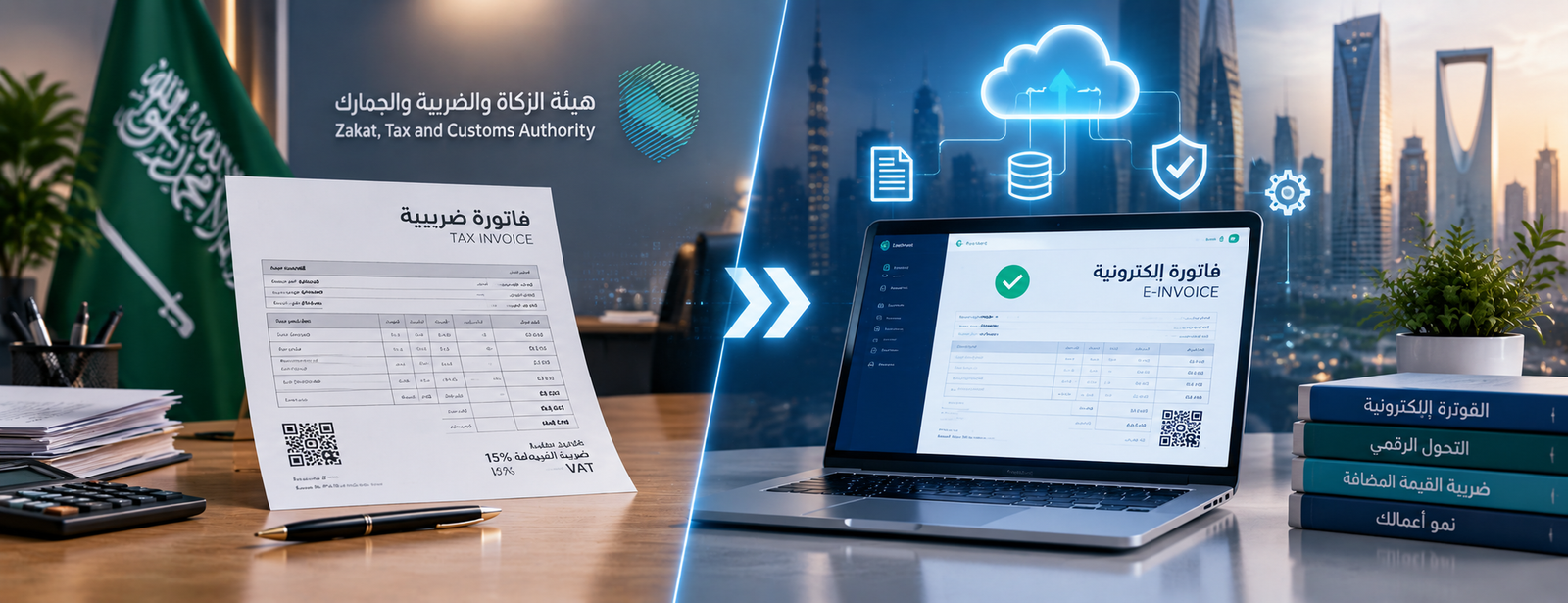
The Difference Between Tax Invoices and Electronic Invoices in Saudi Arabia
Tax invoices and electronic invoices are frequently confused. Some business owners believe they are two separate types of invoices, while others assume that any invoice containing value-added tax automatically becomes an electronic invoice.
However, the difference between a tax invoice and an electronic invoice is simpler and more important than that: a tax invoice describes the type of document and its tax content, while an electronic invoice describes how the invoice is issued, stored, and processed electronically. Therefore, the same tax invoice can also be an electronic invoice when it is created through an electronic system that meets the requirements.
The Zakat, Tax and Customs Authority explains that an electronic invoice is an invoice issued and stored in a structured electronic format, and that the e-invoicing system includes two types of tax invoices: the tax invoice and the simplified tax invoice.
In this guide, you will learn the practical differences between the two terms, when to use each invoice, their required elements, their relationship with e-invoicing and value-added tax, and how the right accounting system helps manage the process more accurately.
What Is a Tax Invoice?
A tax invoice is a document used to record the supply of a product or service. It includes the commercial and tax information required to substantiate the transaction and the value-added tax due on it.
A tax invoice is generally issued for business-to-business (B2B) transactions and contains all the required tax-invoice elements. The Zakat, Tax and Customs Authority explains this use directly in its official definition.
A tax invoice may include information such as:
- Supplier name.
- Supplier address.
- Tax identification number.
- Required buyer information.
- Invoice number.
- Issue date.
- Supply date, if different.
- Description of the products or services.
- Quantities.
- Unit price.
- Discounts.
- Taxable amount.
- Value-added tax rate.
- Tax amount.
- Final total.
The importance of a tax invoice is not limited to showing the tax amount. It also forms part of the establishment's accounting cycle, as it can be used to record sales, the customer's account, output tax, payments, and the transaction's connection to inventory.
For more details about the requirements, elements, and issuance method, see the guide Tax Invoices in Saudi Arabia.
What Is an Electronic Invoice?
An electronic invoice is an invoice issued and stored in a structured electronic format through an electronic system. It contains the tax-invoice requirements applicable to the type of transaction.
A paper invoice that has been photographed or scanned does not become an electronic invoice merely because it is stored on a computer. Creating a document manually and then converting it into an image or digital file is also insufficient; the invoice must originate from a structured electronic solution.
The e-invoicing system aims to transform the issuance of invoices and credit and debit notes from paper-based procedures into a structured electronic process that enables data to be processed and exchanged between the seller, buyer, and connected systems.
The e-invoicing process includes:
- Creating the invoice within the system.
- Entering customer information.
- Adding products or services.
- Calculating the tax.
- Generating the required technical data.
- Issuing the invoice.
- Integrating with the Fatoora Platform when Phase Two applies.
- Storing the invoice electronically.
- Processing returns through credit and debit notes.
- Maintaining a record of transactions.
You can learn more about the system through the guide Electronic Invoice.
The Difference Between a Tax Invoice and an Electronic Invoice
The difference between a tax invoice and an electronic invoice is that the former describes the nature of the invoice and its tax content, while the latter describes the electronic method used to create, store, and process the invoice.
Therefore, the two terms are not mutually exclusive.
An invoice can be:
A tax invoice and an electronic invoice at the same time.
This is currently the usual situation for establishments subject to e-invoicing requirements in Saudi Arabia, where the tax invoice is issued through a compliant electronic system.
| Comparison criterion | Tax invoice | Electronic Invoice |
|---|---|---|
| Concept | A type of tax document | A method for issuing, storing, and processing the invoice |
| Primary purpose | Documenting the supply and tax | Digitizing the invoicing process |
| Focus | Tax and commercial content | System, format, and electronic exchange |
| Use | Usually B2B transactions | Includes B2B and B2C |
| Issuance method | Currently issued through an electronic system when subject to the regulations | Must be issued electronically |
| Value-added tax | A core element of a taxable transaction | Processed according to the invoice type |
| Types | Tax invoice and simplified tax invoice | Includes both types when issued electronically |
| Related documents | Credit or debit note | Notes are issued electronically |
| Fatoora Platform | Falls within e-invoicing | Integration occurs according to the applicable phase |
| Relationship with accounting | Records sales and tax | Connects invoicing to the electronic system |
A common but incorrect question is: Should I use a tax invoice or an electronic invoice?
In many cases, the answer is not a choice between the two. You may need to issue an electronic tax invoice that combines the tax document type with the electronic issuance method.
Ready to Try the System?
Start your free trial or speak with the sales team for help choosing the right solution.
Is a Tax Invoice the Same as an Electronic Invoice?
They are not the same by definition, but both descriptions can apply to the same document.
To simplify the concept:
- Tax = What type of data and obligations does the invoice contain?
- Electronic = How was the invoice created, stored, and processed?
The Zakat, Tax and Customs Authority confirms that an electronic invoice contains the tax-invoice requirements and then distinguishes within the system between a tax invoice and a simplified tax invoice.
What Is an Electronic Tax Invoice?
An electronic tax invoice is a tax invoice that contains the required tax information and is created, stored, and processed through an electronic invoicing system.
It represents the point where the two concepts meet.
For example, when a software company sells a service to another company registered for value-added tax, the system can generate:
- Supplier information.
- Buyer information.
- Tax identification number.
- Service description.
- Supply value.
- Value-added tax.
- Total.
- Required technical data.
The document is then issued through the electronic system and processed according to the requirements applicable to the establishment.
In this case, the invoice is:
Tax because it documents the transaction and tax.
And Electronic because it was created and processed through an electronic system.
What Is the Difference Between a Tax Invoice and a Simplified Tax Invoice?
This comparison should not be confused with the difference between a tax invoice and an electronic invoice.
The tax invoice and simplified tax invoice are two types within the electronic tax-invoicing system.
ZATCA explains that a tax invoice is generally issued from one establishment to another in a B2B transaction, while a simplified tax invoice is generally issued from an establishment to an individual consumer in a B2C transaction.
| Comparison aspect | Tax invoice | Simplified tax invoice |
|---|---|---|
| Typical use | B2B | B2C |
| Buyer | Usually a company or establishment | Usually an individual consumer |
| Level of detail | More detailed | Simpler |
| Buyer information | Required in greater detail | Less detailed |
| Common use | Business-to-business supplies | Stores, restaurants, and retail businesses |
| Electronic invoicing | Yes | Yes |
| Integration in Phase Two | Subject to clearance | Subject to reporting |
The Zakat, Tax and Customs Authority officially presents the tax invoice and simplified tax invoice as the two main types within the e-invoicing system.
When Do You Use a Tax Invoice?
A tax invoice is generally used when the supply takes place between two establishments, particularly when the buyer needs to record the transaction and tax in its accounting records.
Example:
A distribution company sells equipment worth SAR 20,000 to another company.
In this case, the buyer needs a document showing:
- Supplier name.
- The supplier's tax identification number.
- Buyer information.
- Product details.
- Amount before tax.
- Value-added tax amount.
- Total.
It is important for the customer information to be correct because the invoice becomes part of the accounting and tax records of both parties.
When Do You Use a Simplified Tax Invoice?
A simplified tax invoice is generally used for direct sales to consumers, such as:
- Restaurants.
- Cafés.
- Supermarkets.
- Clothing stores.
- Pharmacies.
- Retail stores.
- Businesses that operate through points of sale.
ZATCA explains that this type is generally issued from an establishment to an individual and contains the main elements required for simplified invoices.
For this reason, businesses with a high volume of daily sales need a point-of-sale system connected to accounting and e-invoicing instead of recording every invoice manually.
Restaurants and cafés can use an accounting system for restaurants and cafés that connects orders, points of sale, accounts, and inventory to e-invoicing. In addition, the accounting system from AamalSoft complies with Fatoora Platform requirements and supports value-added tax.
How Is Value-Added Tax Related to a Tax Invoice?
A tax invoice records the supply value and the associated value-added tax, while invoice data is later used in the establishment's tax records and reports.
Value-added tax is an indirect tax applied to products and services, subject to exceptions and different classifications based on the type of supply.
Therefore, the accounting system must be able to:
- Determine the tax classification of an item.
- Calculate the tax.
- Handle tax-inclusive and tax-exclusive prices.
- Apply discounts correctly.
- Record output tax.
- Record input tax.
- Manage returns.
- Prepare tax reports.
To understand how tax is calculated, the registration thresholds, and tax returns, see the guide Value-Added Tax in Saudi Arabia.
What Is the Difference Between an Electronic Invoice and a Paper Invoice?
An electronic invoice is created and stored through a structured electronic system, while a paper invoice depends on creating and processing the document in paper form.
The key differences include:
| Element | Electronic Invoice | Paper invoice |
|---|---|---|
| Creation | Electronic system | Manual or paper-based |
| Storage | Electronic | Paper files |
| Search | Fast within the system | Requires searching through the archive |
| Accounting integration | Direct in integrated systems | Requires data entry |
| Data sharing | Automated and structured | Manual |
| Saudi e-invoicing | Meets the requirements when a compliant system is used | Does not meet the system requirements |
Phase One of e-invoicing in Saudi Arabia began on December 4, 2021, requiring covered taxpayers to issue and store invoices through a compliant electronic system.
Is a PDF File Considered an Electronic Invoice?
Having an invoice in PDF format alone is not enough for it to qualify as a compliant electronic invoice.
What matters is how the invoice was created and whether it was issued through a compliant accounting system containing the required elements.
An invoice prepared manually and then photographed or scanned is not considered an electronic invoice under ZATCA's definition.
The integration phase also introduces additional technical requirements for the format and data generated by the system. Therefore, the invoicing system itself must be evaluated rather than only the appearance of the file sent to the customer.
How Is Phase Two Related to the Difference Between Tax and Electronic Invoices?
Phase Two makes the relationship between the two concepts clearer because it connects tax invoices to an electronic system integrated with the Fatoora Platform.
Phase Two, also known as the Integration Phase, began gradually on January 1, 2023. During this phase, the targeted taxpayers' e-invoicing solutions must integrate with the systems of the Zakat, Tax and Customs Authority and issue invoices in the required format.
At this stage, the process is no longer limited to creating an invoice that contains tax. It also includes:
- Generating the required data.
- Issuing the invoice electronically.
- Configuring the invoice-generation unit.
- Integrating with the Fatoora Platform.
- Sending the document data.
- Receiving the processing status.
- Storing the document and response.
You can learn about the detailed requirements of this phase through the guide Phase Two of Electronic Invoicing.
A Practical Example Explaining the Difference Between a Tax Invoice and an Electronic Invoice
Suppose Company A sells equipment to Company B for SAR 10,000 before value-added tax.
If the transaction is subject to a 15% rate:
- Supply value: SAR 10,000.
- Value-added tax: SAR 1,500.
- Total: SAR 11,500.
From the tax-invoice perspective:
The document must display the transaction, supplier, buyer, supply value, tax, and total details.
From the electronic-invoice perspective:
This information must be issued through an electronic system and stored and processed in the required manner, with Phase Two procedures implemented when they apply to the establishment.
Therefore, the same document can be described as:
An electronic tax invoice totaling SAR 11,500.
This example explains why the two terms should not be compared as alternatives to each other.
Ready to Try the System?
Start your free trial or speak with the sales team for help choosing the right solution.
The Accounting Difference Between a Tax Invoice and an Electronic Invoice
From an accounting perspective, a tax invoice is the document that records the transaction, while e-invoicing is the technical environment that creates the document and connects it to the rest of the workflow.
When an invoice is issued through an integrated accounting system, the following can happen automatically:
- Record the sales value.
- Record output tax.
- Update the customer balance.
- Record the payment method.
- Deduct the products from inventory.
- Calculate the cost of sales.
- Create the accounting entry.
- Update sales reports.
- Update tax reports.
- Store the invoice.
This is one of the main reasons not to rely on a simple invoice-printing program when a company's workflow is more complex.
Common Errors Caused by Confusing Tax and Electronic Invoices
Assuming That Adding 15% Makes an Invoice Electronic
Adding tax means that the document contains tax treatment, but this alone does not satisfy the e-invoicing requirements.
Treating an Electronic Invoice as an Alternative Type to a Tax Invoice
The correct distinction is that “electronic” describes the issuance method, while “tax” describes the invoice type.
Using Word or Excel to Issue Invoices
A document created manually in a word processor or spreadsheet does not, by itself, satisfy the requirements of an electronic invoicing system. Phase One requires covered taxpayers to use a compliant electronic solution.
Sending an Image of a Paper Invoice
Scanning a paper invoice and converting it into an image does not make it an electronic invoice according to the Authority's definition.
Confusing a Tax Invoice with a Simplified Tax Invoice
The invoice type depends on the nature of the transaction and the buyer. The same type should not automatically be issued to every customer.
Editing the Original Invoice After Issuance
Credit and debit notes are used to process subsequent changes in accordance with the system requirements instead of altering the invoice record in an unstructured manner. These notes fall within the official e-invoicing concept.
How Do I Know Whether an Electronic Invoice Is Valid?
An invoice's validity can be evaluated by reviewing several aspects:
- It was issued through an electronic system.
- The invoice type is appropriate for the transaction.
- The supplier information is correct.
- The tax identification number is correct.
- Buyer information is included when required.
- The numbers and dates are correct.
- The products and services are clearly stated.
- The tax is calculated correctly.
- A QR code is included when required.
- The invoice cannot be altered in an uncontrolled manner.
- Fatoora Platform procedures were completed when the establishment entered Phase Two.
The Zakat, Tax and Customs Authority provides an electronic-invoice verification service through QR-code scanning.
Why Do You Need an Accounting System That Supports Both Invoice Types?
Because the invoicing process does not end when the document is printed.
The system must be able to manage:
- Tax invoices.
- Simplified tax invoices.
- Credit notes.
- Debit notes.
- Value-added tax.
- Customer accounts.
- Inventory.
- Points of sale.
- Branches.
- Accounting entries.
- Reports.
It must also support the e-invoicing requirements applicable to the establishment.
The Zakat, Tax and Customs Authority explains that a taxpayer may obtain an invoicing system from any provider, provided that the system used complies with e-invoicing requirements. A provider's presence on a particular list is not the only factor determining compliance.
Therefore, before selecting a program, review the guide Accounting Software Compliant with Electronic Invoicing.
How Does DigitalPro Help Manage Tax and Electronic Invoices?
DigitalPro connects invoices with accounts, sales, inventory, points of sale, and reports, so invoicing does not operate as a process separate from the rest of the system.
AamalSoft presents DigitalPro as a solution combining accounting, points of sale, and e-invoicing, with readiness to comply with Phase Two according to the information published on the website.
An integrated workflow can help with:
- Creating an invoice from a sale.
- Calculating value-added tax.
- Update the customer balance.
- Recording payments.
- Manage returns.
- Updating inventory.
- Generating sales reports.
- Creating an accounting trail for the transaction.
- Connecting invoicing to points of sale.
- Managing branches.
The accounting and point-of-sale system enables establishments that combine sales, inventory, and accounting to manage these processes in an integrated manner.
Companies that need to access their accounts from multiple locations can obtain a cloud accounting system .
During the demonstration, it is better not to view only one successful invoice. Test:
- A tax invoice issued to a company.
- A simplified tax invoice issued to an individual.
- A partial return.
- A credit note.
- A discount on the invoice.
- A credit invoice.
- More than one payment method.
- The invoice's effect on inventory.
- The invoice's accounting entry.
- The tax report.
Explore AamalSoft solutions, then book a demonstration to test tax and electronic invoices using transactions similar to your business before adopting the system.
Frequently Asked Questions About the Difference Between Tax and Electronic Invoices
What Is the Difference Between a Tax Invoice and an Electronic Invoice in Brief?
A tax invoice describes the document type and the tax information it contains, while an electronic invoice describes how the document is created, stored, and processed electronically.
Therefore, a tax invoice can also be electronic at the same time.
Is Every Electronic Invoice Considered a Tax Invoice?
E-invoicing under the ZATCA system covers both types of tax invoices: the tax invoice and the simplified tax invoice. The document type is determined by the nature of the transaction.
Is Every Tax Invoice Electronic?
For taxpayers subject to the e-invoicing regulations in Saudi Arabia, the generation and storage phase requires invoices to be issued electronically through a compliant invoicing system.
Is a Tax Invoice the Same as a Simplified Invoice?
No. A tax invoice is generally used for B2B transactions, while a simplified tax invoice is generally used for sales to B2C consumers.
Is a PDF Invoice Considered an Electronic Invoice?
The PDF format alone is not the criterion. The invoice must have been created and stored through an electronic solution that meets the requirements. A scanned paper invoice is not considered an electronic invoice.
Must an Electronic Invoice Include Tax?
This depends on the nature of the supply and its tax status. An electronic invoice describes the issuance method, while tax regulations determine how the supply and the applicable tax amount are treated.
When Do I Use a Tax Invoice?
It is generally used for a sale from one establishment to another and contains all the required tax-invoice elements.
When Do I Use a Simplified Tax Invoice?
It is generally used for a sale from an establishment to an individual consumer, such as transactions at restaurants, retail stores, and cafés.
How Is an Electronic Invoice Related to the Fatoora Platform?
During Phase Two, targeted establishments must connect their electronic invoicing systems to the Zakat, Tax and Customs Authority's Fatoora Platform and issue documents in the required format.
Can Excel Be Used to Issue Electronic Invoices?
Using spreadsheet software is not sufficient as the electronic invoicing system required for establishments subject to the system. E-invoicing requires a compliant electronic solution.
Which Program Is Suitable for Issuing Electronic Tax Invoices?
The suitable program supports value-added tax, tax and simplified invoices, credit and debit notes, e-invoicing, and the required integration, while also connecting invoices to accounts, inventory, and reports.
Conclusion
The difference between a tax invoice and an electronic invoice is that a tax invoice defines the nature of the document and its tax content, while an electronic invoice defines how the document is created, stored, and processed electronically.
Therefore, the correct question is not, “Which one should I use?” but rather, “What type of tax invoice does the transaction require, and how will I issue it electronically and correctly?”
An establishment selling to a company may need an electronic tax invoice, while a retail store or restaurant generally needs an electronic simplified tax invoice. In both cases, invoicing should be connected to tax, accounting, inventory, and points of sale whenever the nature of the business requires it.
Using an integrated accounting system reduces repeated data entry and discrepancies between invoice and accounting figures. Therefore, you can request a free trial of DigitalPro and test issuing both types and connecting them to inventory, accounts, and reports before making an operational decision.
Start Managing Your Business with Complete Flexibility
Try AamalSoft free of charge. Start issuing ZATCA-compliant electronic invoices within minutes.
- Free trial with no credit card
- 24-hour technical support
- ZATCA compliant