
Your Comprehensive Guide to Understanding Closing Accounts
Imagine that you are driving a car on a long journey through different cities. On this trip, you need to look at the dashboard from time to time to see how much fuel you've consumed, how far away you're from your destination, whether the engine is running efficiently or if there's a problem that needs to be fixed. In the business world, whether you're running a small store in your neighborhood or a large company, closing accounts are your dashboard. Closing accounts are not just dry numbers that accountants collect at the end of the year, they are the full story of what happened to your owner and your effort over a specific period of time. In this article, we'll take you on a simple journey to explain what these calculations are, and how to understand them even if you're not an accounting major.
What are Closing Accounts?
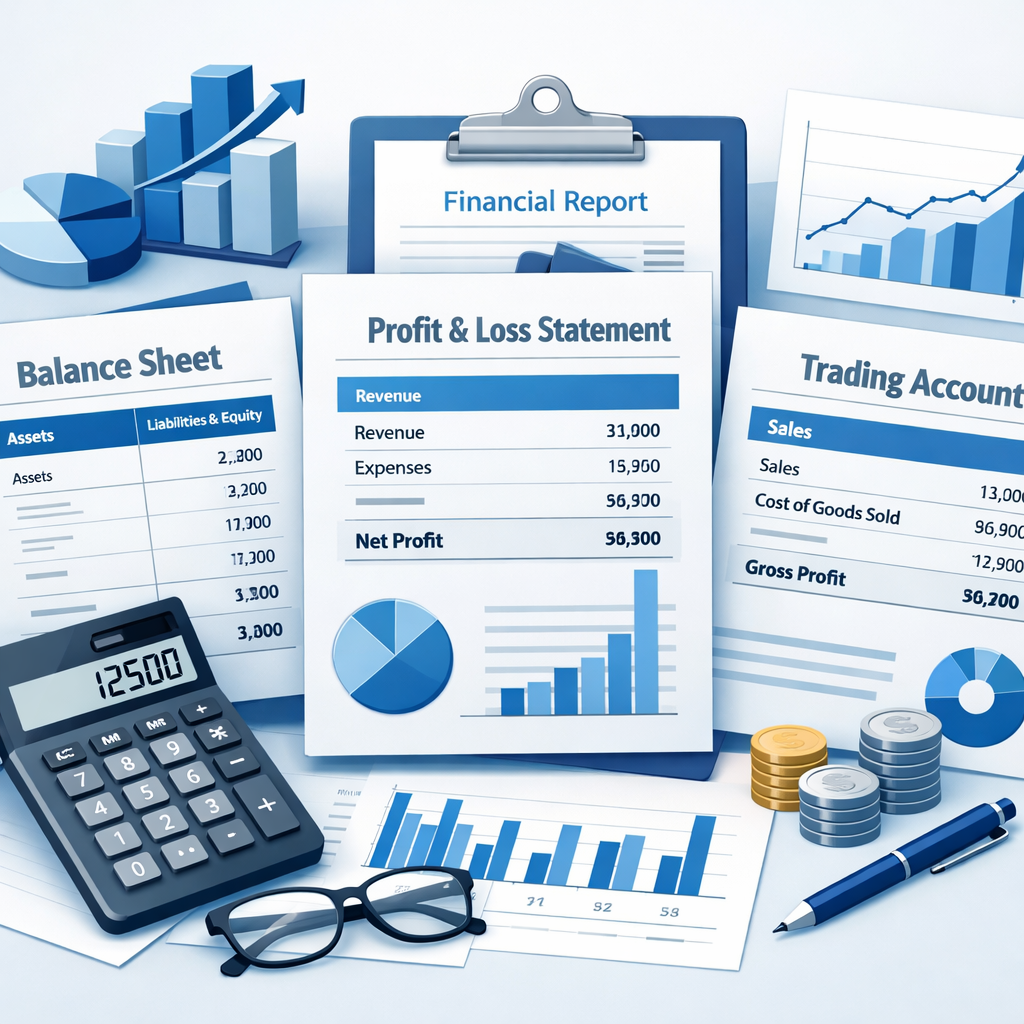
Simply put, final accounts are final reports that are prepared at the end of the financial year and are typically 12 months. These reports aim to summarize all the financial transactions carried out by the entity during the year, and provide a clear picture of two key results:
-
Activity Result: Did We Make a Profit or a Loss?
-
Financial Center: What assets do we have and what obligations do we have at a given moment?
Think of it as a certificate of appreciation for the work. The student gets his certificate at the end of the year to know his level, and the trader prepares his final calculations to know the fruit of his hard work.
The three pillars of the final accounts
The final accounts are mainly composed of three main parts, each of which tells us a different side of the story:
First of all, the Trading Account: The language of buying
and selling This account is the first step, and it is intended for purely trading activities. His goal is to find out the total profit or total loss. Imagine you buy shirts for 50 riyals and sell them for 80 riyals. The difference here is 30 riyals is your total profit from the sale itself, before we calculate the rent of the shop or the salaries of the employees.
What do we find in a trading account?
-
First Term Inventory: The goods that you had in the warehouse on the first day of the year.
-
Purchases: All goods purchased during the year for the purpose of sale.
-
Sales: All the money that came into you from the sale of goods.
-
Last Term Inventory: Goods that have not been sold and remain in warehouse on the last day of the year.
-
Direct Expenses: These are expenses that would otherwise not have reached you, such as shipping or customs expenses.
The result: If your sales and remaining inventory are greater than your old purchases and inventory, you've made a total profit.
Profit and Loss Account: The Whole Picture
Now that we know our profit from buying and selling, we now need to know the real profit that will be put in your pocket. This is where the profit and loss calculation comes in. This account takes the total profit from the trading account, and then subtracts all other expenses that you run your business with but are not directly related to the goods.
Examples of these expenses:
-
Rent an office or shop.
-
Salaries of employees and administrators.
-
Electricity, water, and internet bills.
-
Advertising and marketing expenses.
-
Depreciation is the gradual decrease in the value of your cars or appliances due to use.
The result: after subtracting all these expenses from the total profit, we arrive at the net profit. This is the most important number, because it represents the real increase in your wealth.
Balance Sheet : A Photograph of Your Wealth
While the trading account and the profit and loss account tell us what happened during the year, the balance sheet tells us where we are at the end of the year. It is a photograph of what the company owns and what it has.
The budget is based on a very simple formula:
Assets What you own = Liabilities + Equity Your capital and profits
-
Assets: These include cash in the bank, goods in the warehouse, cars, real estate, and even debts you have with customers.
-
Liabilities: Includes bank loans, and debts you owe to suppliers.
-
Equity: The net worth of your business, which is what you have left over if you sell all of your assets and pay off all your debts.
Why are closing accounts vital to your business?
Some may ask: I know I sell well, so why do I need all these complications? Here's why:
-
Real Performance Evaluation
You may sell goods for one million riyals, but if your expenses are one million and one hundred thousand, you lose despite the many sales. The closing accounts reveal this bitter truth to you early on so that you can adjust your course. -
If
you ever want to expand your business and go to the bank to apply for a loan, or look for an investor to share with you, the first thing they will ask for is the final accounts of the past years. No one puts their money into a business that doesn't have clear financial reports. -
Legal and Tax Compliance
In most countries, government entities such as the Zakat, Tax and Customs Authority require accurate financial reports to account for zakat or taxes due. Having regulated closing accounts protects you from fines and legal problems. -
Planning ahead
When you see last year's numbers, you can decide: next year I'll try to reduce electricity expenses or increase my marketing budget because I've made good sales. Numbers are the best advisor for decision-making.
To understand the final accounts, you need to know the meaning of some of the words that accountants repeat:
-
Depreciation: Imagine that you bought a car for the company for 100 thousand riyals. After a year, it won't be worth 100,000. We consider this lack of value as an expense and distribute it over the years of use of the car.
-
Accounts Receivable: These are customers who have purchased from you and have not yet paid. They are your asset because the money will come back to you later.
-
Accounts Payable: These are suppliers from whom you have purchased goods and have not yet been paid. They are a commitment to you.
-
Working Capital: The difference between your nearby assets such as cash and goods and your nearby debt. It is the fuel that drives your business every day.
How are these accounts set up? Quick steps
The process starts on the first day of the year and ends on the last day:
-
Daily Registration: Record every bill of sale, purchase, or expense as soon as it occurs.
-
Posting: Aggregating these operations into separate accounts for electricity, sales account, etc.
-
Revision Balance: Ensuring that all numbers are balanced inside is equal to outside mathematically.
-
Adjustments: Adding expenses related to the year but not yet paid, or excluding expenses that were paid in advance for the next year.
-
Output of reports: This is the final stage in which the final accounts that we talked about appear.
Analyze the results
After the final calculations are ready in your hands, don't just look at the final profit figure. Look deeply:
-
If the total profit is high but the net profit is very small: it means that you are good at buying and selling, but your administrative expenses are rents, salaries, and waste that eat up your profits. You need to squeeze expenses.
-
If sales are increasing but cash in the bank is running low: This could mean that you are selling too much and your customers are not paying quickly, which could cause you a liquidity crisis.
-
If your debt to suppliers is increasing dramatically: this is an alarm bell that you may soon be unable to repay.
Tips for non-specialists for dealing with closing accounts
-
Don't be afraid of numbers: it's just a mirror of your business. The more you look at it, the more familiar it becomes.
-
Use technology: Modern accounting software like Entries does most of the hard work and issues these reports to you at the click of a button.
-
Ask your accountant: Don't be shy about asking him, what does this number mean?. Its job is to help you understand and not just collect numbers.
-
Compare to previous years: The number alone doesn't mean much, but comparing it to last year tells you whether you're moving forward or falling behind.
Ultimately, concluding accounts are not an end in themselves, but a means. It is the tool that gives you confidence in your decisions, clarity of vision, and honesty with yourself and your partners. Investing in understanding and preparing accurate closing accounts is an investment in the sustainability of your business. Always remember that what can't be measured, can't be managed. Make your numbers an ally in your journey to success, and don't leave them to be an unpleasant surprise at the end of the road. Whether you're running a micro-business or aspire to build a business empire, start by organizing your records today, and make sure your closing accounts are a true mirror of your ambition and hard work.