 English
 العربية

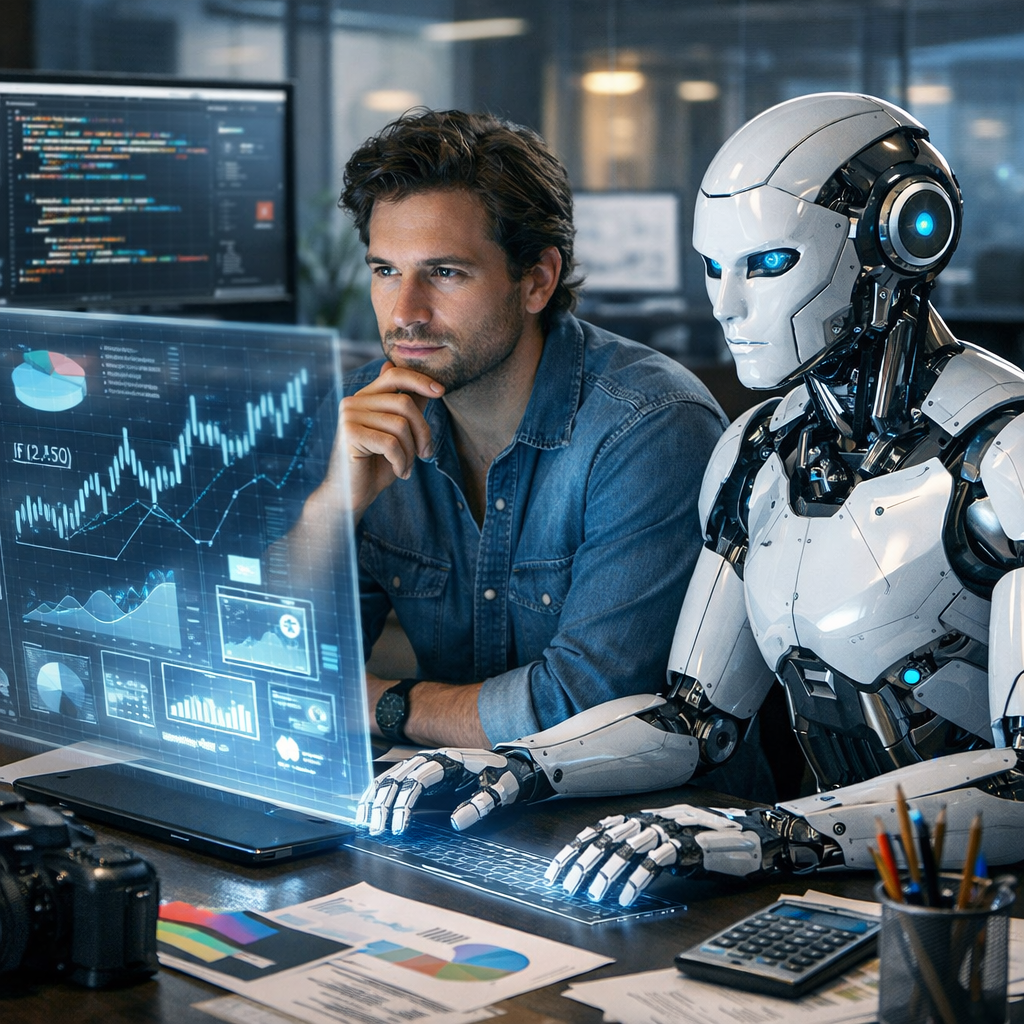
Artificial Intelligence and the Labor Market.
Imagine waking up in the morning to find a new co-worker who doesn't sleep, doesn't get sick, doesn't ask for a raise, and can even get your hours done in a matter of seconds. This fellow is not a human, but an artificial intelligence. Recently, the term has become ubiquitous, from newscasts to café sessions, and with it growing concerns: Will AI take my place?
The fact that we are living through one of the greatest transformations in human history today. But before we give in to worry, we need to understand the nature of this change. AI is not just a robot to replace a human, it is a powerful tool that is reshaping the way we work. In this article, we'll sail together to understand what's really happening in the job market, who are the victims, who are the winners, and how you can protect your career and even thrive in this new era.
In the past few years, we've seen massive leaps, especially with the advent of generative AI like ChatGPT. These tools are no longer just moving robotic arms in factories, but are writing, drawing, programming, and analyzing. This development made office workers, creatives, and programmers feel for the first time that technology has knocked on the doors of their offices, not just traditional factory doors.
Back to the past:
In order to understand the future, sometimes we have to look back. This isn't the first time humans have been intimidated by technology. When the steam engine appeared in the 18th century, workers feared that their manual jobs would disappear. A movement known as the Luddites emerged, workers who smashed textile machines out of fear for their livelihoods.
When electricity, then computers, then the Internet appeared, the same fears were repeated. Each time, some jobs were already disappearing, but in return, new jobs were appearing that no one had imagined. Did anyone in 1900 imagine a job as an app programmer or a digital marketing expert? Artificial intelligence is the Fourth Industrial Revolution, and it follows the same historical pattern: it eliminates old tasks, creates entirely new opportunities, and ultimately raises the overall standard of living.
History teaches us that technology doesn't kill jobs, it kills routine tasks. The farmer who used to plough the land with his own hands now drives a sophisticated tractor, and the writer who used to use a feather is now using a word processor. Artificial intelligence is simply the new tractor of the modern office worker.
What is Artificial Intelligence Simply (AI)?
Beyond the technical complexities, we can define AI as the ability of a machine to simulate some of the capabilities of the human brain, such as learning from data, recognizing patterns, and making decisions based on previous information. He's not as intelligent as we humans are; he doesn't have feelings, he doesn't understand the deep social context, he doesn't have intuition.
You can liken AI to a super-intelligent predictor. When you ask him to write a letter, he doesn't think about meaning like we do, but instead anticipates the next word based on the millions of texts he's read before. It is simply a super-fast data processing machine, which can read an entire library in a second and summarize it for you. This distinction is very important, because it shows us the limits of the machine: it is good at information, but it lacks wisdom and vision.
Who is most vulnerable?
We must be honest and realistic: there are jobs that will be greatly affected, and may disappear in their current form. AI excels at routine, repetitive, and data-driven tasks. Here are some examples:
-
Data entry and simple administrative tasks: Any work that involves moving numbers or organizing files routinely, AI can be done with 100% accuracy and lightning speed. These functions are on their way to full automation.
-
Basic customer service: Automated systems are now able to solve 80% of common problems without human intervention, reducing the need for armies of traditional call center staff.
-
Translation and proofreading: Literal translation or correction of spelling mistakes is now an AI task par excellence. A translator who translates word for word is most at risk, while a literary translator who conveys spirit and culture will still be in demand.
-
Simple accounting and preliminary financial analysis: AI can review thousands of invoices and detect errors or fraud in seconds, a task that would have taken accountants many weeks.
-
Programming for beginners: New tools can write simple code based on the user's request. This means that a programmer who is content to copy and paste ready-made code will find himself in a bind, while a programmer who designs complex systems will find artificial intelligence a powerful helper.
But wait, that doesn't mean that the owners of these professions will stay at home. It means that the nature of their work will change. Instead of entering data, the employee's role will be to review and verify what the AI has produced, and make decisions based on that data.
Where do humans excel?
There are vast areas where AI is still a child lurking in front of the human mind. These are the areas we need to focus on to ensure our continuity:
-
Emotional intelligence and empathy: Can you imagine a robot comforting a patient in a hospital, or understanding the feelings of a child with a problem at school? Professions that rely on deep human connection, such as nursing, teaching, psychiatry, and social work, are very safe. Humans always need a human touch in their moments of weakness or learning.
-
True creativity and innovation: AI can mimic art or writing based on what it has learned, but it cannot create a revolutionary idea out of nowhere or express a unique human experience stemming from suffering or joy. The innovators, designers, and strategic thinkers who break the rules will always stay ahead of the curve.
-
Solve complex problems in unexpected environments: AI succeeds in structured environments. But what about a plumber trying to fix a sudden malfunction in an old house with strange extensions, or a construction engineer dealing with changing weather conditions and difficult terrain?
-
Leadership and ethical decision-making: Major decisions that concern the future of companies or countries require wisdom, an understanding of values and ethics, and a sense of responsibility. Artificial intelligence cannot take responsibility for a wrong decision, so humans will still have the final say in fateful decisions.
New Jobs:
Just as the internet created the job of social media manager, AI will create entirely new jobs that we never dreamed of. We are already starting to see the emergence of professions such as:
-
Prompt Engineer: A person who masters the language of dialogue with artificial intelligence to get the best possible results.
-
AI Ethics Checker: His job is to ensure that these systems do not discriminate and that they adhere to laws and human values.
-
AI Systems Trainers: Humans who provide the machine with the right data and teach it how to understand our language, behavior, and emotions more accurately.
-
Human-Machine Collaboration Specialists: Experts whose job is to design work environments that ensure the best integration between the human employee and AI tools.
Survival Kit
If you're asking, "What do I do now?", the answer is to develop your skills. It's no longer enough to just be proficient in your specialty, but you should have a life jacket that contains the following skills:
-
Digital literacy and artificial intelligence: You don't need to become a programmer, but you should know how to use AI tools in your field. An employee who uses AI will replace an employee who doesn't.
-
Critical and analytical thinking: Since AI can make mistakes or provide misinformation, your ability to examine information, verify its authenticity, and analyze it in depth will be more valuable than ever.
-
Flexibility and continuous learning: The world is changing at an astonishing speed. The ability to relearn a new skill every year, and let go of old convictions, has become a necessity for survival in the job market.
-
Social skills and emotional intelligence: Your ability to negotiate, persuade, work in a team, and build trust-based human relationships is hard currency that a machine can't forge or replace.
Practical tips for every employee:
Don't wait for AI to knock on your office, take the first step:
-
Don't fight technology, believe it: Look for AI tools that can help you in your current business. If you're an accountant, learn how to use AI to analyze big data.
-
Focus on added value: Always ask yourself: What am I doing that AI can't do? Is it building a relationship with the customer? Is it thinking of solutions outside the box?
-
Invest in yourself: Set aside just one hour each week to read about what's new in your industry and how it relates to technology. There are thousands of free online courses that explain the basics of AI in a simple style.
-
Try the tools for yourself: Don't just hear about ChatGPT, open these sites and try asking them for simple tasks. You will discover for yourself its strengths and weaknesses.
Ultimately, AI is not the end of the professional world, but rather the beginning of a new chapter in human development. Jobs will not disappear in the literal sense, but will evolve and transform. The human being to be replaced by artificial intelligence is not the hardworking or creative employee, but the employee who rejects change and sticks to the old ways in a new world.
The future belongs to those who combine the power of the machine with the human spirit. AI will take over boring, exhausting, and dangerous tasks, leaving us humans with space to create, think, communicate, and build a more humane world.
Instead of anxiously asking if my job is in jeopardy, ask yourself passionately: How can I use AI to become a better and stronger version of my job? Always remember that machines have information, but only humans have wisdom and vision. The journey into the future has just begun, and the seat is available for you to be in the cockpit, not in the spectator seats.
Add New Comment