 English
 العربية

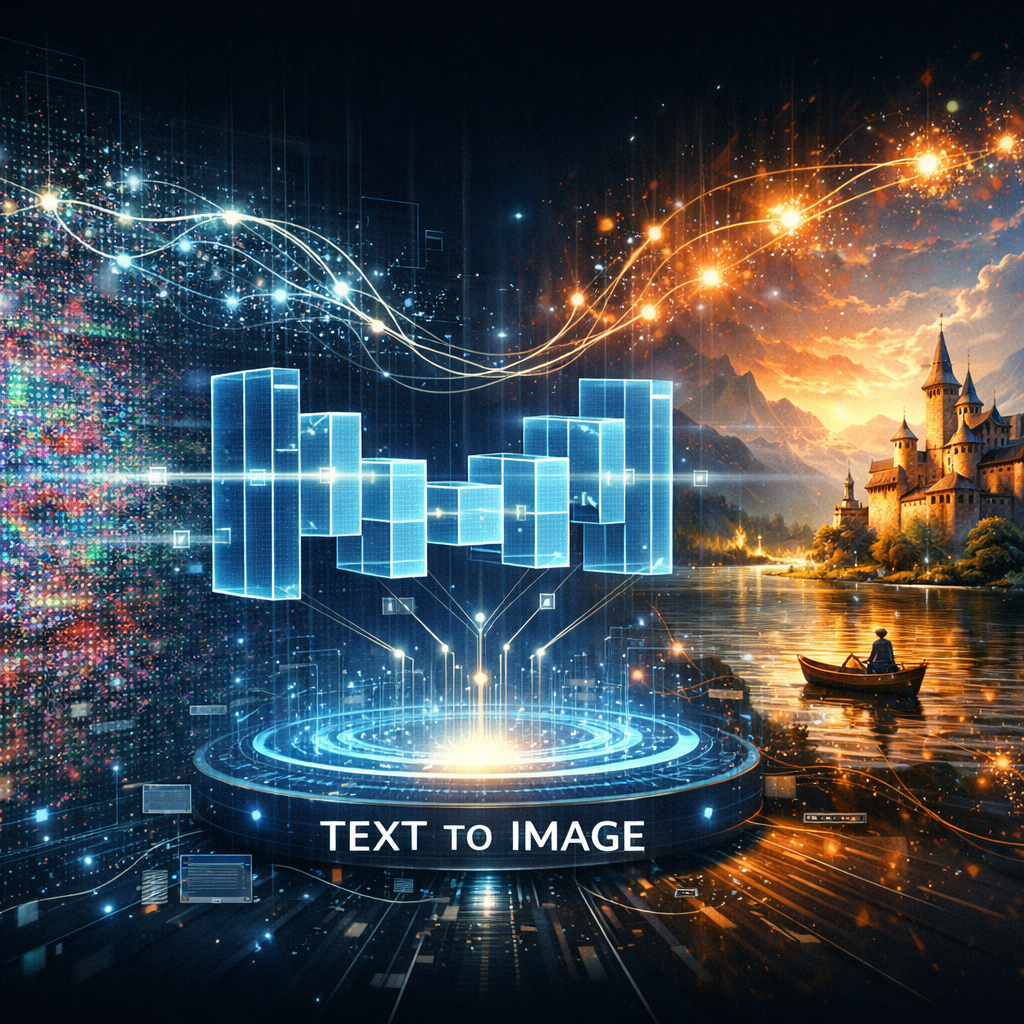
Diffusion Models:
Recently, the world has seen an amazing leap in the ability of machines to create, as anyone can write a sentence as simple as an astronaut riding a horse on Mars in the style of Van Gogh, and the computer will instantly produce a dazzling painting. This revolution in tools like Medjourney and Dall-E is the product of intelligent algorithms known as Diffusion Models. In this article, we'll explore this world in a simplified way to understand how the machine turns noise into art, and why this technology has changed the rules of the game.
What are propagation models?
To understand diffusion models, let's imagine a simple example from our daily lives. Imagine a marble statue that has been smashed into dust; the challenge is to rebuild it from that dust. Diffusion models do something similar; they are generative models designed to generate new data, images, sounds across two opposing concepts: noise addition and noise removal.
1. Frontal Process Adding noise or organized destruction
The process starts quite clearly, let's say a snapshot. The model adds very small amounts of Noise – random dots that resemble the noise of an old TV – to the picture gradually. At each step, the image becomes less and less clear, until we finally reach a stage where the cat's features disappear completely, leaving only a purely random and meaningless noise. The answer is that we want to teach the computer how to destroy so that it can later learn how to fix it.
2. Reverse Process Removing Hype or Generative Magic
This is where AI starts its real work. During the training phase, the model observes each step of the destruction, and learns how to anticipate how much noise has been added in each phase. Once it's mastered, we ask it to do the opposite: Here's this pile of random noise, can you demystify it a little bit to get closer to a real image? Over time, the features begin to emerge from the center of the fog, until the final image is complete. That's why we see images in programs like Midjorn that start as blurry color spots and then gradually become sharp and clear before our eyes.
Why did the diffusion models outperform their predecessors?
Before the advent of propagation models, there was a crowned king of the world of image generation known as innovative competition networks (GANs). These networks operated as a team of two people: one trying to fake the generator plate, and the other trying to detect the characteristic counterfeiting. Despite its success, this technique had major drawbacks:
-
Training difficulty: It was like a very sensitive scale; if the generator outweighed the special or vice versa, the entire system collapsed.
-
Lack of variety: She tended to produce very similar images and ignored a lot of possibilities.
This is where the propagation models came to offer the radical solution. Historically, attempts have been made with VAEs that were good at understanding the structure of data but whose images lacked clarity and blurred. Then the GANs networks came to deliver sharp but moody images and difficult to train. The propagation models combine the best of both worlds, offering impressive optical accuracy beyond GANs, and training stability that surpasses VAEs. Most importantly, she doesn't just try to mimic images, she understands the deep statistical distribution of data. This means that when she paints a tree, she doesn't put green spots like what she saw before, but she embraces the concept of a tree from scratch, giving her a tremendous capacity for innovation and diversity. It has transformed the generation process from a risky competitive battle into a quiet and structured learning and development journey, where every step of the hype is a thoughtful improvement towards the end goal.
How does AI understand what we're asking of it?
Some may ask: Well, a model learns to turn noise into an image, but how does he know that he should draw a cat and not a dog when I ask him to? As the model is trained, images are not randomly thrown into it, but each image is attached to an accurate text description (Metadata). Here, the model learns a unique visual language; he understands that the word sunset is always associated with the hues of orange and purple, and that the word reflection requires the repetition of the top patterns at the bottom of the image, as in water. Thanks to a revolutionary technology called CLIP, developed by OpenAI, the model now has an interpreter. This technique acts as a link that understands the contextual meaning; it not only knows that a dog is an animal, but it understands the difference between a running dog and a sleeping dog. When a user writes a Prompt, the guidance system whispers in the propagation model's ear during each step of the noise removal: make this spot look more like an astronaut's helmet, add some shine here to make it look like it's in space. This instantaneous and continuous interaction is what allows the model to transform a written sentence into a tangible visual reality with astonishing accuracy. This is where we get to the heart of the technical engine, which is called the U-Net. Imagine it as a smart magnifying glass that passes over the image at every stage. Its function is to search for and accurately identify noise to remove it. It's called U-Net because its structure resembles a U-letter, where it starts by compressing an image to understand its general context, such as: Where is the sky?This balance of overall vision and precision is what makes the end results seem so realistic.
Applications that go beyond just beautiful images
Although the popularity of diffusion models has been associated with artistic images, their potential extends to much wider areas than we can imagine:
-
Filmmaking and video
industry tools like OpenAI's Sora rely on similar principles to generate complete, realistic videos from just text. This will change the way films are made, as directors can create complex scenes or experiment with visual ideas at a fraction of the cost and speed of lightning. -
Medicine and drug discovery
This may sound strange, but the structure of proteins or chemical molecules can be thought of as a kind of three-dimensional image. Scientists are using diffusion models to generate new designs for proteins that didn't exist in nature, helping to create drugs to treat intractable diseases. -
These
models can take old blurry or low-resolution photos, consider them partial noise, and then reconstruct them in Super Resolution, bringing old memories or historical photos to life. -
Weather and climate forecasting
uses propagation models to create very accurate simulations of wind and cloud movement, helping meteorologists to make more accurate forecasts of extreme weather events.
Challenges and ethics
As with any revolutionary technology, diffusion models raise difficult and important questions:
-
Intellectual Property Rights and Technical Justice: This is the hottest issue right now. As these models feed on millions of images available online, owned by artists and photographers who have spent years developing their techniques, an ethical and legal question arises: Do AI companies have the right to use this human production without permission or compensation? Initiatives such as Nightshade have recently emerged that allow artists to digitally poison the data of their images to make them unlearnable by a machine, reflecting the scale of the conflict between human creativity and technological growth.
-
The Dilemma of Truth and Deepfakes: With diffusion models reaching the level of hyperrealism, it has become very difficult for the untrained eye to distinguish between a real and a generated image. This opens a wide door to the dangers of political disinformation, falsification of historical facts, and personal blackmail. We are now in dire need of non-forgivable Digital Watermarks to catch up with everything the machine produces to ensure transparency.
-
Data bias and stereotyping: AI is a mirror of what you've been trained on. If most of the images of doctors in the training data are of men, the model will always tend to generate images of male doctors, ignoring the diverse reality. Combating these biases requires a conscious effort from developers to ensure that these models are fair and representative of all human spectrums.
-
The Future of Creative Careers: The Concern About Human Substitution Is Real and Justified. But history teaches us that new tools often change the nature of work rather than eliminate it. Just as the camera did not kill the art of painting, but pushed it towards abstraction and modern schools, diffusion models may push human artists toward new levels of conceptual creativity, where idea and vision become more important than the skill of manual execution. Designers will learn how to become technical directors who guide the machine, rather than spending hours on tedious repetitive tasks.
Diffusion models are not just a fleeting technological trend, they are a redefinition of how we approach data and creativity. We have gone from a computer as a machine that executes commands, to a stage where it has become a partner capable of imagining and innovating in the midst of chaos. We are still in the Stone Age of this technology. The evolution is now extending to virtual reality to build digital worlds with audio descriptions. In the future, these models may design entire cities or create new building materials. The ability to generate solutions from the noise of possibilities is the force that will drive the next innovation. Ultimately, AI remains a mirror for us; it learns from our data, mimics our creativity, and the real secret is not in the algorithm itself, but in the human imagination that guides it and asks it the right questions. So, the next time you see a stunning AI-generated image, remember that it started as a mess of hype, and with a little science and a lot of imagination, it turned into art.
Add New Comment