
Reinforcement Learning
Imagine a toddler trying to learn to walk for the first time. No one gives him a manual of instructions explaining the angles of knee bending or how much force is needed to push the ground. Instead, the child starts trying; he stands up and falls, feels some pain and negative feedback, and then tries again to change his balance slightly, so he succeeds in taking one step and feels joy or sees his parents' encouragement give positive feedback. With the passage of time and many attempts, the child discovers the optimal policy to walk without falling. This simple landscape is at the core of what we in the AI world call Reinforcement Learning. It's a simulation of one of the most natural ways of learning in living beings: learning through trial and error, seeking reward and avoiding pain. In this article, we'll explore this exciting world in a simplified way, to understand how a machine can become intelligent not because we've been given information, but because it's lived an experience and learned from it.
Psychological Roots – From Pavlov's experiments to computer algorithms
Before reinforcement learning became a technical term, it was a well-established concept in behavioral psychology. In the early 20th century, scientists such as Ivan Pavlov and B.F. Skinner conducted famous experiments on animals. Skinner discovered that mice can learn to squeeze a particular lever if they get a reward food every time they do so. This principle, known as procedural conditionality, is the foundation on which reinforcement learning in computer science is built. The difference is that in a computer we use numbers as rewards. A reward is a numerical value that increases when the system approaches its goal. Instead of instincts, we use math and probability to help the machine choose the action that will lead to the largest sum of these numbers over time. This connection between psychology and computer science is what makes reinforcement learning unique, as it tries to simulate the will and pursuit of goals.
What is Simply Augmented Learning?
If traditional AI is like a student memorizing answers from a supervised learning textbook, reinforcement learning is like an explorer who is placed in an unknown forest and has to find a way out. Technically simplified, reinforcement learning is a branch of machine learning, where it aims to train a computer program we call an agent to make a series of decisions in a particular environment, with the aim of reaching the highest possible reward in the long run. The fundamental difference here is that we don't tell the machine the right move at every moment. In reinforcement learning, we give the machine a goal and allow it the freedom to experiment, then we reward it when it succeeds and punish it when it fails.
The Five Components: How Does This System Work?
To understand how reinforcement learning works, we must imagine a system of five basic elements that constantly interact with each other in a vicious circle that only ends with the goal being achieved:
-
The Agent: The protagonist or program that is trying to learn. Think of it as a video game player, a software trading on an exchange, or even an algorithm that controls the temperature of a data center.
-
The Environment: The world in which an agent lives and interacts. It could be a chessboard, city streets for a self-driving car, or even the human body in medical applications.
-
The State: This is the current state of the agent within the environment. In chess, the state is where the pieces are on the board. In stock trading, the condition is the current market prices and its indices.
-
The Action: The decision or movement made by the agent. Such as moving a chess piece, buying an arrow, or speeding up a car.
-
The Reward: This is the result that the agent gets after performing the action. A positive reward may be extra points, a financial gain or a negative loss, a collision.
The Feedback Loop:
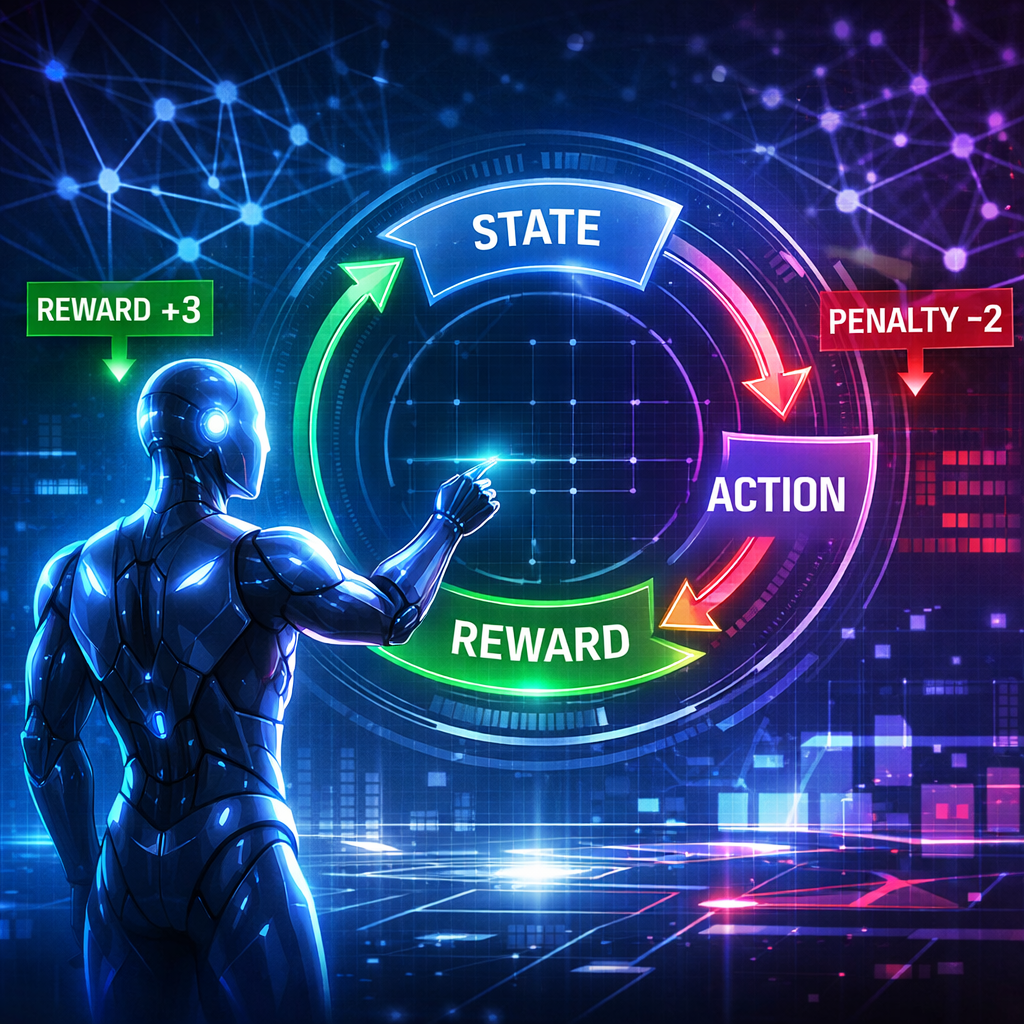
The process begins when an agent notices the current state, then takes a specific action, the environment changes and moves to a new state, and the agent receives a reward. This cycle is repeated millions of times. Initially, the proxy's movements are random, but over time, he begins to correlate actions to outcomes, and develops a smart policy that dictates what to do in each case.
Comparing the types of machine learning
To make the picture clearer, let's put reinforcement learning in context compared to the other types in this simplified table:
First: Supervised Learning
-
Learning Source: Based on tagged data (i.e., containing inputs and with it the correct answer beforehand).
-
Objective: To predict future values or to categorize data into specific categories.
-
A simple example: Face recognition in photos.
-
Feedback: Immediate, where the model knows directly whether its answer is correct or false.
Second: Unsupervised Learning
-
Learning Source: Untagged raw data, and the system searches for patterns or relationships within it.
-
Objective: To detect structures or aggregations hidden in data.
-
A simple example: categorize customers according to their interests or purchasing behavior.
-
Feedback: There is no specific feedback or correct answer known in advance.
Third: Reinforcement Learning
-
Learning Source: It is based on the principle of trial and error through interaction with the environment.
-
The goal: to maximize the overall reward in the long run.
-
A simple example: teaching a robot how to walk.
-
Feedback: Late, where the model gets rewarded after a series of steps rather than immediately.
The Exploration vs. Exploitation Dilemma: One of the
most interesting and important concepts in reinforcement learning is the balance between exploration and exploitation. This dilemma confronts not only machines, but we humans in every decision we make. Imagine you went to your favorite restaurant. You have two options: exploit, which is to order your usual dish that you love and know how to taste well, or to explore, which is to order a whole new dish that you have never heard of before. A new meal may be bad, but it can be a lot tastier than your usual dish. In reinforcement learning, the agent must balance exploitation and exploration. If he always uses his knowledge, he may not discover better strategies. If he always explores, he will not produce stable results.
Deep Reinforcement Learning:
With the advent of Deep Learning and artificial neural networks, reinforcement learning has revolutionized. Neural networks act as an agent's eye and brain, allowing them to understand very complex environments. This combination is what allowed AlphaGo to defeat world champions, as the neural network saw the Go's patch and understood its complexities, while reinforcement learning was the engine that decided the movements.
Amazing apps that change the face of reality
Augmented learning isn't just toys or lab experiments, it's a driver of massive innovations:
-
Generative AI ChatGPT and Language Models
The secret behind ChatGPT's success is the human feedback reinforcement learning technology (RLHF). After the model learned the language, humans were engaged to evaluate its answers. If the answer is helpful, the form gets a reward. Over time, the model learned how to speak in a way that satisfies humans and follows their instructions accurately. -
Robotics and complex tasks
In modern factories, this technology is used to teach robotic arms how to handle flexible or fragile materials. Instead of programming each movement, the robot tries and adjusts its finger pressure based on the reward until it masters the task. It is also used to teach robots how to balance and walk on difficult terrain. -
Energy management and smart cities
companies like Google are using reinforcement learning to reduce energy consumption in their data centers. The dealer here controls the cooling systems, and his goal is to reduce the electricity bill while maintaining a safe temperature. These systems have saved millions of dollars and reduced carbon emissions. -
Healthcare and precision medicine
Reinforcement learning helps clinicians design dynamic treatment protocols. For example, in the treatment of chronic diseases, the agent can suggest a change in doses based on the patient's body's daily response, in pursuit of a full recovery with minimal side effects. -
E-commerce and advertising
recommendation algorithms in YouTube, Netflix, and Amazon use some kind of reinforcement learning. It suggests content to you based on your past interactions, with the aim of keeping you entertained and benefiting in the long run.
Challenges and limitations:
Despite these successes, reinforcement learning remains one of the most difficult types of AI to implement:
-
The Late Reward Problem: Sometimes the agent makes thousands of moves before they know whether they have succeeded or failed like a game of chess that ends after a long time. This makes it difficult to know exactly which move was the reason for the win.
-
Reward Hacking Design: Machines are sometimes stupidly clever. If you ask an agent in a video game to collect the most points, they may find a software vulnerability that makes them collect points without finishing the game! Designing an accurate reward that reflects the true goal is an art in itself.
-
Real-world safety: We can't let a self-driving car experience a crash only to learn it's bad. So scientists are forced to build high-precision virtual simulators for training, which is expensive and complicated.
The Future of Reinforcement Learning:
The ultimate goal of AI scientists is to access general AI (AGI). Reinforcement learning is the strongest candidate for achieving this, as it focuses on the ability to learn rather than the stored information. In the future, we may see personal assistants learning our habits, efficiently managed economic systems, and robotic space explorers making their own decisions.
Ultimately, reinforcement learning teaches us an eloquent human lesson: Mistake is not the end of the road, but part of the learning process. True intelligence is not in not falling, but in the ability to analyze the cause of the fall, to get up, and to try a new path. The machine that defeats world champions or drives cars safely was not born intelligent, but has worked hard and failed millions of times. This is perhaps the most human aspect of AI; the idea that experience is an accumulation of lessons from failure that have been turned into impressive successes.