 English
 العربية

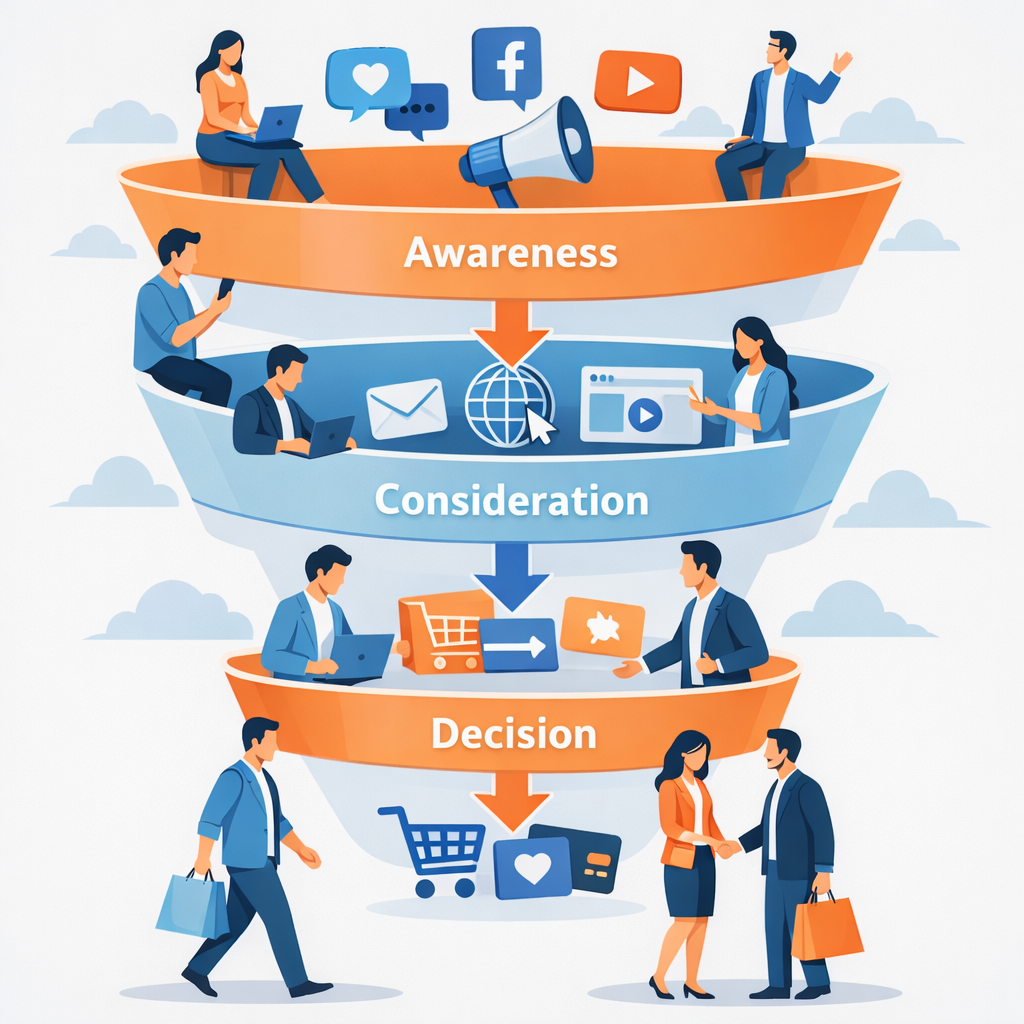
Suppress marketing.
In today's business world, we hear a lot of complex terms that can make a non-specialist feel overwhelmed. One such term is "marketing funnel." But the truth is that this concept is very simple, and we practice it in our daily lives without even realizing it. If you own a small business, are thinking about starting your own business, or are even interested in understanding how companies decide to target you with ads, this article is your comprehensive and clear guide.
What is marketing funnel simply?
Imagine owning a coffee shop on a busy street. Thousands of people pass by in front of the shop every day, this is the pinnacle of the vast repression. Some of these people stop looking at the plaque hanging outside, some come in to ask what types of coffee are available, and only a few of them ask for a cup of coffee and pay for it. This is exactly what the “marketing funnel is." It is a visual representation of the stages that a potential customer goes through from the first moment they hear about your product or service, to the moment they decide to buy, and beyond. It is called suppression because the number of people is initially very large, and then gradually decreases at each stage until only the "real agents" remain.
What is marketing funnel simply?
Imagine owning a coffee shop on a busy street. Thousands of people pass by in front of the shop every day, this is the pinnacle of the vast repression. Some of these people stop looking at the plaque hanging outside, some come in to ask what types of coffee are available, and only a few of them ask for a cup of coffee and pay for it. This is exactly what the “marketing funnel is." It is a visual representation of the stages that a potential customer goes through from the first moment they hear about your product or service, to the moment they decide to buy, and beyond. It is called suppression because the number of people is initially very large, and then gradually decreases at each stage until only the "real agents" remain.
Why do we need "repression"?
Some may ask: why not just display the product and wait for people to buy? The customer needs a journey to build trust and make sure that this product is the solution to their problem. Suppression helps entrepreneurs to:
-
Understanding the customer: where does the customer hesitate? And why does they leave without buying?
-
Save money: Instead of spending huge sums on random ads, you can target people at each stage with what they really need.
-
Increase sales: By optimizing every step of the journey, you can convert more "viewers" into "buyers."
History of Suppression – Where Did the Idea Come From?
The concept of marketing suppression is not born today but goes back more than a hundred years. In the late 19th century, the American advertising expert Ellis St. Elmo Louis developed a simple model called AIDA. This model is the cornerstone of everything we know today about marketing.
The AIDA model consists of four letters that symbolize the following stages:
-
A Consciousness: Getting people's attention.
-
I Interest: Get them interested in what you have to offer.
-
D Desire – Desire: Convincing them that they want this product.
-
An Action – Action: Pushing them to make a purchase.
With the development of the internet and technology, repression has become more complex and detailed, but the essence has remained the same: a journey that begins with acquaintance and ends with trust and purchase.
History of Suppression – Where Did the Idea Come From?
The concept of marketing suppression is not born today but goes back more than a hundred years. In the late 19th century, the American advertising expert Ellis St. Elmo Louis developed a simple model called AIDA. This model is the cornerstone of everything we know today about marketing.
The AIDA model consists of four letters that symbolize the following stages:
-
A Consciousness: Getting people's attention.
-
I Interest: Get them interested in what you have to offer.
-
D Desire – Desire: Convincing them that they want this product.
-
An Action – Action: Pushing them to make a purchase.
With the development of the internet and technology, repression has become more complex and detailed, but the essence has remained the same: a journey that begins with acquaintance and ends with trust and purchase.
The stages of marketing funnel are detailed in a simple way
Let's break down the funnel into three main areas, and explain what happens in each:
-
Top of the Funnel Top - TOFU: "Consciousness Stage"
Here, the only goal is for people to know that you exist. The customer at this stage may not even know they need your product, or maybe they have a problem and are looking for general information.
Watch a video on TikTok, read a Facebook post, or Google "how to solve a problem like this."
Don't try to sell here! Provide useful educational or entertainment content. Tell people who you are and what you do, but in an indirect way.
Example: If you sell skincare products, you can publish an article titled "5 Tips to Protect Your Skin from the Sun in the Summer." Here you are providing value, and people will start to recognize your brand. -
Middle of the Funnel - MOFU: "Attention and Evaluation Phase"
At this stage, the person becomes a "potential customer". He now knows you, knows that he has a problem, and starts comparing the available solutions.
Comparing your prices to competitors' prices, reading other customers' reviews, and subscribing to your newsletter to get more information.
What should you do? This is where your expertise should come into play. Give him evidence that your product is the best. Give simple "gifts" in exchange for his information such as a free eBook or a simple discount code.
Example: You can provide a video explaining the difference between your product and the cheap products on the market, or post success stories of customers who have used your product and their lives have changed. -
Bottom of the Funnel - BOFU: "The Decision and Buying Phase"
This is the decisive moment. The customer is now ready to buy but needs a "small payment" to make the final decision.
He puts the product in the shopping cart, looks for payment methods, or calls customer service to ask for a warranty.
Make the process very easy. Offer irresistible offers, a money-back guarantee, or free shipping. Remove any fear or hesitation in the customer.
Example: "Buy now and get a second piece for free," or "Gold guarantee: get your money back if you don't like the product within 30 days."
Post-purchase – The stage that many forget
in traditional funnel, the journey ends with the purchase. But in modern marketing, there is a fourth very important stage: "loyalty and refereeing."
A customer who once bought from you is a treasure. If his experience is great, he will do two things:
-
Buy back: This saves you the costs of looking for new customers.
-
Talking about you: He will become a "free marketer" for you, telling his friends and family about the quality of your product.
Therefore, don't neglect the customer after they pay the money. Send him a thank you letter, ask for his opinion, and offer him a special discount for his upcoming purchases.
How to build a marketing funnel specific to your project? Practical steps
that don't need a huge budget to build an effective funnel. You can start with the following steps:
Step One.
If you're selling children's toys, your audience is moms and dads. Look for them in Raising Kids groups on Facebook or Instagram.
Step Two: Set Your Goals at Each Stage
-
At the top: My goal is for 10,000 people to watch this video.
-
In the middle: My goal is for 500 people to sign up for my mailing list.
-
At the bottom: My goal is for 50 people to buy the product this month.
Step Three: Create the Right Content
Don't use the same message for everyone. The person who sees you for the first time needs "information", the person who compares needs "confidence", and the person who buys needs "motivation".
Step Four: Use Simple Tools
You can use social media platforms Instagram, TikTok for the top, email or WhatsApp for the middle, a simple website or even a landing page for the bottom.
Common mistakes beginners
make when building a marketing funnel may fall into some traps that waste your effort:
-
Rushing to sell: Trying to sell in the stage of awareness is like asking someone to marry on their first date! Give the customer time to get to know you.
-
Neglect the middle of the funnel: Many companies attract people to the top and ask them to buy the bottom, but they forget about the "education and persuasion" in the middle, leading to customer flight.
-
Purchase complexity: If your site is slow or has a lot of checkout steps, the customer will leave at the last minute. Make it a one-button push if possible.
-
Not measuring results: If you don't know how many people have come in and how many have been excited, you won't know where the problem is. Use simple tools like Google Analytics or even a simple Excel spreadsheet.
Practical Example: Marketing Suppression of an Online Sports Trainer
Let's imagine how a sports trainer would apply this concept:
-
Top Awareness: He posts short videos on TikTok explaining "exercises to treat back pain at home." It is watched by 50 thousand people.
-
Mid-interest: At the end of the video, he says, "If you want a free diet schedule for a week, click on the link in the bio." 2000 people sign up and carry the table.
-
Bottom decision: He sends these 2,000 messages via email: "I have an intensive training course for a month with personal follow-up, and on the occasion of the new month, there is a 50% discount for the first 20 subscribers." 40 people buy the course.
-
Post-purchase: Follows up with subscribers, encourages them, and when they achieve results, asks them to shoot a video about their experience to post and attract new customers.
Marketing funnel is not magic, it's just an "arrangement of ideas" and respect for the customer's human journey. When you start looking at your project through the stages of repression, you'll discover a lot of missed opportunities. Start small, focus on delivering value at every stage, and always remember that the goal is not just to get a "one sale," but to build an ongoing relationship with a customer who trusts you and loves what you offer. Successful marketing is one that gently takes the customer's hand out of the darkness of ignorance to the light of the solution and buying, and the marketing funnel is the map that will get you and get your customer there safely.
Add New Comment